
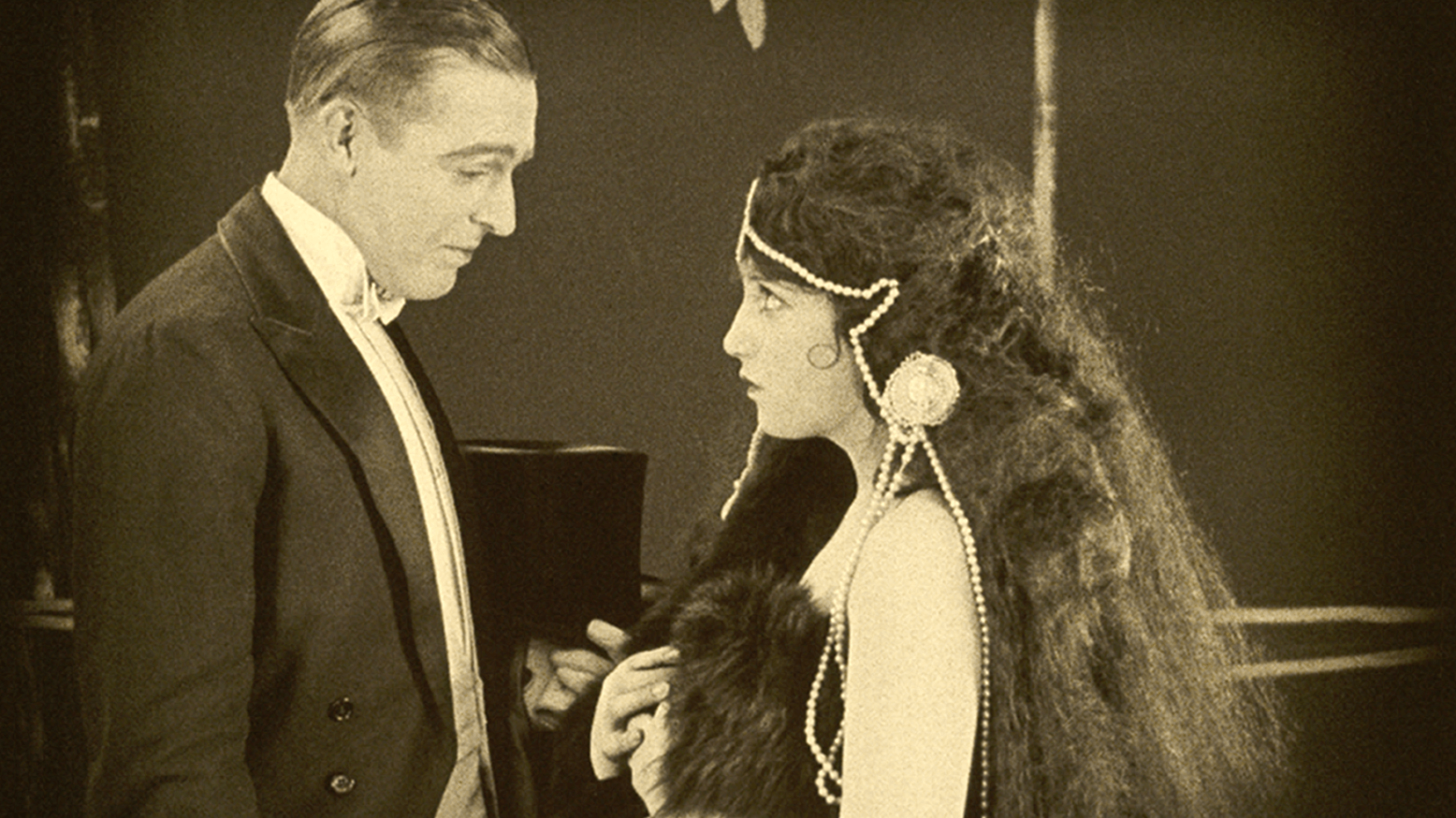
When producer Jesse Lasky suggested to Cecil B. DeMille that his next project should be based on Austrian playwright Arthur Schnitzler’s Anatol, the director was unenthused. Borderline scandalous upon its Vienna unveiling in 1893, and still pretty hot stuff when John Barrymore starred in the title role on Broadway in 1912, the play took young Anatol through a series of dalliances with women up and down the social scale. DeMille told Lasky that the episodic structure and feckless main character were an unpromising basis for a movie. Lasky, however, had an idea. He suggested they cast stars Gloria Swanson, Wanda Hawley, Agnes Ayres, and Bebe Daniels, all of whom—especially Swanson—had become too big to remain as players in DeMille’s stock company. This was an era when it was considered a needless extravagance to put more than one star in a picture. Not to mention that Cecil Blount DeMille himself had been a highly profitable name brand at least since The Squaw Man in 1914.
Lasky’s “all-star” suggestion didn’t make DeMille any keener. But DeMille was always prudent about his dealings with front offices, and he finally agreed to take on Anatol. Jeanie Macpherson, Elmer Harris, Lorna Moon, and Beulah Marie Dix collaborated on a screenplay that kept some of the European worldliness of the original, while passing muster with the far more uptight American public and the various censors that policed its entertainment. This balancing act was already DeMille’s specialty, perhaps even more than his legendary flair for spectacle—his name above the title signaled movies with plenty of sex, offset by a certain amount of respectable deniability.
The movie eventually called The Affairs of Anatol (DeMille wanted to call it Five Kisses, another argument he lost) became a major hit in 1921. DeMille’s cachet as a director and the first-rate cast, including nationwide heartthrob Wallace Reid as Anatol, helped build excitement that translated into big ticket sales. The movie’s Chicago premiere, claimed Exhibitors Herald, had “the inner lobby … packed with waiting patrons and a double line extended from the box office for a distance of a hundred yards.”
And what did the 1921 punters get for their money? A movie that gave a charming and elegant impression of literary merit, while retaining just a dollop of its literary source. Anatol Spencer is introduced as a wealthy young man who evidently doesn’t have to work. That leaves him to spend most of his time with his new bride, Vivian (Gloria Swanson), whose prettiness and charm are somewhat diminished by her annoying use of baby-talk.
Anatol is ripe for an extramarital entanglement, and he finds it in the person of Emilie (Wanda Hawley), an old school chum who has become a kept woman. But Anatol doesn’t decide to become her next sugar daddy, oh no (or at least not explicitly—remember, deniability). Anatol wants to rescue her. The trouble is, Emilie rather likes her lifestyle and secretly thinks she can get Anatol to become the next bill-payer, especially after he sets her up in an apartment. There are arguments about fast friends, cocktails, and Emilie’s old (in both senses) boyfriend, played by a delightfully louche Theodore Roberts. It all ends badly, of course, with Anatol smashing up Emilie’s (obviously real—this was DeMille) furniture á la Charles Foster Kane.
Anatol storms off to the country with Vivian in tow, looking for a cleaner and purer life. Instead he finds Annie Elliott (Agnes Ayres), who, to support her fashion addiction, has stolen the church funds entrusted to her devout husband (an enjoyably gooberish Monte Blue). Annie seeks to drown her shame in the nearest river, but she is pulled out by Vivian and Anatol. As Vivian goes for help, and Annie revives despite Anatol’s incompetent attempts at first aid, Annie finds a solution to her troubles—in the form of his wallet. So much for the second attempt at social work.
The third, and by far the most enticing section, involves Bebe Daniels, whose character boasts an all-timer of a name: Satan Synne. Daniels, gifted at comedy and drama, shows off her abilities at both, swanning around her underground abode in a robe designed to look like an octopus and serving drinks that appear to be made by Lucifer’s bartender. Anatol seeks to sin with Satan, but even his effort to have an honest-to-goodness affair is thwarted. Satan is really the devoted wife of a desperately ill World War I veteran, and her, ahem, activities are aimed at paying for his treatments.
The movie is a little long (especially Hawley’s section) and a little coy, but The Affairs of Anatol is still a deliciously funny, wry look at a man with major-league commitment issues. DeMille’s vision gets stunning support from the work of French art director Paul Iribe and costume designer Clare West. Iribe’s arrival was announced in the trades with as much glee as some of the stars: He was, exhibitors were informed, the first to use platinum in jewelry, and the designer of the short-vamp shoe. He was there at the behest of Paramount to create “extraordinary settings,” proclaimed the ads.
The ballyhoo was, for once, justified. Iribe’s art direction is one of the film’s most striking aspects. The Green Fan nightclub, for example, where Anatol takes Vivian and encounters Emilie, has a marquee with an enormous fan that opens and shuts. The Devil’s Cloister, where Satan Synne plies her trade, is hung with velvet and glows with flames coming from who-knows-where. (Reid’s “uh-oh” reaction to this menacing setup, as he’s greeted at the door by a handmaiden wearing a gold-lamé Egyptian miniskirt, is hilarious.) Both these introductory sequences (as well as the intertitles) have color applied using the studio’s proprietary process, another touch that adds to the film’s deluxe atmosphere.
Gloria Swanson, who was about to step up in the studio hierarchy, took the role of Vivian as a gesture of gratitude to the man she always called “Mr. DeMille,” whose movies had made her a star. Swanson had just given birth to her first child, and she was still breastfeeding, but sleep deprivation was just part of her troubles. Her husband didn’t want her to make the film and her marriage “was strained to the breaking point,” she later wrote. Things were little better with some of her colleagues. Wallace Reid’s redemptive charm is essential to Anatol, who might otherwise be an insufferable pill, what with his careless treatment of Vivian and his persistent self-delusion. But on the set, Reid had an ill-kept secret—he was deep into the morphine addiction that played a part in his death at thirty-one, just two years later. “He gave me the jitters,” Swanson said.
DeMille had given his treasured “young fellow” (as he always called Swanson) her pick of roles. She told him to decide, and he asked her to play the wife, which may seem odd. Emilie’s screen time is generous and nearly unbroken, and Satan Synne is a meaty part that Swanson could have nailed. The choice makes more sense, however, if the viewer pays careful attention to her interactions with Max (Elliott Dexter), Anatol’s best friend—we all know what happens with “best friends” in a sex comedy. Swanson and Dexter’s subtle indications of what’s really going on with Max and Vivian are one of the delights of the movie, and add an ironic twist to the finale.
The critics, who were either familiar with Arthur Schnitzler’s work or wanted to give readers that impression, were about as excited about this Anatol as DeMille himself had been when presented with the project. “It is right about here,” says DeMille biographer Scott Eyman, “that the critics began to turn on DeMille.” Robert Sherwood’s review in Life magazine, to cite just one, said the movie “should be enormously popular with those who think Schnitzler is a cheese.” But Anatol continued another pattern for DeMille; it minted money, ringing up $1.1 million against its cost of $176,508. While it may not be faithful to its source (a fine old Hollywood tradition in any case), more than a century on The Affairs of Anatol remains a sneaky joy. And despite the doubts of both DeMille and Swanson, as Lasky had promised, Anatol did make a fine farewell to their partnership, until they met again on Sunset Boulevard almost thirty years later.
Presented at SFSFF 2025 with live musical accompaniment by Mont Alto Motion Picture Orchestraa