
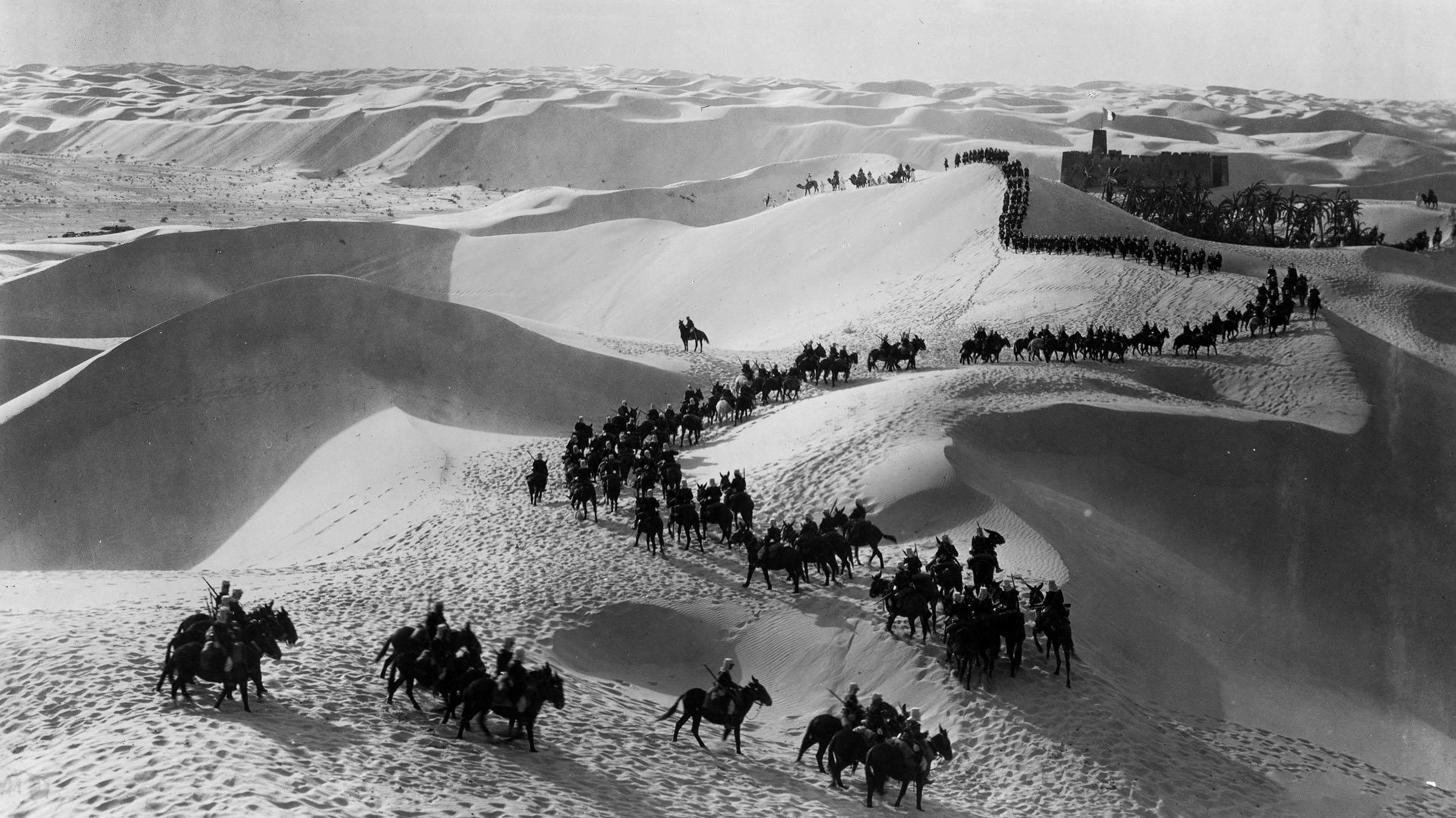
This feature was published in conjunction with the screening of Beau Geste at SFSFF 2025
UNDERCOVER LOVERS
The allure of blood, sun, sand, and war drew Hollywood to North and Northeast Africa like flappers to Rudolph Valentino. One popular subject was the Rif War (1921–1926), an attempt by the Amazigh of Morocco to throw off the colonial rule of Spain and France. The movies embraced the conflict, as well as earlier Tuareg uprisings against the French across the Sahara, as an opportunity for further, sandier romance. The Song of Love (1923) features Norma Talmadge as a beautiful Algerian dancer, Joseph Schildkraut as an undercover French agent festooned in beads and spitcurls, and Arthur Edmund Carewe, seemingly the only performer involved to realize how kitschy the film really is, steals the show as a chain-smoking, open-shirted stand-in for freedom-fighters like Abd el-Krim and Kaocen Ag Geda.
The Song of Love was obviously inspired by The Sheik (1921), with its runaway box office and Valentino’s sex appeal kicking off a phenomenon. Directed by George Melford, the picture takes place in Biskra, Algeria, “a city of adventure, where the new civilization rubs elbows with the old” and the sheik’s oasis home “a palm garden of the Sahara,” but as for the people themselves, the title cards assure the audience that “civilization has passed them by.” This theme carried on in the film’s plot twist: the sheik is no Arab at all but a lost son of English and Spanish parents, thus teasing interracial romance but following the then-acceptable status quo. The Sheik may be more famous, but The Arab had been the real pioneer of the desert romance with a 1915 Cecil B. DeMille adaptation that also starred the playwright of the source material, Edgar Selwyn. It received a big-budget remake with a location shoot in Tunisia directed by Rex Ingram and starring Ramon Novarro in 1924. Another Tunisia-shot romance, Tales of the Thousand and One Nights, was a 1921 French production led by Russian émigrés.
COLONIAL MISRULE
The desert, its people, and their attempts to gain independence provided a backdrop for courage and brotherly love, at least for European characters, and saw the rise of the Foreign Legion picture as a genre. While not the first, 1926’s Beau Geste is the prototype, with its lonely desert outpost, brutal commander, and everlasting brotherly love. Paramount rushed both Beau Geste and its 1928 sequel, Beau Sabreur, to the screen.
Sudan was similarly used as a testing ground for colonial soldiers to find themselves or at least die honorably. Gordon of Khartoum wasn’t portrayed in a silent feature, but A.E.W. Mason’s The Four Feathers was shot three times, the 1929 version incorporating real footage of Sudan. The Light That Failed, Rudyard Kipling’s story about a soldier-artist who loses his sight in action and then returns to combat for an honorable death, was also filmed multiple times. The climax was moved to the Great War in an eponymous 1923 Paramount production, directed once again by Melford, who seems to have been on permanent assignment to the dunes of Yuma since The Sheik’s success. He and his cast were nearly blown away in a sandstorm years later while shooting 1929’s Love in the Desert, a part-talkie romance of a Bedouin woman and an irrigation engineer.
L’Atlantide (1921), a colonial French film shot in Algeria, is typically exotic, though the idea of a desert queen regularly kidnapping French soldiers, driving them to their deaths, and then bronzing their bodies like baby shoes to display as décor is, perhaps, not exactly an argument in favor of enlisting. Just as dangerous, the Barbary Pirates are the subject of two large-scale Hollywood costume epics, with scheming and power-plays as important as swashbuckling. Charles Farrell is the American hero fighting the brigands of Tripoli in 1926’s Old Ironsides and Milton Sills is an Englishman who joins the corsairs of Algiers in 1924’s The Sea Hawk.
EGYPTMANIA
Even before the 1922 excavation of Tutankhamen’s tomb, ancient Egyptian themes were popular. Georges Méliès attempts to revive his late wife under the shadow of a sardonically painted Sphinx in The Monster (1905), only to be rewarded by a grimly humorous corpse dance. The real Sphinx, as well as the pyramids, make an appearance in the Kalem location shoot for 1912’s From the Manger to the Cross. The historical setting also provided cover for censor boards, with Theda Bara’s mostly lost 1917 epic Cleopatra displaying acres of bare flesh under diaphanous slivers of fabric, avoiding outright nudity by the grace of providence and strategic adhesive tape. For historical accuracy, of course.
Modern Egypt was portrayed as a place of perilous love with both feet firmly planted in Orientalist tropes. When Antonio Moreno falls for a revived mummy in 1915’s The Dust of Egypt, chaos ensues but it’s all a dream. In Ernst Lubitsch’s The Eyes of the Mummy Ma (1918), Pola Negri is forced to pose as a mummy by Emil Jannings, who goes on to stalk her across two continents. In 1926’s Made for Love, an archaeologist and his wife discover they are reincarnated ancient lovers and nearly perish again when local conspirators decide to murder them in the tomb and blame it on the gods, declaring: “We’ll help along the curse of Isis—with dynamite!” In Paramount’s Burning Sands (1922), Milton Sills romances Wanda Hawley while helping an Egyptian aristocrat fend off the machinations of his scheming son. (You’ll never guess who the director is.)
The newly independent nation set about pursuing a national cinema, with the feature A Kiss in the Desert, helmed by Palestinian-Chilean directors Ibrahim and Badr Lama, released in 1927. A few months later, Egyptian stage actor Aziza Amir produced and starred in Laila, a tale of love and betrayal directed by Egyptian-born and Paris-educated Estephan Rosti. In a heavily symbolic story, Amir plays a village girl who finds herself pregnant by her fiancé but he is involved with a beautiful tourist from the West and leaves her to a fate.