The love of a man for a woman waxes and wanes like
The moon…but the love of brother for brother
is steadfast as the stars, and
endures like the Word of the Prophet.
— Arabian Proverb
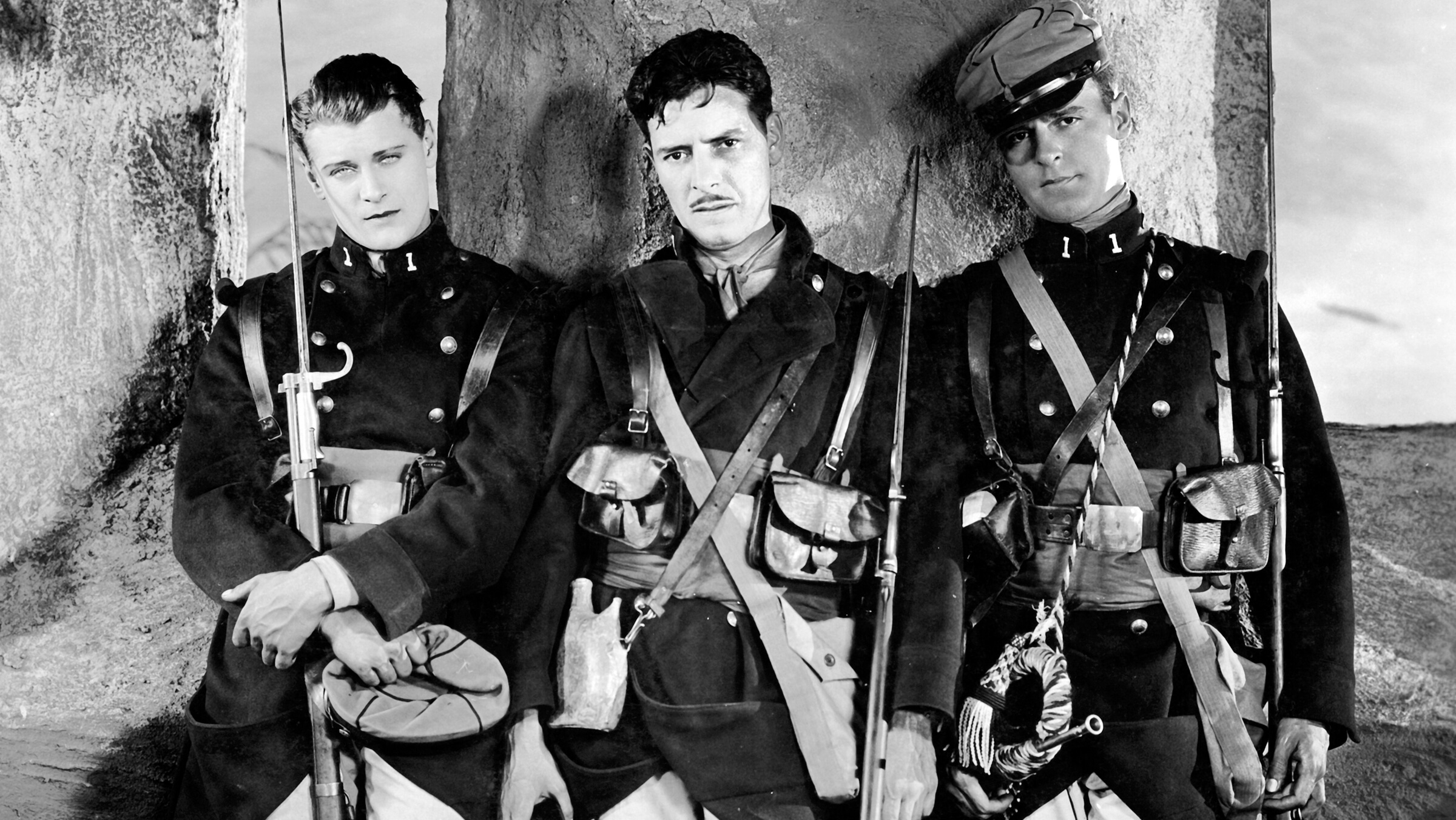
The title that opens Beau Geste is neither an Arabian proverb nor does it come from Percival Christopher Wren’s 1924 source novel. Even so, the sentiment by scenarist Paul Schofeld neatly conveys what makes Beau Geste special. It is a mystery about a jewel theft in an English manor. It’s an epic of battle and treachery in a remote French Foreign Legion outpost. But at its heart, Beau Geste is the story of three brothers, Beau (Ronald Colman), Digby (Neil Hamilton), and John (Ralph Forbes) “whose love for each other,” a title tells us, “proved stronger than their fear of death.”
Herbert Brenon, then one of Hollywood’s most successful and admired directors, was given a copy of the new novel in 1925 by author James M. Barrie when they met in London to discuss the impending production of A Kiss for Cinderella, their follow-up to 1924’s Peter Pan. Barrie told Brenon, “You might like to read this on the voyage over to America.”
Brenon did read Beau Geste on the ship and immediately saw the novel’s enormous cinematic potential. Above all, he was affected by the Geste brothers’ relationship. It “moved me deeply,” Brenon wrote, “for my brothers, Algernon and Chandos, both a little older than I, had passed away far too soon. I missed them both very much and this drama of the devotion and sacrifice of three brothers remained indelibly printed on my mind.”
As soon as Brenon landed in New York, he rushed to the office of Paramount head Jesse L. Lasky and begged him to read the novel. The next day, according to Brenon, he found Lasky “beaming! Book in hand, he enthused: ‘This is a truly great story, Herbert, and will make a perfect picture. But to do it properly, it will cost more than any picture we have ever made.’”
Brenon recalled that Lasky was concerned that there was little conventional romance in the story, aware that no hit film had ever been centered on a theme of brotherly love. But “that’s what appeals to me,” Lasky said. “Something new, something different, thank God.”
Lasky had big plans for the film and gave Brenon the resources to ensure “that both the locale and the atmosphere [of the book] be faithfully reproduced,” meaning the waterfronts of Marseille, the Legion headquarters at Sidi Bel Abbés, and at one or more Foreign Legion outposts in the Sahara.
While Brenon began assembling his cast, a camera crew from Pathé News was assigned to shoot test footage of the European and African sites. The plans to film abroad, however, were abruptly canceled. The outbreak of the Riffian war in North Africa made filming there impossible. A safer location was found in California’s southeast corner just north of the Mexican border in a vast expanse of white dunes known as “The American Sahara.” The Imperial Dunes ringed a massive area of hard ground called Buttercup Valley, perfect for building the tent city—dubbed “Camp Paramount”—where some two thousand cast, crew, workers, and livestock all lived during filming.
When Herbert Brenon first visited the site, he was awestruck, writing that it was “a scene of such majestic splendor as I had never witnessed. We were standing in a sort of huge, deep saucer or sugar bowl. Everywhere we gazed upon smooth or rippled dunes, encircled by hills and mountains of sand, too beautiful to describe. Sand, glorious white sand. ‘This is the spot!’ I told my colleagues.”
Brenon cast several actors who had worked with him before—Alice Joyce, Norman Trevor, Mary Brian—and Paramount chose others. Wallace Beery was initially cast as the sadistic Sergeant-
Major Lejaune and then moved over to Old Ironsides and was replaced by his brother Noah. William Powell, a few years before gaining fame as a droll charmer, was still playing villains and took the role as Lejaune’s toady Boldini. Rising star Neil Hamilton was cast as Digby Geste and young British actor Ralph Forbes was eldest brother Beau. Charles “Buddy” Rogers won the role of youngest brother John but when Paramount acquired Ronald Colman from Goldwyn, everything shifted: Forbes became John and Buddy Rogers became unemployed, until Wings made him a star the following year.
They filmed all interiors on the Paramount lot: the Marseille café, the barracks, and the lavish rooms of Brandon Abbas, the Gestes’ childhood home. The first scenes filmed, however, were exteriors showing the children giving John Geste the rare honor of a Viking’s funeral, shot on location at Pasadena’s Busch Gardens.
Preparing Camp Paramount was a massive project, taking longer to build than the Fort Zinderneuf set and the oasis. The road from Yuma was paved only partway, then extended with two miles of plank road across the dunes. That road ended at the top of a ninety-foot dune, on which they constructed a chute used to slide fifty tons of freight each day down to the desert floor. At the bottom, supplies were transferred to sand sleds pulled by tractors or mules and transported across about a mile of Buttercup Valley on yet another plank pathway. The result, erected in under a month, had three hundred fifty tents, a giant mess hall run by world-class chefs, a hospital, post office, tennis courts, stables for horses, cattle, and camels, and much more. A well produced ample hot water for the eighty showers. Ten thousand gallons of drinking water were trucked in daily.
Even with all the amenities the camp offered, filming in the desert was tough. The heat and arid climate gave Ralph Forbes a nosebleed so severe that he burst a blood vessel and collapsed. There were outbreaks of diphtheria, dysentery, and smallpox. A stampede resulted in a crushed foot for one rider and the death of at least one horse (the scene is in the film). When William Powell and Bernard Siegel (as Schwartz) climb up the lookout tower, the shots fired at them were real bullets courtesy of sharpshooter Pardner Jones.
In Hollywood, editor Emma Hill assembled a rough cut as footage came in from the location. When filming wrapped, she and Brenon returned to Paramount’s Astoria studio with forty reels of negative ready for further editing and titling. These were pruned down to ten reels.
Beau Geste premiered on August 25, 1926, at New York’s 2,615-seat Criterion Theatre. It was an immediate smash, playing to standing-room crowds for months. Road shows played across the country, then the world, with enormous success. In the century since, Beau Geste has continued to be regarded as one of the most significant American films of the silent era, so firmly ensconced in the pantheon that it was generally assumed to be safely preserved.
It was not.
Restoring Beau Geste required the Library of Congress, Robert A. Harris, and James Mockoski to seek out what 35mm material survived in archives around the country as well as 16mm prints from private collectors. They eventually used material from six sources.
UCLA held three reels of nitrate print and three of duplicate negative. The Museum of Modern Art also provided a dupe negative as well as a diacetate print. A 16mm print from George Eastman Museum had shots that did not survive in 35mm.
The most challenging 35mm material came from Paramount’s archives. While excellent pictorially, the image was cropped along the left edge to about the width of a soundtrack. Harris and Mockoski meticulously—some might say miraculously—made the cropped frames whole again by grafting the needed imagery from other prints and negatives.
The result gives Beau Geste the restoration it has long deserved, not only bringing back its beauty but also its epic grandeur. Now, we don’t have to merely read that it is one of the great films, we can see for ourselves.
Presented at SFSFF 2025 with live musical accompaniment by Mont Alto Motion Picture Orchestra