
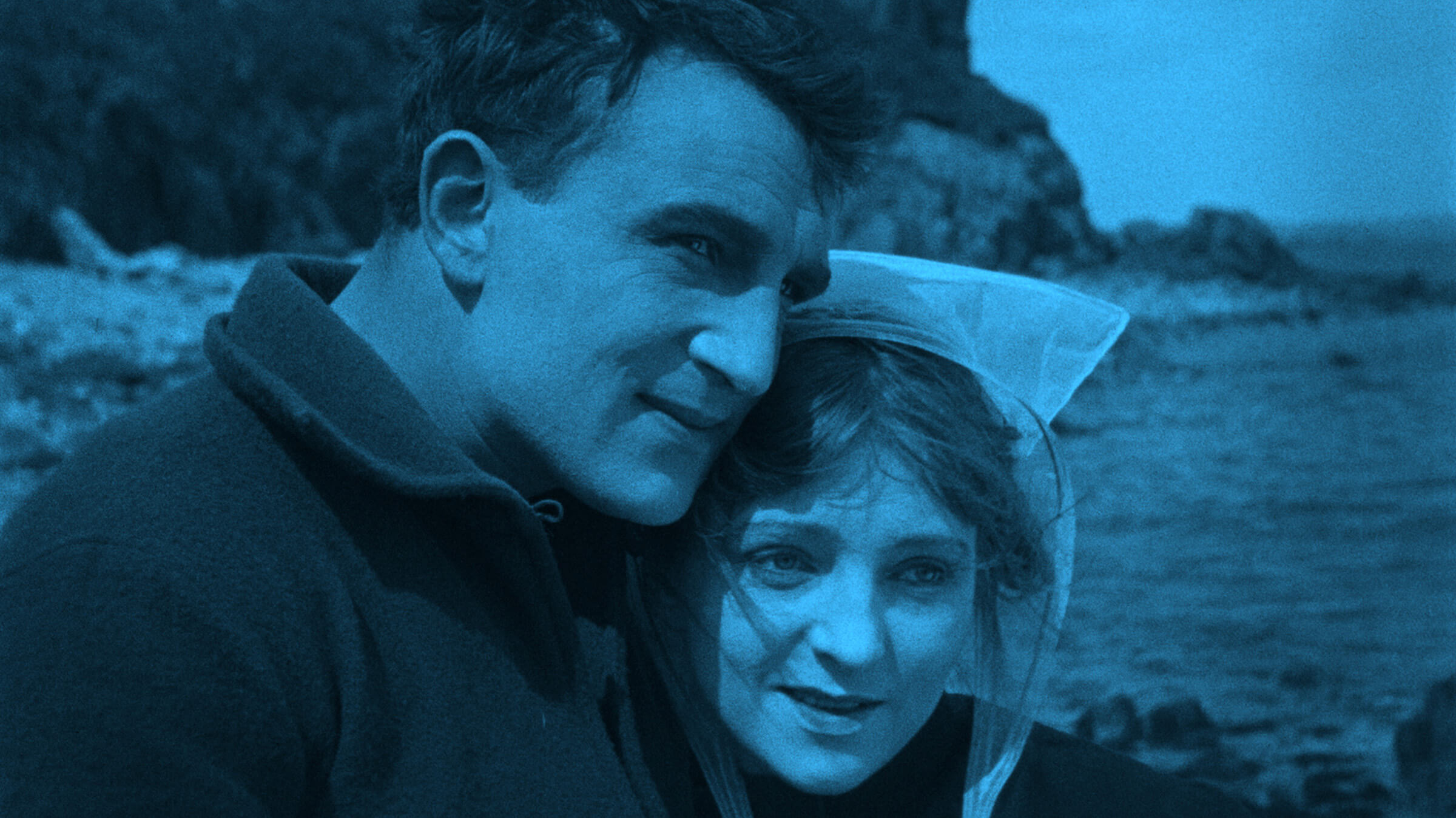
Primarily set in a small Breton village, with a cruise to the high seas off Iceland and a visit to Indochina, Island Fisherman showcases the distinctive blend of naturalism, melodrama, and experimentation that emerged in France after World War I. The atmospheric story of Yann, a hunky Breton fisherman strangely unwilling to marry the pining Gaud, despite mutual attraction and familial approval, was perfectly balanced between commercial and avant-garde cinema; it simultaneously fed its audience’s hunger for films that celebrated traditional French culture, while filling the screen with the latest in hallucinogenic superimpositions. Today Island Fisherman is considered one of the masterpieces of the silent era; when it was released in 1924, it was discussed in cine-clubs and played specialized theaters, like the Vieux-Colombier, that promoted this new genre, the art film.
Two men are primarily responsible for Fisherman, although camera operator Louis Chaix and Charles Vanel who plays Yann also made significant contributions. First came Julien Viaud, a dreamy naval officer who wrote the source novel, Pêcheur d’Islande (literally, Iceland Fisherman), under the pen name Pierre Loti in 1886; next was director Jacques de Baroncelli, whom Louis Delluc, influential promoter of film-as-art, summed up with the oft-repeated epigram, “Baroncelli has only one fault, which is to have none.” This Zen koan of a critique sums up Baroncelli’s strong visual sense and technical competence, as well as the caution that sometimes limited him. Delluc repeatedly nagged the director for his lack of boldness and Baroncelli himself admitted in 1934 that he was “the most persnickety and cowardly of production managers.”
Baroncelli was a latecomer to film. He was dabbling in poetry when the last of his aristocratic family’s fortune crumbled away, resulting in the loss of the family chateau in Avignon and filling Baroncelli with anxiety over the sudden need to earn a living. The young twenty-something headed to Paris and set aside poetry for journalism, eventually landing a position as managing editor of L’Éclair, a conservative Paris daily. The security he found there did not last. At the age of thirty-three, with a wife and child to support, Baroncelli inadvertently ended his journalistic career by putting the paper to bed early one night. He woke up the next morning to headlines in every paper but his own announcing the death of Pius X. L’Éclair reported, “Pope Pius X gravely ill.” Baroncelli was out of a job.
At that point, August of 1914, Baroncelli had never even seen a movie. In his unfinished memoirs he recalls being “thunderstruck” by his first visit to the cinema, instantly deciding he had to enter this new field. Perhaps more telling is the account he gave Musidora and Georges Sadoul of making his first short in 1915: “The House of the Spy cost 5,000 francs and brought me a return of 18,000. I thought there was a fortune in films.”
Both desires—to make movies and money—were still present when he decided to produce Island Fisherman for the independent company he had formed in 1922, the Société Belge des Films Baroncelli. Less than ten years after he’d switched careers, Baroncelli had forty-plus films under his belt and SFB was the second production company he’d organized. He promised his Belgian backers low budgets, steady returns, and three films a year, but after one year of sticking to this schedule, Island Fisherman blew SFB off course. Perhaps he discovered the “nerves and muscle” Delluc found lacking; in any event, the speed and efficiency he’d promised his backers went by the wayside when the production traveled to Paimpol. Although audiences can catch glimpses of the director’s penny-pinching in some of Fisherman’s interiors, Baroncelli built what was essentially a floating studio and put out to sea with cast and crew, returning with sequences that practically splash the audience with salt water.
These images were straight from the book, according to Baroncelli, who wrote after the film’s release, “The book is a film … images and visions follow one after the other like waves.” Baroncelli shared Loti’s romantic views of the rural peasantry as the true heart of France as opposed to busily industrializing Paris. Loti’s attachment to Brittany was also colored by his close friendships with a series of handsome Breton sailors, relationships that coexisted with a wife and mistresses. “How I love them, those rough sailors,” Loti wrote to a friend in the mid-1880s. It’s hard to imagine today that the author was once enormously popular, respected by contemporaries Henry James and Marcel Proust. Even before his death in 1923 Loti’s books were considered dated and dusty; he’s almost completely forgotten now, save by literary scholars who either critique his imperialist tales of love in exotic lands or analyze his Breton novels for their subtext of same-sex desire.
“He is loti-sizing feverishly,” a reporter described Baroncelli on location. Perhaps the director, who claimed to have practically memorized the book, had “loti-sized” enough to transfer some of the novel’s subtext to the film adaptation along with the vivid imagery. There’s something enigmatic about Yann’s reluctance to marry, something oddly urgent about shipmate Sylvestre’s efforts to promote matrimony between his two best friends. Charles Vanel plays Yann as a man of instincts, acting before he thinks, not quite civilized. Vanel underplays superbly, doing more with the lift of an eyebrow and a slight smile than the other players do with weeping and palpitations. Big-eyed Sandra Milanovoff as Gaud, the French-Russian answer to Lillian Gish, is the perfect foil to Yann. “She plays her difficult role with tact and moderation,” wrote Jean Tedesco in Cinéa-ciné pour tous.
It’s confusing for contemporary viewers to find avant-garde cheerleaders like Delluc praising films as “naturalist” or even “impressionist.” But at the time, these qualities stood in opposition to the literary and theatrical tradition in film that militant avant-gardists abhorred. Even as Baroncelli documents fishing traditions, records an outdoor wedding, or has Gaud wander along the “wall of the dead,” he transforms these elements. The scenes of village life have a stylized, folkloric quality and the ever-present sea is personified as a jealous femme fatale. In Baroncelli’s hands, the little fishing community where all the women wear black in a kind of preemptive mourning seems as lost to time as Brigadoon. Even as Baroncelli was recreating the handline fishing technique Yann brags about to Gaud, bigger boats and nets were becoming common, hurrying the cod industry to the end of what journalist Mark Kurlansky calls “a 1,000-year fishing spree.” The abrupt appearance of two women wearing 1920s style dropped-waist chemise dresses and bucket hats in the bar scene is as shocking as Yann’s drunken violence.
Baroncelli further manipulates the naturalism of the location shoot and Breton extras with a host of editing techniques from the avant-garde toolbox. He orchestrates these disparate elements into a sophisticated whole that borrows from avant-garde pioneer Abel Gance and even calls to mind films from a later wave of experimentation by directors like Antonioni and Mizoguchi. Repeated motifs of windows and doors are underlined by reverse camera angles that swing our perspective from inside to outside. Baroncelli intercuts Ozu-like pillow shots of sea and sky to build up a set of oppositions: inside/outside, land/sea, female/male, life/death. The director collapses space with rapid montages of his far-flung characters, building a mystical connection between Gaud, Yann, and Sylvestre, a connection reinforced by a ghost ship that emerges out of the fog to Yann in Iceland, bringing him news of Sylvestre in Indochina and Gaud at home in Brittany. Baroncelli collapses time as well as space with superimpositions that juxtapose past and present, the dead and the living. Decades of French bureaucrats bearing bad news are compressed into half a minute of screen time.
More than one contemporary review cites the sea as the film’s true main character but ultimately it’s death that plays the lead role in Fisherman. And perhaps those two overlap, given the fishing industry’s high mortality rate at the time. “Pêcheur d’Islande is the book in which Pierre Loti put the most of himself,” wrote Baroncelli shortly after the film’s release in 1924, adding that Loti was driven by a dread of death: “That dread, which pursued him to the ends of the earth … he first recorded in Pêcheur d’Islande.” Baroncelli leaves such limiting summaries out of the film and lets his visuals invite multiple interpretations. As befits an art film, the audience emerges bemused, pondering, still in the film’s grip.
Presented at SFSFF 2025 with live musical accompaniment by Guenter Buchwald and Frank Bockius