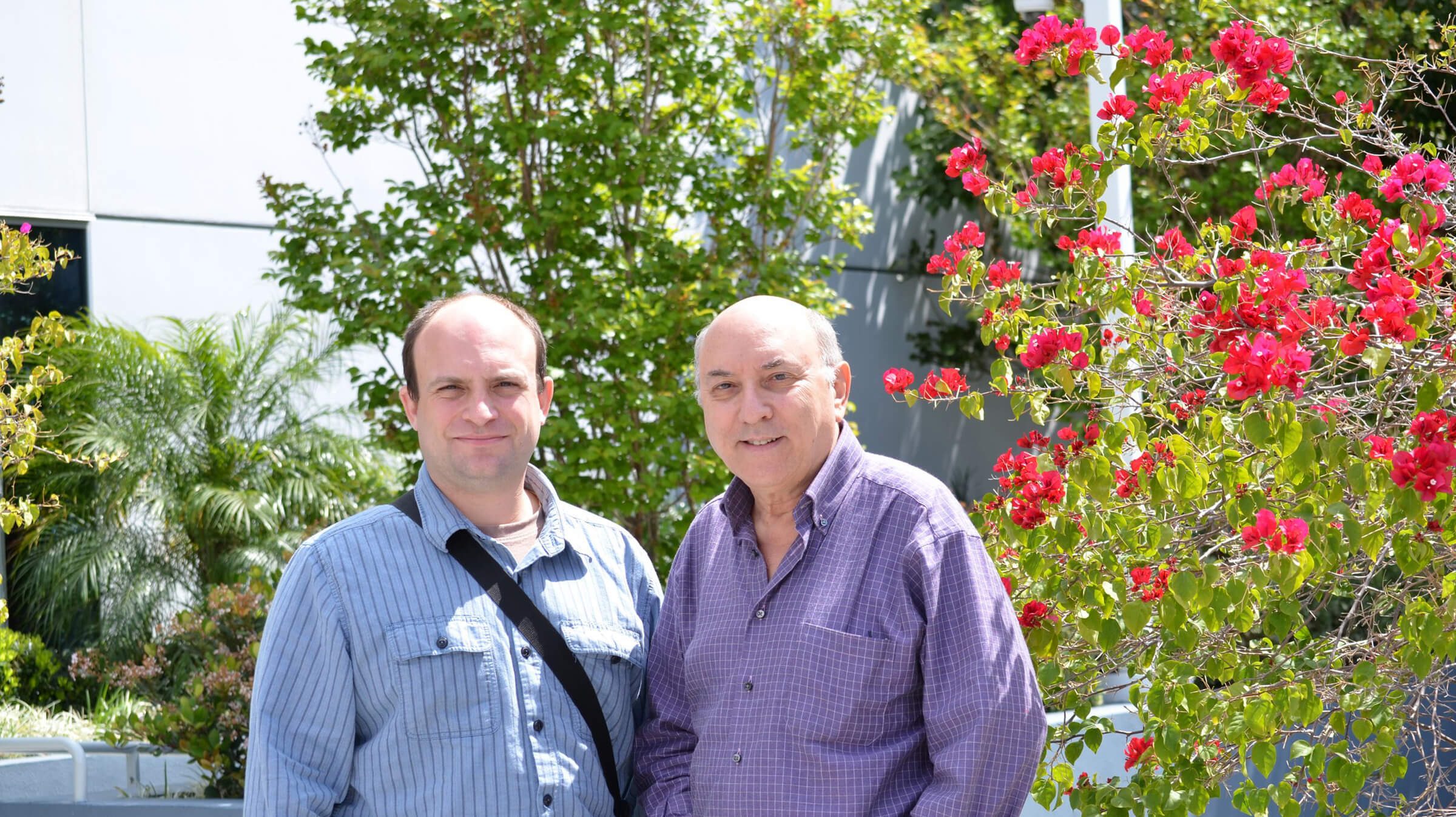
Collectively, they’ve seen worse. Like the time audio was missing from a pivotal moment in David Lean’s magnum opus, Lawrence of Arabia, the actor who delivered the lines long dead. Or the painstaking patchwork that was necessary to make The Godfather into a cohesive whole when much of its negative was missing. So, when Robert Harris of the Film Preserve and James Mockoski of Maltese Film Works began gathering material to restore 1926’s Beau Geste and saw that Paramount had copied this major critical and box-office success on a printer set up for an optical track, it was bad—but with their seventy-five years of combined experience, they were going to find a way.
Harris of course is a legend in preservation circles having restored not only Lawrence of Arabia but other canonical titles that include Spartacus and Rear Window. Since 1992, Mockoski has managed the film library for Francis Ford Coppola’s American Zoetrope, which boasts its own classics—Apocalypse Now, The Conversation, and The Godfather trilogy among them—each with their own complex restoration histories. It was actually through Zoetrope that Harris and Mockoski started working together and only recently that they’ve pooled their resources for an ambitious slate of restorations.
Their first project as a dedicated team was The Johnstown Flood, the Fox studio special-effects-
laden disaster film, which played at SFSFF 2023. And while they juggle multiple projects across movie history, their focus is to rescue as many titles as possible from Paramount’s silent-era glory days. Three of those titles are already completed and play the festival this year: the aforementioned Beau Geste, directed by Herbert Brenon; Cecil B. DeMille’s 1921 The Affairs of Anatol, with its dazzling color effects; and The New Klondike, the 1926 baseball comedy directed by Lewis Milestone. All three were done with the support of another new partner, the San Francisco Silent Film Festival, and reflect the kind of varied and distinctive pictures that SFSFF audiences have to look forward to at future events. — Editor
HOW DID THIS LATEST PHASE IN YOUR COLLABORATION COME ABOUT?
Mockoski: Each of us has worked with Paramount before on other restorations. A trust built up and it just snowballed from that. They offered us Beau Geste three years ago and have since given us access to north of one hundred titles.
Harris: You have to remember that Paramount was the studio in the silent era. MGM was coming up but Paramount was quite something. It had DeMille, [Josef von] Sternberg, Lubitsch. But only about ten to fifteen percent of its silents survive. When we first started looking at what’s been saved, we discovered that there are a lot of films from 1913, 1914, 1915. Then nothing from 1916 or 1918. For 1920 and 1921 there’s a smattering. By 1925 and 1926 there are more, but Paramount was producing forty or fifty features a year and only six or seven of them survive.
CAN YOU TALK A BIT ABOUT THE BEAU GESTE PROBLEM?
Harris: Beau Geste is such an important film. Every archive had something on it and everyone thought the others had restored it, but no one had. The original road show version does not exist as far as we can tell. UCLA had three reels of it that were slightly trimmed, but everything else was from the wide release version. They were full of splices, scratches, and decomp. Paramount had reprinted theirs in anticipation of the 1939 remake but used sound-film printer gate. So, we had to literally replace the missing part of the frames with the picture area from other prints. It was crazy.
Mockoski: It’s now pretty close to the road show version. Reining in all the elements was a challenge, but we had a lot of cooperation from Paramount, UCLA, MoMA, the Eastman Museum, the Academy. The Library of Congress supervised the entire project, which really made it come together. It’s also where the restoration is deposited.
WHAT WERE SOME OF THE CHALLENGES ON THE NEW KLONDIKE AND AFFAIRS OF ANATOL?
Mockoski: For Anatol we had to emulate the Handschiegl color using inferior references. Paramount had restored it once before but had a slightly different interpretation of the color. Ours is a hybrid.
Harris: We had to go back and try to figure out what it looked like 104 years ago. The late David Shepard had a 16mm print, which wasn’t perfect but gave us a ballpark of where we needed to be. Klondike was an easier one. The only thing that existed was an original print stored in tinting rolls. They built release prints from these rolls, tinted sequence by tinted sequence.
Mockoski: The slugs in between shots would be labeled “A,” or “L.A.” It took us a while to figure out it meant amber, light amber …
Harris: I initially thought “L.A.” meant Los Angeles negative. It was a head-scratcher. From there, it took about a week to conform it and then we realized we had the whole film. But no one knew that going in. You never know what you’ve got until you scan all the nitrate.
WHAT ARE YOUR PLANS FOR DISTRIBUTION?
Mockoski: We can do our restorations but doesn’t matter if they’re not seen. Our partnership with SFSFF only makes sense—the festival has such a large following. Arthouse distributor Rialto Pictures will release the titles theatrically and we’re launching our own home-video label. We’re calling it Artcraft, a nod to the 1916 company set up to distribute Mary Pickford’s films. We’re looking into streaming.
Harris: A big problem for us is piracy. It seems like twenty-four hours after something streams, it shows up online for free. And, they say, “well, hire your attorneys.” We aren’t a profit center. We’re trying to break even. Whatever money we can squeeze out of it, goes into the next project.
WHAT MIGHT BE NEXT?
Mockoski: We’ll have some surprises, but we’re talking about It with Clara Bow for next year. We’re finishing up Miss Lulu Bett …
Harris: A wonderful William de Mille film. It’ll be the first time most of it will be seen from the original nitrate prints.