
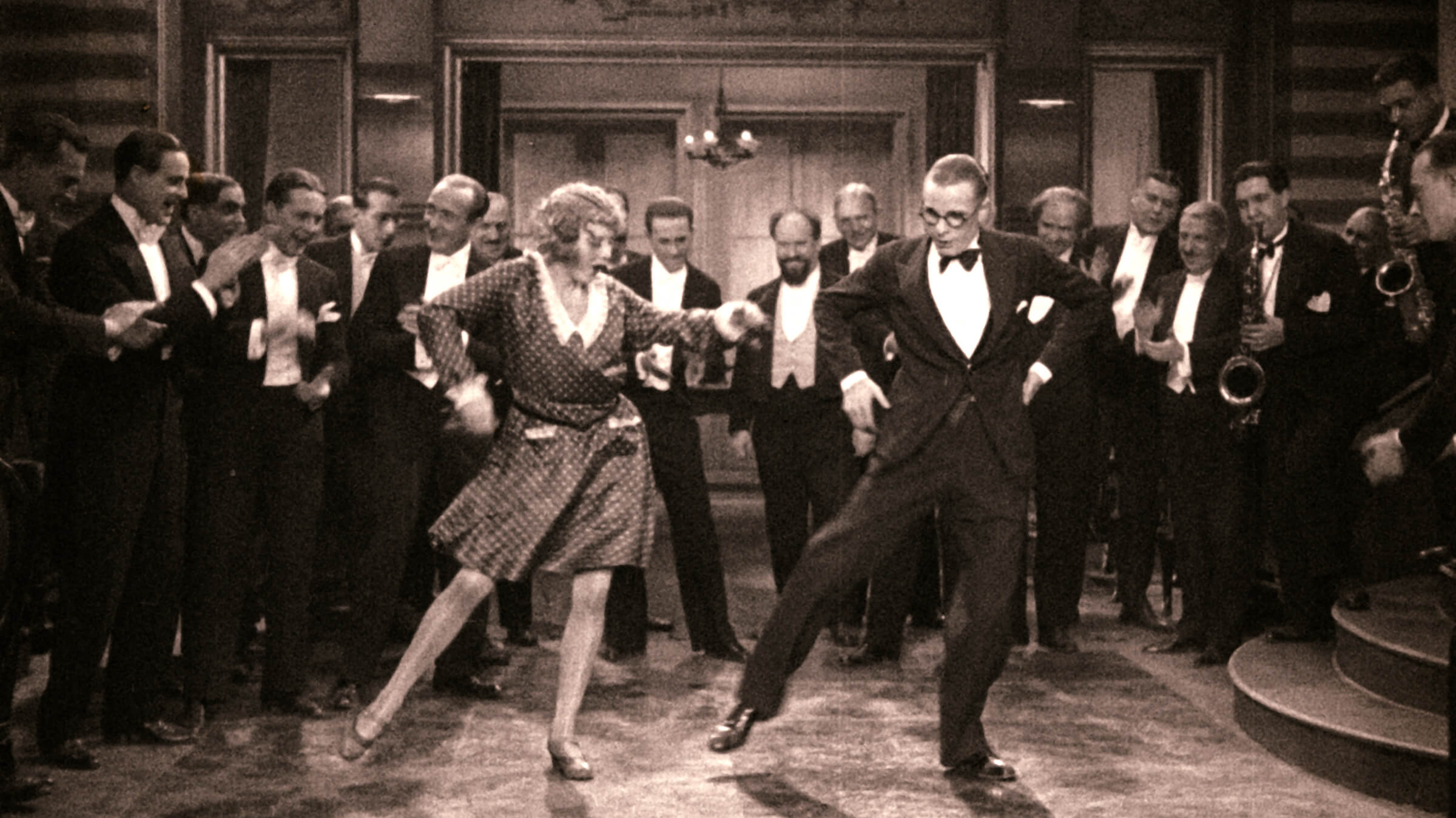
Anny Ondra, the rowdy and radiant star of the German comedy Saxophone Susy, was a celebrated Czech actress now best remembered for two of her British films, made right at the end of the silent era. By starring in Alfred Hitchcock’s The Manxman (1929) and Blackmail (1929), this doe-eyed, flaxen-haired star qualified as the first ever Hitchcock Blonde. English actress Joan Barry live-dubbed Ondra’s dialogue in the sound version of the latter film—right from the start it was clear her accent would prevent her making a success of English-language talkies. Instead, Ondra spent the 1930s working in Germany, where she had already established herself, and she became one half of a celebrity couple following her marriage to champion boxer Max Schmeling.
The fact is that Ondra’s pan-European career had already brought her, and her key team of collaborators, to Berlin in the late 1920s, which is where they made Saxophone Susy, the best surviving example of her skills in physical comedy, and proof, if it were needed, that Ondra had genuine star power before she ever met the Master of Suspense. She plays the loose-limbed heroine of this bewitching Jazz Age caper, a comedy of switched identities, which is a kind of silent musical complete with showstopping solo dances and full production numbers. The plot mechanics give Ondra’s character, an upper-crust baron’s daughter from Vienna, the chance to train with the Tiller Girls in London and become the star attraction at a West End jazz club. As German film magazine Der Kinematograph put it, the story “is as whimsical as possible, which means that the most impossible situations arise, but they are effective and give the young Czech comedienne the opportunity to show her film talent in the right light.” Her character’s glory comes despite, or perhaps because of, Ondra’s brilliantly executed repertoire of endearingly eccentric dance moves. And her extravagantly happy ending arrives amid a slew of slapstick, witty visual gags, and a little pointed commentary on the foibles of predatory men. It’s a joy to watch from start to finish.
Ondra was born Anna Ondráková on May 15, 1903, in what is now Poland, to Czech parents. She grew up in Poland, Croatia, and Czechia, and her father was an army officer who fiercely disapproved of his daughter’s interest in acting. Although he arranged for her to take a government job, Ondra instead persisted in pursuing her stage ambitions until she was spotted by actor-director Gustav Machatý (best known for directing 1933’s sensual Ecstasy, with Hedy Lamarr) and offered work in the cinema. Her big break came with her brief appearance in a film Machatý starred in, Lady with a Small Foot (1920).
Soon, Ondra became a big name in Czech cinema, specializing in comedy and therefore marketed to the public as “Buster Keaton in skirts,” “Woman-gag,” or more poetically, because of her sleepy eyes, bee-stung pout, and cloud of blonde curls: “the Czech porcelain doll.” The director of Saxophone Susy, Karel Lamač, was also her boyfriend and colleague during this period. He directed and/or acted with Ondra in numerous Czech silents, including Gilly in Prague for the First Time (1920), White Paradise (1924), and The Lantern (1925). Lamač became a successful actor, director, and screenwriter, directing more than a hundred films and acting in around sixty. He was six years older than Ondra, but they entered the film industry around the same time. He had worked as a camera operator during the war, but his showbiz credentials included founding an orchestra and working as a stage magician. Long after their romantic relationship ended, their professional association, and their friendship, continued.
Together with cinematographer Otto Heller (later to go on to a formidable career in Britain, shooting such classics as The Ladykillers (Alexander Mackendrick, 1955) and Peeping Tom (Michael Powell, 1960), and screenwriter Václav Wasserman, Lamač, and Ondra formed a group known as the “Strong Four” in Czech cinema, making films that were popular at home and abroad. After a string of successful international coproductions, Ondra and Lamač made a permanent move to Berlin, founding Ondra-Lamač-Film, and teaming up with the German company Hom-Film.
It was as part of this collaboration that they made Saxophone Susy, with Heller as director of photography. This adaptation of a play by Hans H. Zerlett follows the antics of two Viennese girls. The first, Susy (Mary Parker), is studious but so poor that she has been pushed into a career as a chorus girl. The other is flirtatious and posh, but longs for the footlights more than anything else: this is Ondra’s impish Anni, whose leering father is played by Gaston Jacquet. On the boat to England they swap places, so Susy takes Anni’s place at an elite boarding school and Anni can learn the ropes at the Tiller school of dancing, a formidable institution where the staff spend as much time keeping men out as rehearsing the dancers (all played by members of Berlin’s Haller-Revue).
Composer Paul Dessau wrote a score for the film, which is now lost but was apparently very funny. Plus, Rudolf Nelson wrote a jazzy number, “Die Susie bläst das Saxophon,” with German lyrics by Zerlett; and Karel Hašler penned a song in Czech. A British firm, Supreme Film Co., created a synchronized score for the film, which was played using a short-lived technology based on light and mirrors. With its European locations, cast, and crew, Saxophone Susy was a crowd-pleaser on the international circuit, so much so that Lamač and Ondra remade it as a sound film, 1933’s Baby, in both German and French versions.
The silent film only exists in a slightly truncated form, and it seems likely most of the lost scenes are those to do with the real Susy and her adventures in academia. This has the effect of making Saxophone Susy even more of a showcase for Ondra’s acrobatic comedy chops, from the moment Ondra makes her entrance, legs appearing in a basement window, to her happy-ever-after finale.
Ondra’s performance is worth lingering over. Her routines are as bizarre as her appearance is glamorous. We first see her dancing when she has accidentally landed on stage in the midst of a number in which the troupe pretend to be mechanical dolls. Her glitching movements, pratfalls, and subsequent flight through the air attached to a prop airplane are a riotous improvement on the rather tame choreography followed by the professional dancers. In a subsequent audition scene she creates a routine out of a parody of modern dance, calisthenic jerks, and dashes of Egyptomania, culminating in a high-speed, undercranked crawl in circles balanced on her rear end. No wonder she faints at the end. Such scenes prepare us for her idiosyncratic debut in the jazz club, and the film’s glorious finale in the baronial hall. Ondra’s off-kilter choreography places her in a line of eccentric female performance running from the kooky violence of silent cinema’s earliest slapstick comediennes to the outlandishly alienated poses of the two Maries in Věra Chytilová’s Czech New Wave masterpiece, Daisies (1966). While the plot of Saxophone Susy revolves around conventional ideas of female dancers as objects of male fascination, lust, and pursuit, Ondra’s oddball performance is a glorious rejection of such objectification. She’s too weird, and too much fun, to be a sex symbol.
Presented at SFSFF 2025 with live musical accompaniment by Guenter Buchwald, Frank Bockius, and Mas Koga, with special thanks to Andreas Thein