This interview was published in conjunction with the screenings of Asphalt and The Devil’s Circus at SFSFF 2025
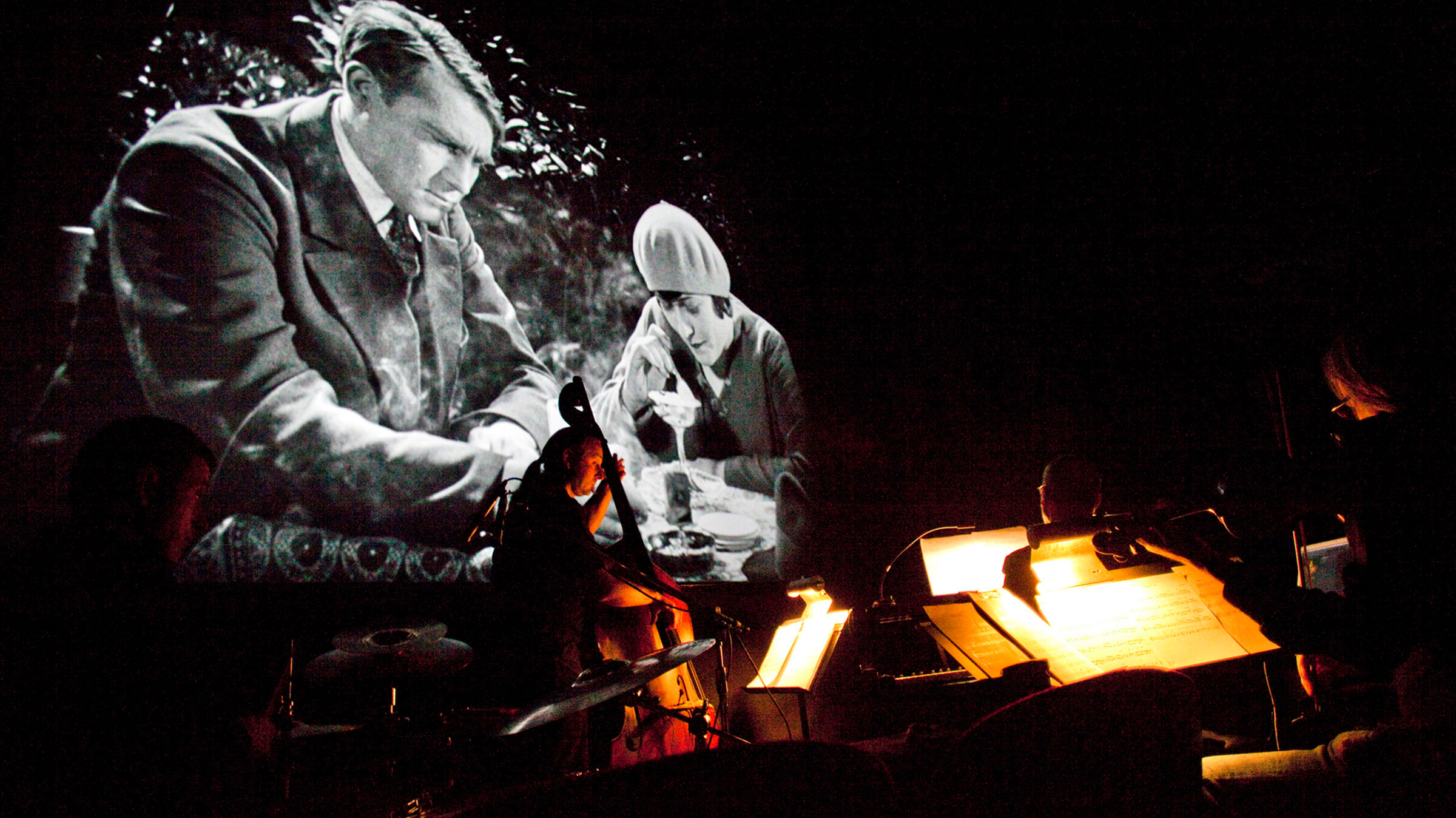
Most nights you can go out in the Bay Area and hear bassist Sascha Jacobsen play. He’s part of no fewer than four regularly performing groups and his expansive musical realm includes not only classical chamber music (he’s a founding member of the Classical Movement Revolution), but also jazz, flamenco, klezmer, and, his true love, Argentine tango. But it’s only a few times a year that you have the chance to hear him accompany a silent film. On those occasions he’s usually joined by his Musical Art Quintet or his ensemble. Known for performing, as Jacobsen has described, “with the ink still wet” on a composition, he takes an improvisational approach, which is how he first started accompanying films more than a decade ago—joining other SFSFF musicians who often work without a set score. He immediately took to it and has since played for everything from The Rat, Hitchcock’s “Apache” crime story; and the Anna May Wong cross-cultural weepie, The Toll of the Sea; to the primordial vampire film, Nosferatu. “The more I delved in,” Jacobsen told me in a recent conversation, “the more I realized the incredible variety that exists in silent film. Now, when I watch something, the images automatically evoke music. It’s like that line by the great Indian poet Rabindranath Tagore, ‘The world speaks to me in pictures, my soul answers in music.’”
What brought you to silent film?
It’s a word-of-mouth business, in the way that music is, and someone called someone who recommended me as a sideman. I played the bass with Donald Sosin. He was a master. I had no experience with it at all. And it turned out to be completely improvised. There was no written music, just general themes. It was sink or swim for me. I loved it. It was for Gerhard Lamprecht’s Under the Lantern, which is two and a half hours long. You have to play straight through without any break. You really have to stay focused the entire time. A few years later, I got to write my own themes for G.W. Pabst’s Diary of a Lost Girl. My quintet played with it for the hundredth anniversary of the New Mission theater.
And your fellow musicians just came along for the ride?
Oh yes, they love to improvise. They fit right in.
How do you prepare for a film?
I watch it straight through the first time. Then I watch it to gauge the emotions of each scene and think about what music would best evoke those feelings, whatever it is: happiness, sadness, fright. It’s really about the emotions, and giving some context. If there’s a villain, the music has to let you know, hey, this is the bad guy. Every film is different, but I do play with modern audiences in mind, to appeal to modern audiences—as long as the music fits the themes.
Is there a genre or style of film you prefer to play for?
I like the darker films. I like using strings and working with dense harmonies. I really enjoyed playing for the German film Mother Krause’s Journey to Happiness. Here are these four people living a really bleak existence with no hope of escaping it. Musically speaking that is very rich—and, as dark as it gets, you have to just drive it home. A couple years ago I played for A Midsummer Night’s Dream. It has lighter moments, which is definitely fun to do. But comedy, for me, is just not as juicy.
Do you ever see something in a film, a character dancing, or a reference to a specific piece of music and try to match it?
If something specific is happening musically, I might try to match the instrument, the style, the tempo. I will also do some historical research, especially if there’s a famous score. Hans Erdmann composed a great original score for Nosferatu. I definitely studied that one. What he wrote is so creepy. He used “wrong” notes in a classical musical sense; you immediately know that note doesn’t belong in that chord. It has a lot of dissonance. I was really inspired by that.
When we played for the Ukrainian film Arrest Warrant, I researched Ukrainian folk themes and we riffed off those. For The Toll of the Sea, I looked at music in the pentatonic scale, which is used in Asian folk music—most folk music around the world is in the five-note scale. I didn’t want to go too far outside my ability so I had to strike a balance.
Can you give us an idea what you’ll do for Asphalt and Devil’s Circus?
I’ve set us up like a mini orchestra, with strings, woodwinds, and percussion. Michele Walther will play violin and Dan Zemelman is on piano. Andy Lewis will bring his whistles, gongs, thunder sheets … along with his drum kit. Sometimes I think the percussionist is the one who has the most fun when we play [laughs]. Sheldon Brown will bring a clarinet, saxophone, and flute. They’re all so talented and always add something special to the performances. One time, at an Italian Cultural Institute event, we played for the 1911 film The Inferno, and Sheldon brought a contrabass clarinet. It’s a lot, really large. He used it for that final scene when the devil comes out … I was so glad he brought it. It was just awesome.
Any kind of film you want to play with but still haven’t?
I keep bugging Anita [Monga] for an Argentinian film so I can really play some tango. Or anything from South America. I understand those films are harder to come by today. But my background allows me to go down all possible avenues. I don’t have too many musical boundaries.