
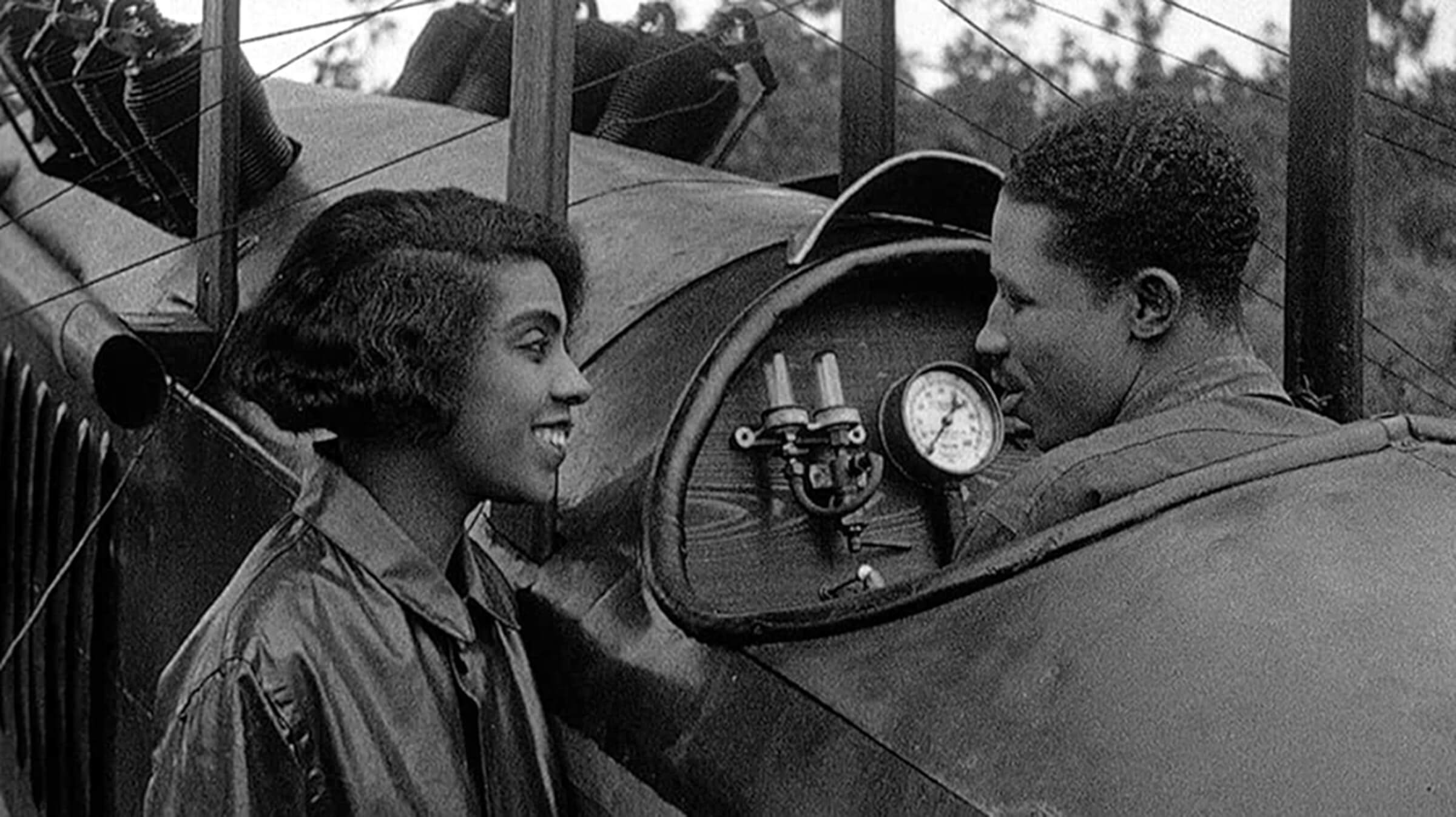
Advertised as “The Greatest Airplane Mystery Thriller Ever Produced,” The Flying Ace stands as one of the best surviving examples of silent-era race cinema (films made with predominantly Black casts for exhibition to Black audiences). The Flying Ace represents both the ambition of race film producers and the appeal their movies offered Black moviegoers. Its importance to film history was acknowledged when it was added to National Film Registry by the Librarian of Congress in 2021.
In 1920, white film producer Richard E. Norman set up the Norman Studios in Arlington, Florida, a suburb of Jacksonville. “The Winter Film Capital of the World,” as heralded among film production companies, hosted seasonal studios for Kalem, Selig, Essanay, among others. A specialist in genre films, Norman produced adventures, comedies, and romances, as well as home talent films featuring nonprofessional actors in itinerant see-yourself productions. Ever a businessman, Norman recognized a niche in catering to Black patrons and, between 1919 and 1928, produced seven race features.
The Flying Ace, Norman’s sixth race production, was filmed at his Arlington studio with location shooting outside Mayport, also used in his 1919 railroad drama The Green-Eyed Monster. The plot revolves around a returning war hero, Captain Billy Stokes—the title’s Flying Ace—who is resuming his prewar position as a railroad detective. When a payroll agent disappears along with $25,000, Stokes must track them down and avoid falling victim to an unscrupulous rival pilot, the suave yet shady Finley Tucker who has eyes for the stationmaster’s daughter, Ruth Sawtelle. With two pilots vying for Ruth’s affections—and the whereabouts of the missing payroll—the film’s climax not unexpectedly occurs in the skies.
For several years, Norman had been preparing for an ambitious airplane drama. His plans first involved Captain Edison C. McVey, a Black daredevil aviator self-styled as the “King of Stunts.” Plans with McVey never coalesced, but Norman emerged from that encounter committed to developing an aerial picture. Shortly after the partnership with McVey fizzled, Norman was contacted by an agent of Bessie Coleman, the famed Black aviatrix, who was on a U.S. tour billed as the “Dashing and Daring Girl Who Flirts with Death in her Airplane.” A Texas native, Coleman had attended aviation school in Paris where, in 1921, she became the first Black person (and Native American) to earn an international pilot’s license. Upon returning to home, Coleman became a sensation and was widely celebrated in the Black press. Norman immediately recognized the potential draw of a Bessie Coleman film.
Tragically, their plans to collaborate never went further than mutual enthusiasm for the project (and disagreements about who would finance it). On April 30, 1926, Coleman and her mechanic died while practicing for an airshow in Jacksonville. Had she survived, she likely would have met Norman while in his city and The Flying Ace would have been a very different film. In what his biographer Barbara Tepa Lupack describes as “a macabre bit of showmanship,” Norman didn’t hesitate to capitalize on the sensationalism of Coleman’s death as he forged ahead with production of his aviation drama.
With no McVey and no Coleman, Norman needed star power for his film. After failing to attract talent from the Colored Players Film Corporation of Philadelphia, which had a number of celebrated stage actors on contract, Norman cast husband-and-wife duo Lawrence Criner and Kathryn Boyd in the lead roles, both accomplished actors with New York’s Lafayette Players, stock company of the prestigious Harlem theater. Implicitly alluding to Coleman, Norman promoted Boyd as “Pretty, demure, yet possessed of the nerve of a female dare-devil.” And McVey was certainly not far from his mind when Norman described Criner as “the virile type of athletic manhood necessary for motion picture leads.” Supporting cast included Norman regular Steve “Peg” Reynolds as Captain Stokes’s one-legged sidekick and flight mechanic who, among other comic exploits, shoots a gun through his hollow crutch. A popular comedian, Reynolds accompanied the film at many screenings, regaling audiences with stories of his experiences as a movie actor.
Of course, for many moviegoers, the real star of the film was the plane, marketed by Norman (rather crudely given the recent tragedy of Coleman’s fatal accident) as “an engine of death.” Norman modeled the plane on Coleman’s Curtiss JN-4. While advertised with sensational language, promising “Real Stunts, Loops, Parachute Jumps, Changing Planes, Flying Upside Down, Fights on Land as Well as in the Air,” the “stunts and thrills” were distinctly rudimentary. Norman’s son, Captain Richard E. Norman, who grew up to be a commercial pilot, remembered the filming and tricks, including the illusion of an inverted plane rendered by turning the camera upside down. However, given the budget constraints of race film production, the plane sequences are nonetheless convincing and highly entertaining—even if the plane never left the ground.
Though The Flying Ace cost more than Norman initially budgeted, it was a financial success for his studio and for Black exhibitors. Norman kept the feature in circulation, surely in no small part because of the national craze for aerial heroics sparked by Charles Lindbergh’s transatlantic flight in May 1927 and reflected in the popularity of Paramount’s Wings (1927), the first film to receive an Academy Award for Best Picture. The demand for The Flying Ace remained steady for nearly a decade.
While neither McVey nor Coleman participated in the film’s production, they certainly informed the film’s reception among Black moviegoers. Their real-life heroics shaped an audience receptive to an image of Black aviation exploits, reinforced by Norman’s marketing. Norman’s race films conjured an alternative reality where its characters enjoyed the same range of experiences and emotions as white characters in mainstream films. Contemporary viewers sometimes dismiss race films as poor imitations of white movies, but this assessment misses both the intention and the appeal of race productions, which are best understood not as imitative, but reinventive.
Nowhere in The Flying Ace does the returning war hero Stokes face the indignities of a Black veteran, nor do Jim Crow realities permeate the haven of Mayfield. This is a narrative that takes place in an all-Black world with both Black heroes and villains. Unlike the silent films of Norman’s competitor—and sometimes correspondent and ally in the race film industry—Oscar Micheaux, the film’s drama does not rely on racism or injustice. Norman wagered his audience wanted fantasy and escapism. Micheaux, in contrast, told “too much truth,” as film historian Jane Gaines describes the effect of his scathing depiction of the brutality of a white lynch mob in his 1920 Within Our Gates.
In Lupack’s assessment, “Norman was determined to give his audience the role models that they craved but never saw in studio productions.” With The Flying Ace, Norman offers his audience a role model not only absent on screen, but one denied in reality. During World War I, while many Black men volunteered to serve, racist policies meant that only a fraction were enlisted. Of those who successfully joined the war effort, most were relegated to menial roles or support positions. The exception was the 369th Infantry Regiment, known as the Harlem Hellfighters, who served alongside French Armed Forces. Celebrated for their valor, the 369th suffered the highest casualties of any American regiment in WWI.
African American men enlisted, serving in segregated regiments, with the hope that defending democracy in Europe would lead to its realization in the U.S. As the NAACP declared, “First your country, then your rights!” However, when Black soldiers returned home, they were quickly reminded of the racist status quo as they faced the threat of lynching for merely wearing a uniform. Sixteen Black WWI veterans were lynched between 1918 and 1920—that we know of. When Captain Stokes wears his uniform throughout The Flying Ace, it would be understood by its audience as an act of bold defiance.
Audiences would have also understood Stokes’s status as a decorated aviator to be an aspirational fantasy. Not until 1940 did the War Department train Black pilots. This fantasy is what drove The Flying Ace’s appeal, with Black newspapers at the time heralding the production as the “greatest colored movie film of all time” and promised readers it was “filled with thrills.” While The Flying Ace reflected aspirations more than realities, its power was in offering a singular attraction: “Never before have colored stars appeared in feature aeroplane romance.”
Presented at SFSFF 2025 with live musical accompaniment by Wayne Barker