Almost from the moment of its corporate birth, Metro-Goldwyn-Mayer saw itself as the classiest of the major Hollywood studios, with the biggest stars, the highest gloss, and the most wholesome entertainment. Unlike competitors, it developed relatively little appetite for the more lurid likes of gangster and horror mellers that exploded into popularity in the talkie era.
Strange, then, that MGM was also home to the talents most associated with screen horror when movies were still silent. Hired away from Universal by the new company as its head of production at just age twenty-four, “Boy Wonder” Irving Thalberg brought with him “Man of a Thousand Faces” Lon Chaney—with whom he’d made the hit epic The Hunchback of Notre Dame the year prior—as well as (eventually) the star’s frequent director Tod Browning. The very first wholly in-house MGM picture to see release in late 1924, He Who Gets Slapped, was a vehicle for Chaney. A year later came a costly period spectacle to rival Hunchback, The Phantom of the Opera … but that was back at Universal, which now had to pay a premium for the services of its former contract player.
Such lavish prestige efforts provided the actor with the roles he remains best known for a century later. But Thalberg knew Chaney did not require luxe settings to satisfy his considerable fans. Many of his MGM films cost less than $200,000 (or about one-sixth Hunchback’s budget)—and still turned huge profits. Frequently forming a creative trio with Browning and scenarist Waldemar Young, Chaney needed only a grotesque physical transformation and equally grotesque melodramatic plot to make the world’s audiences shiver.
Considered by some the absolute apex of their collaborations, 1927’s The Unknown arrived smack in the middle of Chaney’s peak year at Metro. It began with the most popular of his “straight” films, Tell It to the Marines, in which he played the classic tough drill sergeant with a heart of gold, and ended with that most famous of lost films, the vampire-themed London After Midnight. He also found time for Mr. Wu, the last of his several “yellowface” roles (no one’s favorite Chaney interpretations these days), and Mockery, playing a dimwitted peasant caught up in the Russian Revolution.
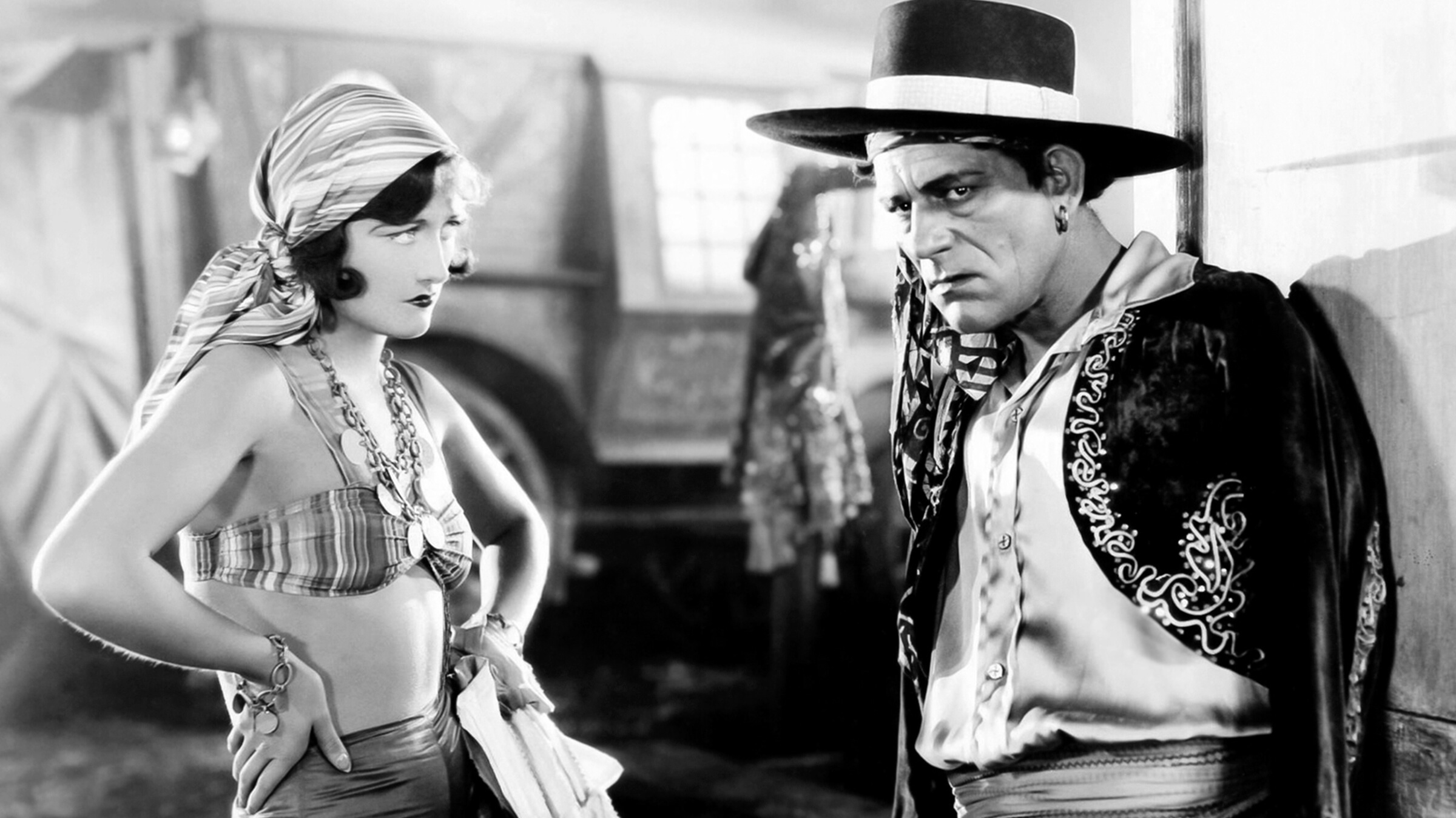
The Unknown was perhaps his humblest MGM enterprise, and the truest to the Chaney-Browning-Young template of twisted psychological and physiological concepts. Based on a story idea by the director (who had once performed in sideshows himself), it was shot under the initial title Armless Alonzo—the character, of course, played by the star. He’s “the sensation of sensations” in the “gypsy circus” Circo Zanzi, who uses his feet to fire a gun and throw knives at comely assistant Nanon (Joan Crawford), the carnival owner’s daughter.
Alonzo is a sneering, resentful loner whose sole confidante is diminutive helpmate Cojo (John George). But he has an aching soft spot for Nanon, who trusts him in return—albeit only because of his disability. “All my life men have tried to put their beastly hands on me … to paw over me,” she tells him. “I shrink with fear when any man even touches me.” He encourages her aversion, undermining the courtship of sweet-natured resident strongman Malabar the Mighty (Norman Kerry). But Alonzo has a secret, withheld from all save loyal Cojo: he isn’t really armless. That’s just an illusion fostered by careful binding. The ruse keeps him safe from suspicion when, in conflict with Nanon’s father (Nick De Ruiz), he commits murder—by strangulation. But it also leads him to a fate of horrific pathos when he makes the ultimate sacrifice for a love that can never be his.
This “story they tell in old Madrid” is, like so many Chaney projects, a romantic triangle in which he is the side doomed to remain unrequited. Sometimes his protagonists are sympathetic, sometimes villainous; in The Unknown, he winds up being both. As David J. Skal and Elias Savada put it in their Tod Browning biography Dark Carnival, “Unlike virtually every other male star in Hollywood, Chaney almost never got the girl.” The Unknown also reinforces these collaborators’ complicated attitude toward the physical differences they obsessively portrayed: Alonzo is at once a freak and a fraud, a “fake cripple” who nonetheless turns out to be a true, tragic misfit.
While famous for his self-applied makeup tricks and the physical punishment endured for particular roles (though he sometimes let publicity exaggerate the latter), Chaney was in reality quite evasive about his transformative methods. For The Unknown, he wore a basic straitjacket to hide his arms. The dexterity of his feet was marveled at, but in fact this was a rare case of him using a body double. An actual armless man named Paul Desmuke was hired for the entire shoot, earning a measure of notoriety he later milked on tour with the Al G. Barnes Circus and Sideshow.
Terms like “horror,” “gruesome,” and “macabre” were thrown around a lot in discussing the Chaney oeuvre. But back then those terms signaled something very different from what they might now, when computerized imagery can realize any fantastical monster and extreme sadistic gore in movies like the Terrifier series and no one bats an eye. The shocks in Chaney-Browning films were more psychologically transgressive: Nothing could stir more fraught viewer response than the expression on Alonzo’s face (very much the actor’s own, sporting no significant alteration here) when he realizes he’s made a ghastly error.
It’s a moment Burt Lancaster subsequently called one of “the most compelling and emotionally exhausting scenes I have ever seen an actor do.” Ingénue Crawford’s unaffected performance, alongside Kerry’s equally winning one, does much to sell this baroque narrative and Crawford later said working with Chaney made her “aware for the first time of the difference between standing in front of the camera, and acting.” As Chaney himself put it, “Grotesqueries as such do not attract me; it is vivid characterizations to which I strive.”
Still, critics were torn between admiration and repulsion, choosing to take particular umbrage at repeat good-taste offender Browning. The New York Herald-Tribune pronounced his art as now “rapidly approaching the pathological.” The New York Sun fulminated that the film “might have been written by Nero, directed by Lucretia Borgia, constructed by the shade of Edgar Allen Poe and lighted by a well-known vivisectionist … the good old days of the Roman Empire are upon us.” Others called it “remarkably unpleasant,” “spiced with cannibalism” (?!), and best enjoyed by “a moral pervert of the present day.”
Nevertheless, it was another hit. Four months later, The Jazz Singer debuted—but Chaney and Co. weren’t bothered, or even interested. In fact, MGM’s chameleonic star held out against the talkies even longer than Garbo, making another eight silent features. He finally caved with the mid-1930 release of The Unholy Three, a remake of his 1925 success for which Browning (re-tied to Universal by then) did not return. Allowing the star to demonstrate his mastery of vocal as well as cosmetic disguise, it was another popular triumph. But a bittersweet one: Chaney was already dying of cancer, which took his life at age forty-seven just weeks later.
In what sounds like a “dark curse” plot from a Lon Chaney film, his principal creative allies also suffered premature exits. Congenitally fragile, Thalberg succumbed to pneumonia in 1936, as did Waldemar Young two years later. Returning to MGM after his enormous hit with Bela Lugosi in Dracula, Browning felt Thalberg’s loss keenly—he was not much liked at the increasingly high-minded studio, especially after scandalizing everyone with 1932’s notorious Freaks. His last directorial feature was in 1939, after which he stomped off into angry, close-mouthed seclusion for the remaining twenty-odd years of his life. “When I quit a thing, I quit,” he said, apparently refusing even to see movies in his semi-forced retirement. This, too, resembled a vintage Chaney scenario: The bitter genius who sacrifices all for love of a medium that in the end proves faithless.
The Unknown was thought lost before a French nitrate print was found that ran fifteen minutes shorter than the original. Only recently were (nearly) all the missing elements discovered in a separate print that had come to rest in Czechoslovakia. The results are almost identical to what audiences saw in 1927, as Browning had eliminated shots and supporting characters he thought gratuitous from the already succinct final cut before its release.
Presented at SFSFF 2025 with live musical accompaniment by Stephen Horne and Frank Bockius