
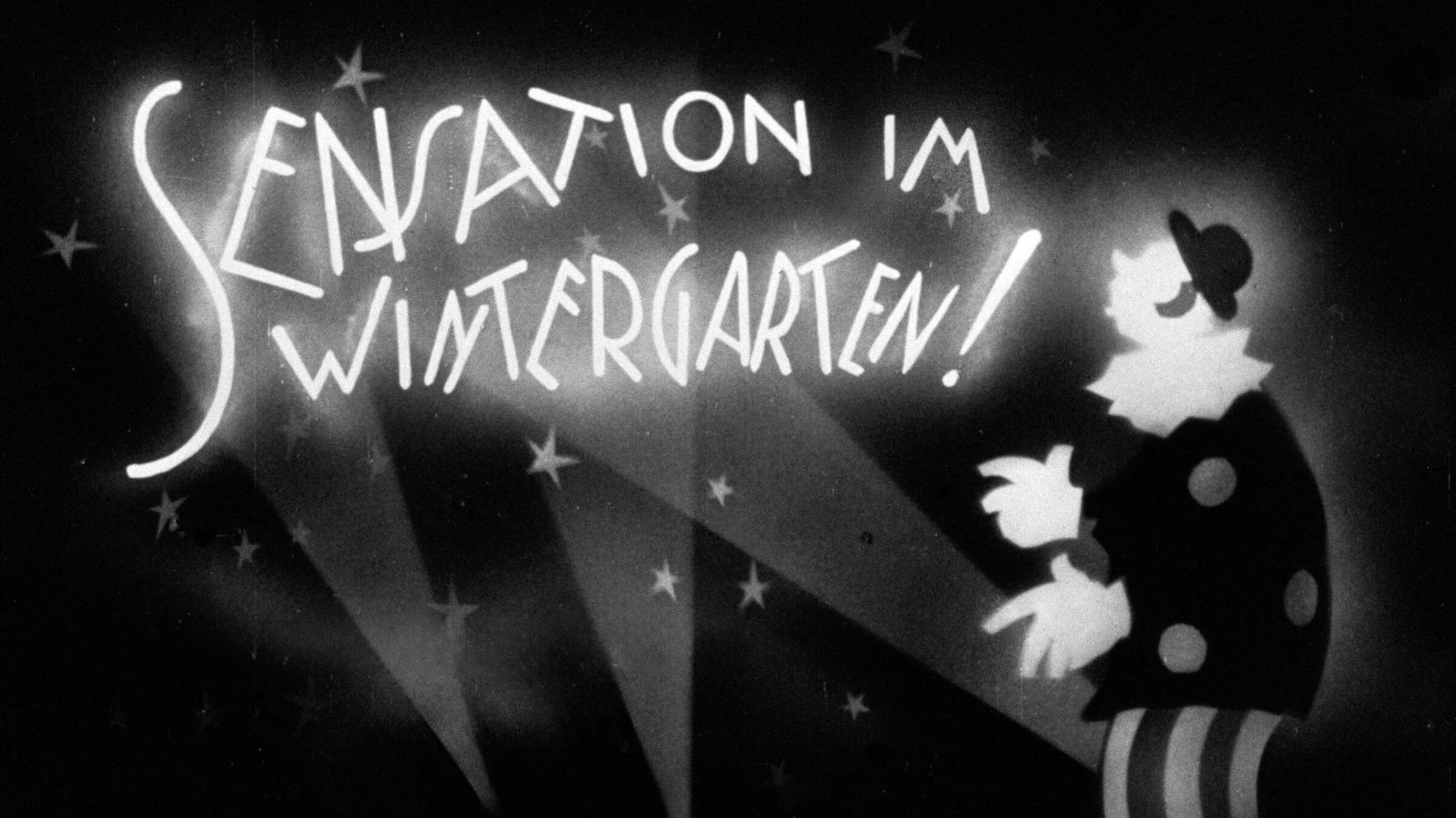
German films of the Weimar era often feature individuals struggling to escape either circumstance and convention, with their fate—especially their happiness hanging in the balance. It was the tenor of the times.
Sensation im Wintergarten (released as Their Son in the U.K.) is one such film. Its story centers on the son of Countess Mensdorf, a boy who runs away and joins a circus when he can no longer endure his mother’s relationship with a debauched aristocrat named Baron von Mallock. As the years pass, the son becomes a celebrated trapeze artist named Frattani; he returns home after performing abroad and encounters Madeleine, his childhood friend and now a lovely young dancer. They fall in love.
The unscrupulous Baron is a gold-digging cad ever on the prowl for younger women, and eventually, he makes moves on Madeleine, whom he happens to see performing at the Wintergarten. He notices her legs, as do the other men who observe her. His advances are frustrated when he discovers Madeleine’s beloved is none other than his stepson, who he thought dead and now sees as a threat to his dissolute ways.
Though a German production, Sensation im Wintergarten was something of an international effort, which was not usual in the late silent era. Its director, Gennaro Righelli, was an Italian working in Germany. Among his more than 110 credits are a German version of Svengali made in 1927 and, from 1930, the first Italian sound release, La canzone dell’amore (The Song of Love).
The film stars the Austrian actor Paul Richter as Paul Mensdorf, the runaway son who becomes an acrobatic sensation. The handsome Richter was very familiar to German audiences. His defining role was as the mythic hero, Siegfried, in Fritz Lang’s two-part Die Nibelungen (1924).
Erna Morena plays Paul’s estranged, passive mother. Morena had worked with the biggest German directors, like Richard Oswald and F.W. Murnau, after making her film debut in 1912 and had her own film series beginning in 1914. She also had the distinction of having starred in the title roles of earlier versions of two later Louise Brooks films, Lulu (1917) and Diary of a Lost Woman (1918), filmed with Brooks in 1929 under the title The Diary of a Lost Girl. The French actor Gaston Jacquet plays the debauched aristocrat who becomes Paul’s stepfather. Jacquet’s other credits include two well-regarded French films directed by another Italian, Augusto Genina, Quartier Latin (1929) and Prix de beauté (1930), appearing to type as a baron and a duke, respectively.
Claire Rommer plays Madeleine, the childhood friend and later love interest of Paul Mensdorf. Her performance of the Charleston on the Wintergarten stage is a standout scene. Rommer had a decade-long, fifty-film run at home until Nazis forced her and husband to escape across Europe, then finally to the U.S. Vladimir Sokoloff, a Russian-born actor who studied at the Moscow Art Theater, plays Berry, an acrobatic clown and Paul’s sidekick. He is superb, one of the most memorable characters in the film. He later put his distinctive face to use in Hollywood, taking small parts in everything from The Life of Emile Zola to The Twilight Zone.
In supporting roles, as the manager of the Wintergarten, is Adolphe Engers, a Dutch-born actor, and Ossip Runitsch, another Russian, who plays the head of the circus. Marcella Albani appears early on in the film in a minor role as one of three women who seek Frattani’s autograph on the ship returning him home. Albani, an actress, producer, and, later, novelist, was an idol of the European cinema in the 1920s, making many films in five different countries (her native Italy, as well as Germany, Austria, France, and Czechoslovakia).
Besides Paul Richter, the other star of the film is the Wintergarten itself. Along with a few exterior shots meant to introduce the venue, a number of key scenes in the film were shot inside the historic building. Notably, it was the vivid cinematography of Mutz Greenbaum (later, Max Greene), who shows off the music-hall from a variety of vantage points, that drew repeated praise from reviewers of the time.
The Berlin venue, which opened in 1887, was widely known throughout the world, and site of the very first German moving image presentation in a theater (in 1895). Acts appearing as far away as Australia were described as being “direct from the Wintergarten.” Goings-on at the venue were even reported in the American press, which noted that Harry Houdini’s 1929 appearance at the “huge establishment was packed to the doors.” What makes the footage shot both inside and outside the Wintergarten all the more precious is the fact that the venue was leveled by bombs during World War II.
Backstage stories, including those set among circus performers and variety acts, have long appealed to moviegoers. This year’s festival features The Clown, with Danish matinee idol Valdemar Psilander, which dates to 1917. Victor Sjöström’s existential melodrama about a wronged clown, He Who Gets Slapped (1924), also comes to mind, as does the notable German production, E.A. Dupont’s Variety (1925), starring Emil Jannings and Lya de Putti (partly filmed inside the Wintergarten). As one German newspaper noted in its review of Sensation im Wintergarten, “Since Dupont’s Variety, circus films have sprung up like mushrooms.”
By the end of the 1920s, German cinema had largely transitioned from the heightened tenor of Expressionism to a less sensational realism. Upon its release in September 1929, Sensation im Wintergarten garnered mixed reviews. The challenge for its director was how to fashion something fresh out of a familiar story and familiar setting.
One German newspaper, Deutsche Allgemeine Zeitung, perhaps still longing for the more experimental days of early Expressionism, wrote of Righelli, “Scene after scene is rationalized and logically constructed by him and firmly riveted together into a strictly structured edifice. In his distinctly Roman films, where he praised the architectural clarity of the eternal city and the structure of the Campagna in ever-new images, this style was appropriate, but not here. Because the world of the artist …,” the writer went on to suggest, is considered emotional, even transcendent.
The review continued, “To capture it cinematically, one must oneself be irrational and romantic, which contradicts Righelli’s nature. As always, he produces images with utmost precision; they all have taste and class, but they remain without illusion and do not merge into the rhythm and magic of the spotlight; indeed, the main scene, the knife jump, appears downright banal in its rational execution.”
But not all thought so. In its review of Sensation im Wintergarten, the German film magazine Kinematograph put it this way. “The ‘variety show’ milieu repeatedly fascinates stage and film writers. The portrayal of this milieu, and even more so of the people who inhabit it, usually doesn’t correspond to reality; but this apparently doesn’t detract from its effect on the audience. Sentimental scenes, the ‘laughing clown,’ and the glimmer of romance that, according to an ineradicable perception, surrounds the so-called ‘artist community’ —all this continues to captivate an audience. The writers of this film, Georg Klaren and H. Jacobi, follow entirely conventional paths in the composition of their script; it is to the credit of Gennaro Righelli, the director, that he manages to arouse interest beyond the conventional plot, to heighten it, and to maintain it until the very end … Righelli, a director with a strong visual sense and temperament, successfully strives to break free from clichés in his depiction of events.”
Does Sensation im Wintergarten offer viewers something fresh in its depiction of variety artists struggling with circumstance and convention, or is this a story we have seen before?
No complete print of the film is known to exist (the third act is still missing), let alone an incomplete German print. Today, however, thanks to the recent restoration of Sensation im Wintergarten, viewers can see for themselves.
Presented at SFSFF 2026 with live musical accompaniment by Guenter Buchwald and Frank Bockius