
À PROPOS DE NICE
Directed by Jean Vigo and Boris Kaufman, France, 1930, 25 minutes
DCP source: Janus Films
RIEN QUE LES HEURES
Directed by Alberto Cavalcanti, France, 1926, 44 minutes
DCP source: Les Films du Jeudi/Les Films du Panthéon
Since the early years of cinema, filmmakers have tried to capture the essence of a city in a kind of visual poem, a genre of film that has come to be known as the “city symphony” film.
Usually city symphony films limit their time frame, most often from morning until evening. Typical filmic tropes include locations and monuments symbolic of particular cities: the Eiffel Tower in Paris, the Statue of Liberty in New York, for example. City symphonies have borrowed from documentary, dramatic and experimental film, newsreels, animation, archival images.
Museum of Modern Art film curator Jon Gartenberg, in writing about New York City symphony films, mentions Manhatta (Paul Strand and Charles Sheeler, 1921) but also some unexpected examples like Edwin S. Porter’s Coney Island at Night (1905) and Empire (1963), Andy Warhol’s eight-hour take of a single shot of the Empire State Building.
Jean Vigo’s Á propos de Nice comes at the seam between the silent and sound eras in 1930. Also, keep in mind that 1929 was the year of Luis Buñuel and Salvador Dalí’s surrealist Un chien Andalou, as well as Dziga Vertov’s kinetic Man with a Movie Camera, two radical departures from movies that came before. Á propos de Nice relies on the familiar approach of visualizing a day in the life of the famous French Mediterranean beach playground for the well-off. But that is the only typical thing about the twenty-four-year-old’s debut.
The opening title credits both Jean Vigo and Boris Kaufman, although it is acknowledged that Vigo is the director and Kaufman the cinematographer. The youngest brother of Dziga Vertov and Mikhail Kaufman, Boris had been sent to Paris by his parents to avoid the draft and stayed, shooting all of Vigo’s films.
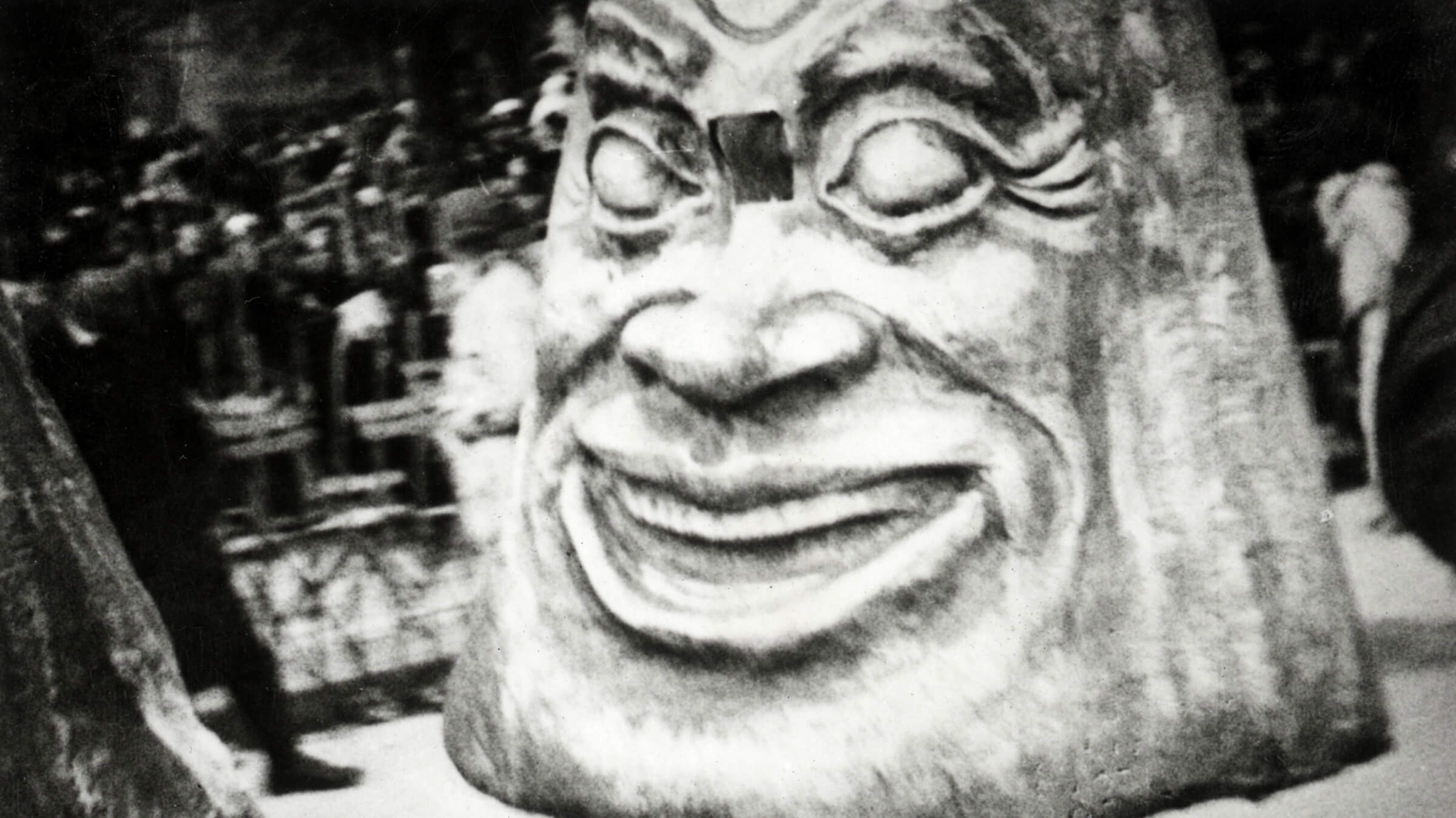
A busy holiday at the beaches brings large numbers of sun lovers. On the boardwalk, the well-heeled amble about, the ladies in their bobs and cloche hats. Waiters are setting up tables at outdoor cafés. Landscapers trim trees. Other workers are putting together giant papier-mâché heads for a parade. The affluent don’t do much, they go for a stroll, gamble at the casino, play tennis. The workers do useful things. Throughout the film, Vigo illuminates this difference between the social classes.
Kaufman’s camera work was not really in the style of his brother (Boris went on to win an Academy Award for his cinematography for On the Waterfront). Nonetheless, Vigo biographer John M. Smith cites a brief sequence in which hotels at the beach are shown as if they were lying on their sides, and then the camera rotates until they’re standing up. Like Vertov, Kaufman uses “the power of the camera to modify the apparently permanent,” writes Smith. Beyond that similarity, Kaufman brings a sense of dynamism to the film. Nonstop motion was Vertov’s identity.
If there were an award for Most Influential Film Director of All Time with only one feature film to their name, I would nominate Jean Vigo, for the tangled romance L’Atalante (1934). The last film he made before his untimely death at age twenty-nine strongly echoed throughout the 1930s poetic realism of Jean Renoir, Marcel Carné, and Julien Duvivier.
Another Vigo short, Zero for Conduct (1933), became a symbol of defiance for the rebellious filmmakers of the French New Wave of the 1950s and ’60s. Vigo’s story of fed-up boys at a boarding school rioting and joyfully wrecking the place. One New Wave icon in particular who championed the film was François Truffaut, who had been a juvenile delinquent himself. He named the film as an inspiration for his first feature, The 400 Blows. In their biography of Truffaut, Antoine de Baecque and Serge Toubiana report that Truffaut was already obsessed with Vigo at the age of seventeen when he was housed at a juvenile detention center and thought he would also die young. Writing a letter to a friend, he signed his name as François-Jean Vigo.
Much has been made of the fact that the auteur of a classic film about a joyful rebellion of schoolboys was the son of a famous anarchist, Miguel Almereyda. In Paris in 1913, Almereyda founded an antiwar socialist magazine, Le Bonnet Rouge. It published for nine years before being banned. In 1917 the chief administrator was convicted of high treason and executed by a firing squad. Almereyda was arrested and murdered in jail. Jean was twelve years old at the time.
“He had succeeded in introducing subversive elements into film,” wrote Vigo biographer P.E. Salles Gomes. During his lifetime, Vigo’s films were considered seditious and dangerous. Zero for Conduct was banned until 1945. L’Atalante was chopped to pieces by Gaumont. Even Á propos de Nice was accused of containing revolutionary ideology.
According to the tried-and-true formula for city symphonies, a film about Paris would prominently feature the Eiffel Tower, elegant and fashionable camera subjects, free-spirited bohemian artists sipping absinthe. In Rien que les heures (Nothing but Time) Brazilian-born Alberto Cavalcanti gives us all that. But he does it with the aim of questioning all that. While the rich have nothing but time to enjoy what life has to offer, it’s “Ceux qui travaillent mesurent les heures qui passent” (Those who work measure the passing hours).
The main image of Gustav Eiffel’s classic structure is seen in the shape of a souvenir thermometer. To the expected images Cavalcanti adds the toilers of Paris who make things go: the poor, the downtrodden that you won’t find in any travel agent’s brochures. The streets of Paris are seen as a microcosm of society. But he turns Paris upside down.
Unlike Vigo’s day in the life of Nice, Rien que les heures has several narrative threads unspooling at once. Images of a well-dressed young man eating steak frites juxtaposed with images of a slaughterhouse. A streetwalker has a hard time finding customers. A young woman hawking newspapers is on the verge of desperation when she is mugged and loses her hard-earned money. A decrepit old woman is seen walking through town, barely able to navigate stone steps. She collapses near the bank of the Seine.
Cavalcanti was so adept, such a prodigy, that he excelled at everything, then moved on and excelled at something else. At age fifteen he studied law at university, got expelled, and studied architecture instead. At age eighteen, he moved to Paris to study interior design. He moved to England and took a job at the Brazilian consulate in Liverpool. Next, he worked with avant-garde filmmaker Marcel L’Herbier as a set designer.
He actually directed his first film before Rien que les heures, the narrative Le train sans yeux, which was impounded because of the producer’s debt and held from release until 1929. Cavalcanti then decided to gather some friends to make something on the cheap, the city symphony film that became his official debut. It is said that Dziga Vertov saw the film and was influenced by it, as was Walther Ruttmann, director of the best known of all the city symphony films, Berlin: Symphony of a Great City (1927).
In 1934 John Grierson invited Cavalcanti to work with the General Post Office telecommunications unit as sound director on the classic Night Mail. When Grierson left for Canada, Cavalcanti headed up the unit, exerting an outsize influence. Years later one GPO director wrote: “British documentary films could not have advanced the way they did without him.”
After directing features for Ealing and other outfits in England, Cavalcanti returned to his native Brazil to become head of production at the Companhia Cinematográfica Vera Cruz in 1950. He also directed a return of sorts to his earlier style with 1952’s O canto do mar (Song of the Sea), a poetic look at the life of impoverished migrants awaiting passage south. Being blacklisted in Brazil as a communist, he returned to Europe to continue working.
David Thomson in his New Biographical Dictionary of Film describes the remarkable versatility of Cavalcanti’s work and the sensibility that he brought to all his projects. “There is always something artificial about his naturalism, a taste for cinema that is more experimental than expressive. Grierson acclaimed Cavalcanti as one of the founders of realism, but it was Grierson who enthused over the ‘creative’ treatment of actuality and who often dignified it with the attention of renowned and deliberate artists from other fields.”
Presented at SFSFF 2026 with live musical accompaniment by Stephen Horne and Frank Bockius