
A film of shimmering lights and deceptive surfaces, Joe May’s Asphalt is a luminous work of late Weimar cinema. It epitomizes the Straßenfilm (“street film”) genre that emerged from the postwar fascination with urban modernity. This genre features the city as its central protagonist, depicting it as an alluring yet treacherous space where excitement and moral danger coexist. Inaugurated by Karl Grune’s Die Straße (The Street, 1923), the genre dramatizes how the modern metropolis seduces and corrupts its inhabitants, particularly the “ordinary man,” whose encounter with the city’s temptations leads to inevitable ruin.
This pattern is evident from the beginning of Asphalt. The protagonist is a young, disciplined police officer and the embodiment of state authority. We first see him directing traffic with dramatic aplomb. But the city has other designs on him. A flirtatious jewel thief named Else catches his attention and draws him into a world of sensuality and deception. What begins as an attempt to uphold the law spirals into moral collapse when the officer inadvertently kills a romantic rival. This premise foreshadows the fatalistic narratives of later film noir, in which respectable men are undone by beautiful yet dangerous women.
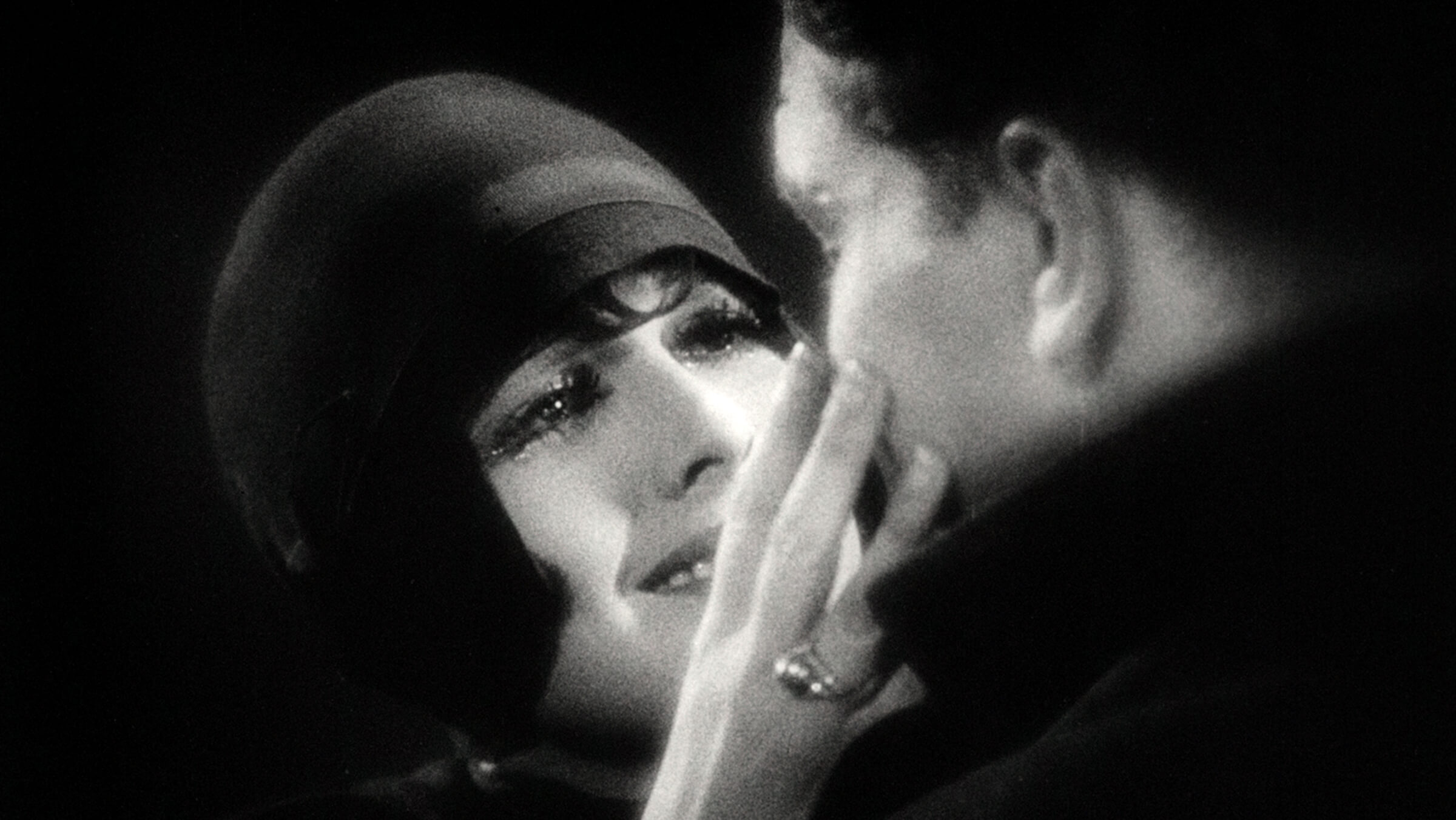
While the plot follows a genre template, the film distinguishes itself through its production values and visual inventiveness. May collaborated with renowned cinematographer Günther Rittau, who had worked on Fritz Lang’s Die Nibelungen (1924) and Metropolis (1927). Rittau’s mastery of the “unchained camera” produced a kinetic visual language that resulted in spectacular images. Sweeping overhead shots (using a new camera crane) reveal the city’s monumental architecture, tracking shots glide along neon-lit boulevards, and extreme close-ups capture the charged glances exchanged between the illicit couple. The handheld camera adds tactile immediacy to interiors, and Rittau’s attention to inanimate objects—such as shop windows, door handles, and the glint of jewelry—invests them with psychological resonance.
Aesthetically, Asphalt is firmly rooted in the Neue Sachlichkeit (New Objectivity) movement, which emerged in the mid-1920s as a reaction against the emotional excess and stylization of Expressionism. New Objectivity favored unsentimental realism, precise detail, and an observational approach that often borrowed from documentary practices. In Asphalt, this manifests itself in the film’s fascination with surfaces—polished streets, glimmering fabrics, and illuminated shop windows—and in its heightened sensitivity to gestures and behaviors. Even the smallest details, from the cut of Else’s dresses to the rhythm of urban traffic, are carefully orchestrated to reveal character and social milieu.
At the same time, the film draws on the Kammerspielfilm tradition established by Lupu Pick’s Scherben (Shattered, 1921) and perfected by F.W. Murnau’s Der letzte Mann (The Last Laugh, 1924). Hallmarks of the form—intimacy, a focus on “little people,” and sharp contrasts between public spectacles and private spaces—are present throughout Asphalt. May uses lighting and camera movement to reveal psychological states, leading viewers from the glittering public realm of the city to the claustrophobic interiors where moral decisions are made. The film contrasts these two spheres—the glittering modernity of the exterior city streets and the stifling domestic space of the young officer’s home—as irreconcilable.
The timing of Asphalt’s release gives it special historical significance. It premiered in March 1929, just months before Berlin saw the arrival of The Jazz Singer, the American “talkie” that ushered in the swift end of silent cinema. In early 1929, all major German productions were still silent films. However, by the end of 1930, the industry had almost completely converted to sound. Asphalt thus stands at the threshold of a technological rupture, embodying the silent era’s final visual triumphs before synchronized dialogue reshaped the movies.
The opening sequence is a self-contained abstract montage of industrial images. Shot at night, it shows workers pounding flaming-hot asphalt into the street surface, their silhouetted bodies contrasting with the glow of the molten material. May uses superimpositions to create a layered, hypnotic rhythm, recalling the abstract city symphonies of Fritz Lang’s Metropolis and Walther Ruttmann’s Berlin: Symphony of a Great City (both 1927). The gleaming asphalt becomes a central metaphor for the modern metropolis as a surface culture obsessed with polish and appearance, concealing instability beneath. During the Weimar period, the term “asphalt” itself became shorthand for cosmopolitan modernity—fast-paced, dazzling, and morally ambiguous. As early as 1928, nationalist critics like Joseph Goebbels twisted this into the anti-Semitic slur “asphalt culture,” denigrating the perceived moral laxity and internationalism of Berlin’s urban life.
Produced by Erich Pommer, famous for his 1927 mega-production of Metropolis, Asphalt was another one of Ufa’s ambitious projects, both in concept and execution. With the exception of a few on-location shots, the film was entirely staged in the Neubabelsberg studios, where a four hundred-meter-long street set was reportedly illuminated by 23,000 light bulbs. At the time, it was Europe’s largest studio set. This monumental artificial cityscape, built by Erich Kettelhut (who was also the chief architect of Lang’s Metropolis), allowed May and Rittau to choreograph light and shadow with absolute control and create a heightened urban reality. The spectacle of electric light aligned the film with Berlin’s own embrace of illumination as a symbol of progress, as seen in the “Berlin im Licht” festival in October 1928. This week-long celebration bathed the city’s streets and buildings in electric brilliance to entice shoppers and tourists.
At the center of the film’s drama is Betty Amann, a twenty-three-year-old German-born American actress whose performance embodies the Weimar “New Woman.” With her bobbed hair, chic wardrobe, and self-assured sexuality, Amann’s Else is both a product of and an emblem for the modern city. Initially, she appears as the archetypal vamp: cool, manipulative, and dangerous. Yet, as the story unfolds, she evolves into a self-sacrificing figure willing to accept punishment on behalf of her lover. Her transformation is reminiscent of Louise Brooks’s Lulu in G.W. Pabst’s 1929 film Pandora’s Box, another complex portrayal of modern femininity that defies simple moral categorization.
Thematically, Asphalt stages a confrontation between two moral orders. On one side is the fast-moving, glittering culture of the modern city, driven by displays of consumption and appearances. On the other is the rigid, patriarchal morality of the police officer’s family home, rooted in Prussian discipline and duty. In this setting, the wayward son’s father, a retired police officer himself, is forced to arrest his own son. From a contemporary perspective, the film’s resolution—the jewel thief’s imprisonment and the young officer’s return to his parents—seems like a conventional return to the old order. However, this ending is also unexpected because it undermines the film’s celebration of sensual pleasure and urban excitement. Could this ending be ironic considering that much of Asphalt revels in the very things it condemns, lingering on luxury goods, fashionable interiors, and the erotic charge of illicit encounters? The abrupt ending can also be interpreted as a reactionary warning sign of the crisis of modernity and the fading myth of the New Woman. The stock market crash a few months after the film’s premiere in 1929 brought an early end to the glamor of the Golden Twenties in the Weimar Republic.
This interplay between critique and seduction is central to the film’s undiminished fascination. May’s camera participates in the culture it depicts, choreographing scenes of looking and being looked at with self-awareness. In one scene, Else’s reflection in a shop window doubles her image, suggesting the multiplicity of urban identities and the act of self-display.
By merging the observational realism of New Objectivity with the psychological intimacy of the Kammerspielfilm and embedding both within a studio-built metropolis animated by electric light, Asphalt achieves a synthesis that is rare in late silent cinema. The film captures the contradictions of Weimar modernity—its technological optimism and moral uncertainty, as well as its embrace of novelty and its nostalgia for order. More than a genre film, Asphalt is a meditation on the city as a space of both liberation and regulation. (It is no coincidence that the protagonist is an officer who regulates the city’s traffic.)
Today, Asphalt stands as a jewel of late silent filmmaking, remarkable for its formal elegance, thematic complexity, and historical position on the brink of the sound era. The film both celebrates and critiques the culture of its time. Above all, however, it is an enduring testament to the visual power of silent cinema.
Presented at SFSFF 2025 with live musical accompaniment by the Sascha Jacobsen Ensemble