
In the latter half of the 19th century, “the woman question”—debate on the rights and roles of “the fair sex”—went from being a rather rarefied topic to a more mainstream one, boosted by the Industrial Revolution greatly increasing women’s presence in a wage-earning workplace. That discussion assumed different forms in different cultures, shaped by factors of religion, economics, governmental structure, and more. In tsarist Russia, where industrialization advanced slowly and class divides were rigid, a great stir was caused by Nikolay Chernyshevsky’s 1863 novel What Is to Be Done? Partly written in “answer” to Turgenev’s classic Fathers and Sons, it places focus firmly on a heroine whose dissatisfaction with her gender’s traditional constraints lead her to a number of bold life choices. Those include communal arrangements in housing, income-generating, and even open marriage.
The book was so influential that four decades later, Lenin wrote a political pamphlet using the same title. After the Russian Revolution, it remained a powerful model that some considered just as important in radicalizing popular thought as the writings of Marx himself. Chernyshevsky’s tome was certainly on the mind of writer Viktor Shklovsky and director Abram Room when they conceived 1927’s Bed and Sofa, a classic if atypical title from Soviet cinema’s extraordinary silent era. Atypical in the sense that this intimate seriocomedy was less conspicuously an illustration of Soviet montage or propaganda than other well-known films of the period.
What seemed very daring at the time was the notion of a domestic ménage à trois—however discreetly portrayed—inspired not only by What Is to Be Done?, but by a rather infamous real-life triangle between Russian avant-garde literary stars Vladimir Mayakovsky, Osip Brik, and Lilya Brik. The filmmakers, however, weren’t about to dramatize similarly elite figures. Their characters are examples (if not exemplars) of a newly empowered proletariat under Socialism.
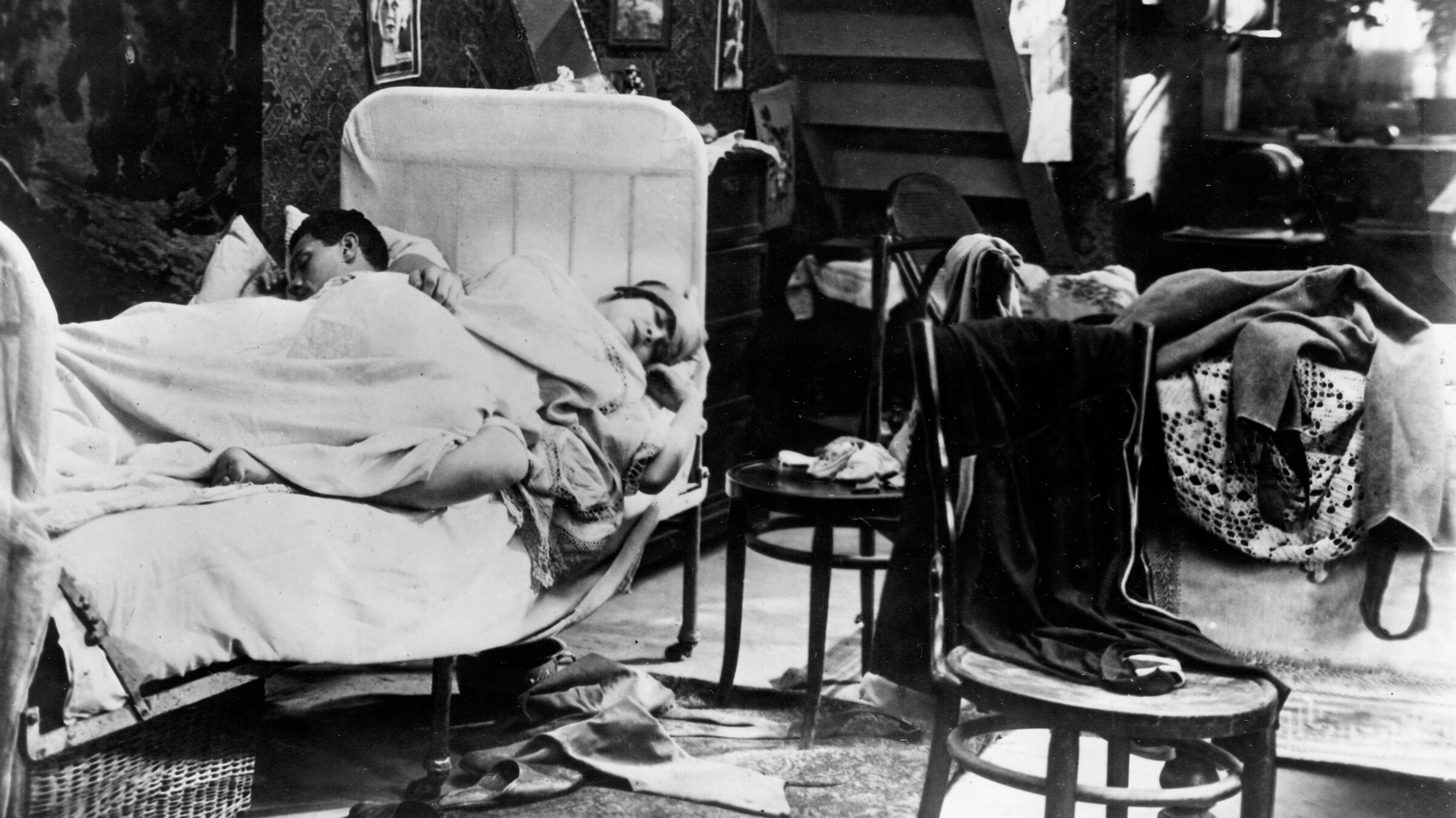
Purportedly the first Soviet narrative feature to extensively exploit Moscow exteriors, Bed begins in “city symphony” mode, showing the metropolis wake from slumber to another busy working day. Its microcosm is the cluttered one-room flat occupied by young couple Kolya (Nikolai Batalov) and Liuda (Lyudmila Semyonova), where taking a morning shower means a quick wash under the trickle of the samovar.
He is a foreman overseeing construction crews repairing and expanding the Bolshoi Theatre—an exciting job on sky-high scaffolding that’s well suited to his athletic exuberance. By contrast, Liuda is stuck indoors in their cramped quarters, alone, tasked with dreary housework. (As a measure of its onerousness, consider that as late as Stalin’s death in 1953, less than three percent of urbanites had hot water from a private tap, according to Gail Warshofsky Lapidus’s 1978 study Women in Soviet Society.) Liuda’s husband is oblivious to that reality, which he compounds by constantly pranking her—failing to grasp that such rough, matey humor is hardly the kind of support she needs.
Meanwhile, typographer Volodia (Vladimir Fogel) arrives via train to take a job at a printing-press plant whose operations are given loving attention by cinematographer Grigorii Giber. He’s welcomed there, but told “it’s up to you to find housing”—a big issue, as the huge influx of new residents (many fleeing rural poverty) has created a crisis. Fortunately, he and Kolya “fought together in the Red Army,” and his old buddy magnanimously offers a couch as temporary bed. Without first consulting his wife, of course.
She adapts gamely enough to this fresh arrival, whom she’ll also have to cook and clean for. But when Kolya has to travel suddenly for work, wife and best friend are left to themselves. For the first time, we see her out of doors—because Volodia is considerate enough to think she might actually enjoy what the city has to offer. Eventually their friendship turns to something else, such that a returned Kolya stomps out in a fury when he realizes there’s a new domestic order at home. But he can find no alternative housing, either … so they arrive at an awkward three-way detente. Still, that vaguely risqué situation is not where Bed and Sofa ultimately lands. Circumstances continue to change, forcing Liuda to make tough decisions that finally render her fully independent of both men.
It was this “open-ended” conclusion that flummoxed many critics at the time. Certain Soviet cultural watchdogs were angry that the film’s protagonists hadn’t behaved like inspirational role models, rising above conflicted personal emotions to flatter the brave new Communist state. Nonetheless, the movie was popular, reportedly drawing well over a million patrons during the six months it was in release. (Although there were reports that some more conservative rural viewers walked out, enraged by the perceived insult to traditional marital roles.) Controversy over its “moral frankness” only generated box-office traffic in Germany and France where it was a considerable hit. But a severely-cut Bed and Sofa got barely seen in the U.K., and it won no distribution in the U.S. at all.
Room and Shklovsky’s creation very much reflected the thinking of the Soviet intelligentsia of the 1920s. While women’s suffrage in the capitalist West was very much tied to political rights for privileged classes, the ideals of the new workers’ state dismissed such bourgeois thinking. Instead, women would experience full economic and social equality via reconfiguration of all institutions: marriage, workplace, collectivization of housework, and child-rearing.
That was the idea. The reality turned out to be something quite different, particularly once Stalin—who was no feminist—solidified his grip on power. In 1930, the Zhenotdel (Women’s Department of the Central Committee) was dissolved entirely. Like people today who dismiss racism by saying they “don’t see color,” the Kremlin opted to deal with sexism by pretending it didn’t exist, declaring full gender equality a done deal. Propaganda began shifting to thinly veiled affirmations of the sanctity of motherhood, even as women continued to enter the workforce in ever greater numbers. Liberalized laws regarding access to abortion and divorce were reversed, further narrowing their options.
Stalin’s emphasis on state economic progress (and silencing dissent), as opposed to improving the lives of individuals, meant that little was done to alleviate women’s burdens. Indeed, it became common parlance that women had to support a “dual identity” as fulltime laborers and fulltime homemakers, something men remained immune from. With that handicap, Soviet women rarely advanced to anything like the same levels of pay, professional status, or political leadership as their supposed masculine equals.
It was a testament to that officially encouraged imbalance that by 1936, at the height of Stalinist terror, Bed and Sofa itself was banned from exhibition. Perhaps surprisingly, at least some of its makers managed to escape persecution in an ever- more-censorious cultural environment. Though vulnerable to targeting as a Latvian Jew, Room continued directing as late as 1973, somehow weathering further straits like the 1935 talkie A Severe Young Man being suppressed for not conforming to Stalin’s credo of Socialist Realism. (And no wonder: That bizarre romance mixes another love triangle, near-nude Young Communist League athletes posing amid Grecian pillars, extravagant Art Deco sets, and the gauziest photography this side of Von Sternberg and Dietrich.) Shklovsky, also Jewish, remained active in various media even longer, until his death in 1984.
After being neglected for nearly half a century, Bed and Sofa was rediscovered at home and abroad in the 1970s, when liberated heroines like those in the acclaimed features Alice Doesn’t Live Here Anymore and An Unmarried Woman freely made choices similar to Liuda’s. It has now long been considered one of the signature films of a remarkable celluloid epoch—even as its bittersweet, heartfelt attention to ordinary people’s relationships is far from the dynamic, polemical terrain of Eisenstein or Vertov. In 1998 there was a perhaps-inevitable remake titled Retro vtroyom, a.k.a. Retro Threesome, so no one could miss the racy point. While that movie has already been largely forgotten, the nearly hundred-year-old original continues to accumulate new fans.
Presented at SFSFF 2026 with live musical accompaniment by Mont Alto Motion Picture Orchestra