
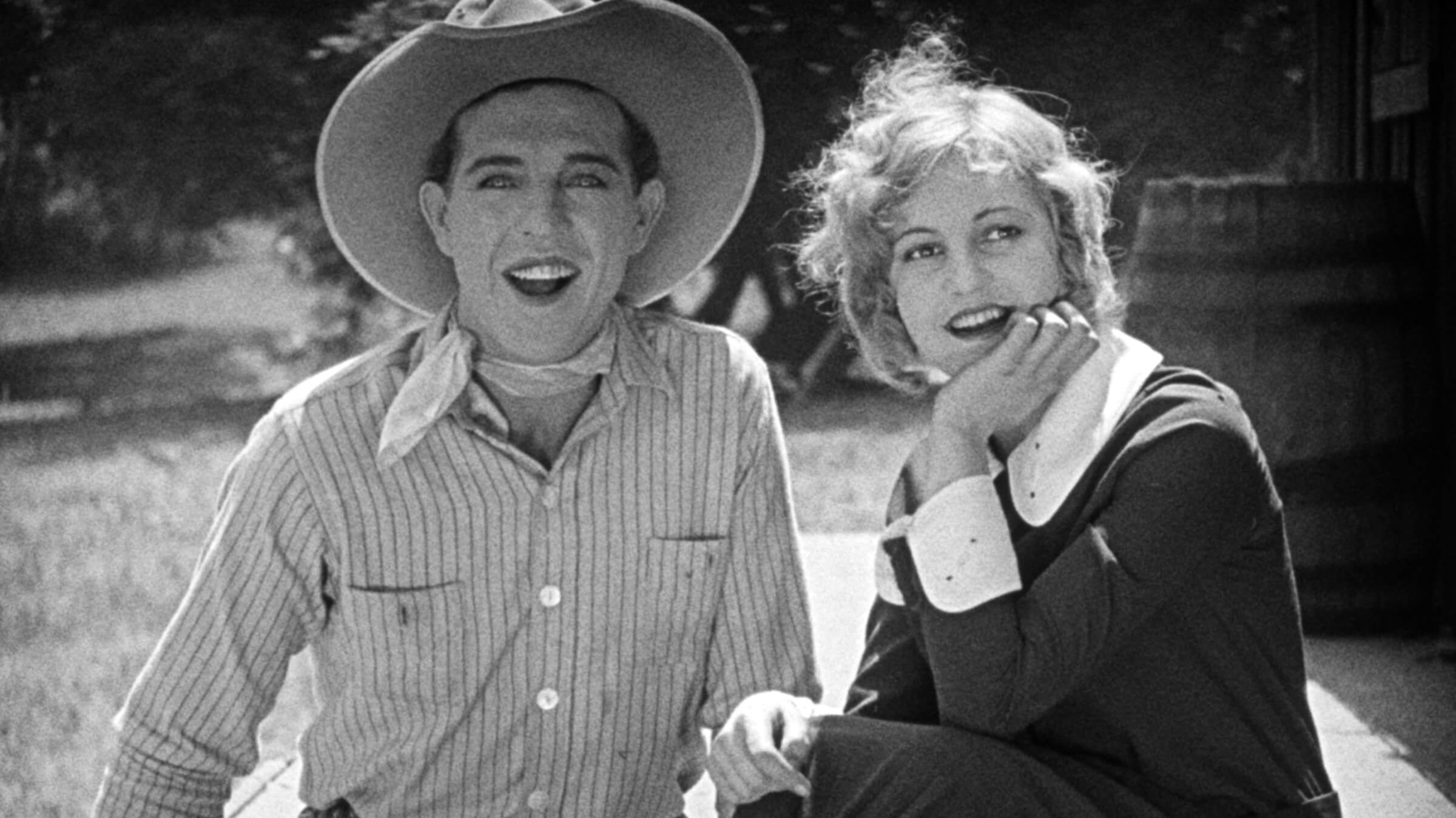
Like John Ford, William Wyler served his apprenticeship in low-budget westerns for Universal, although a few years later. Both branched out ambitiously into other genres, but Ford kept returning to the western genre with which he became identified, while few think of Wyler as a western director. But Wyler’s many and varied films include The Westerner and The Big Country, as well as Universal’s first sound film, the 1929 Hell’s Heroes, a gritty remake of Peter B. Kyne’s novella The Three Godfathers that Ford filmed twice. The many silent westerns Wyler made before that, starting in 1925 when he was only twenty-two, remain mostly out of reach, but we are fortunate to have one of his early five-
reelers, Blazing Days, an amiable, unpretentious, and lively bread-and-butter comedy-drama from 1927.
While Blazing Days is not a startling predictor of its young director’s future eminence, it shows an already well-developed pictorial quality in this beautiful restoration (by Universal Pictures from a 35mm nitrate print provided by the UCLA Film and Television Archive) and a charmingly mischievous strain of humor not always evident in Wyler’s more prestigious films. The generous humanism that marks Wyler’s personality as a filmmaker in numerous genres shines through this formulaic “oater,” as Variety would dub the more routine examples of the western genre. Universal in the silent days catered largely to rural and neighborhood theaters whose clientele adored the fast-paced action and relatively simple characterization of B-westerns. Wyler did his best to make the stock characters in his westerns more realistic than strictly required and conscientiously kept the action flowing, mixing the elements adroitly, as he does in this fifty-minute programmer.
Before graduating to bigger films, Wyler learned his craft with these westerns that enabled him to experiment with infusing his sensibility into what he called “very elementary stories … There was very little time for plots or characterization or anything like that.” But Fay Wray, who starred in one of his two-reelers, remembered his unusual willingness to pause the action for character and take the time to work with her on an emotional scene. As she told Wyler biographer Jan Herman, “All of this had a quality that was richer and more thoughtful than anything you found in those films… But this had a mood and a moment… I appreciated him for the values he was trying to achieve… It made me understand why he became one of the greats. There was a tenderness beneath his exterior.”
Wyler’s star in Blazing Days is Fred Humes, a baby-faced cowboy who mainly excels in his spectacular riding ability and nevertheless radiates a certain wholesome charm. Humes, a Pennsylvania native, was a former cowpuncher on Western ranches who turned to movies, like many other veterans of the actual West after the frontier had closed and modernization set in. The delightful 1975 book The Hollywood Posse: The Story of a Gallant Band of Horsemen Who Made Movie History by Diana Serra Cary (better known as child star “Baby Peggy”) tells the story of many of these colorful characters who wound up hanging around on Gower Gulch, getting jobs riding horses and performing stunts as well as occasionally graduating into starring roles.
The authenticity that those men, still famous or forgotten, brought to the genre became a major part of its audience appeal. Although Humes never became a star on the level of Tom Mix or John Wayne, he had a good run as leading man in twenty-one silent features playing a modest chap with impressive saddle skills. As Wyler recalled, for actors in these actioners, “the main thing was how well you rode and how good you looked on a horse. That was the first qualification, not how much or how well you acted. Of course, acting was a consideration, but the riding was the most important thing.”
Blazing Days was filmed as Smiling Sam, the nickname of Humes’s easygoing character whose fondness for horses is matched by a mysterious and amusing antipathy toward sheep (I can relate because I’m allergic to sheep). Sam Perry rivals his leading lady in the amount of makeup he’s wearing in the early scenes (often thought necessitated by the film stock of the day) but looks more mature and handsome when the goo gets rubbed off during the later action. Sam is introduced playing a guitar in this silent film to amuse himself and a couple of little kids, and his sincerity and relaxed warmth help explain how he is fooled by a corrupt scheme that turns him against the ingénue, Milly Morgan. She is played by Ena Gregory, a teenaged Australian émigré with a background in comedy shorts and westerns with Hoot Gibson and Jack Hoxie.
The plot mechanics in Blazing Days by screenwriters Robert Hill and George Plympton, from a story by Florence Ryerson, involve Milly’s sickly brother, Jim (Churchill Ross), and Sam’s crooked rival, Dude Dutton (Bruce Gordon). Jim is a sympathetic but pliable figure (the West was a haven for what were called “lungers,” or recuperating tuberculosis victims); Jim needs money and is suspected by Sam of being Dude’s accomplice. The sign that Sam, after helping establish justice, has become “sivilized” (as Mark Twain would put it) is that he tolerates living with sheep as well as Milly, including a little lamb that trots after them in the finale.
If you detect some tongue-in-cheek qualities to these shenanigans, Wyler would probably nod his head in shared amusement. What also keeps our interest are the lush landscapes expertly photographed by Al Jones around Lone Pine; the exuberant filming of equestrian exploits (including stunts by Cliff Lyons, a future stunt coordinator for Ford); and the conflict within Sam about whether or not Milly deserves his trust and affection. Perhaps the title was changed to Blazing Days because the picture was made in such hot weather that the camera had to be wrapped in ice to keep the film stock from melting.
Naturally for a formula western, the situation turns out best for the couple and her brother after Sam helps clean up the town with the improbable but entertaining help of an older woman who owns the saloons and is fed up with the town’s rowdiness, Ma Bascomb (the formidable Eva Thatcher). Like many low-budget westerns, Blazing Days is a frugal amalgam of frontier tropes set in modern America, which enables it to comment humorously on Prohibition as well as on the taming of the Wild West.
This potpourri of disparate elements shines brightly in the already capable hands of the young director who came from Europe to take menial jobs and work his way through the ranks of assistant directing for his uncle Carl Laemmle’s studio. Having fun with the way some critics unfairly tended to consider him a personality- deficient non-auteur, Wyler liked to joke that he was one of the few Hollywood directors who could pronounce the word auteur correctly, since he was born in Alsace, which was then part of Germany but now is part of France.
Wyler’s modest, hardworking, unpretentious approach to his early work in this quintessentially American genre served him well and enabled him to show what the studio felt was “more pep in his stuff than the other directors.” His ability to infuse a humble genre piece such as Blazing Days with humane and humorous qualities in the midst of the requisite action points the way toward the way he chose to excel in Hollywood, as a director who did not go out of his way to impose a flamboyantly overt “personality” on disparate projects but worked from the inside out to find qualities within each story that engaged his considerable range of skills and sensibility.
Presented at SFSFF 2026 with live musical accompaniment by Wayne Barker