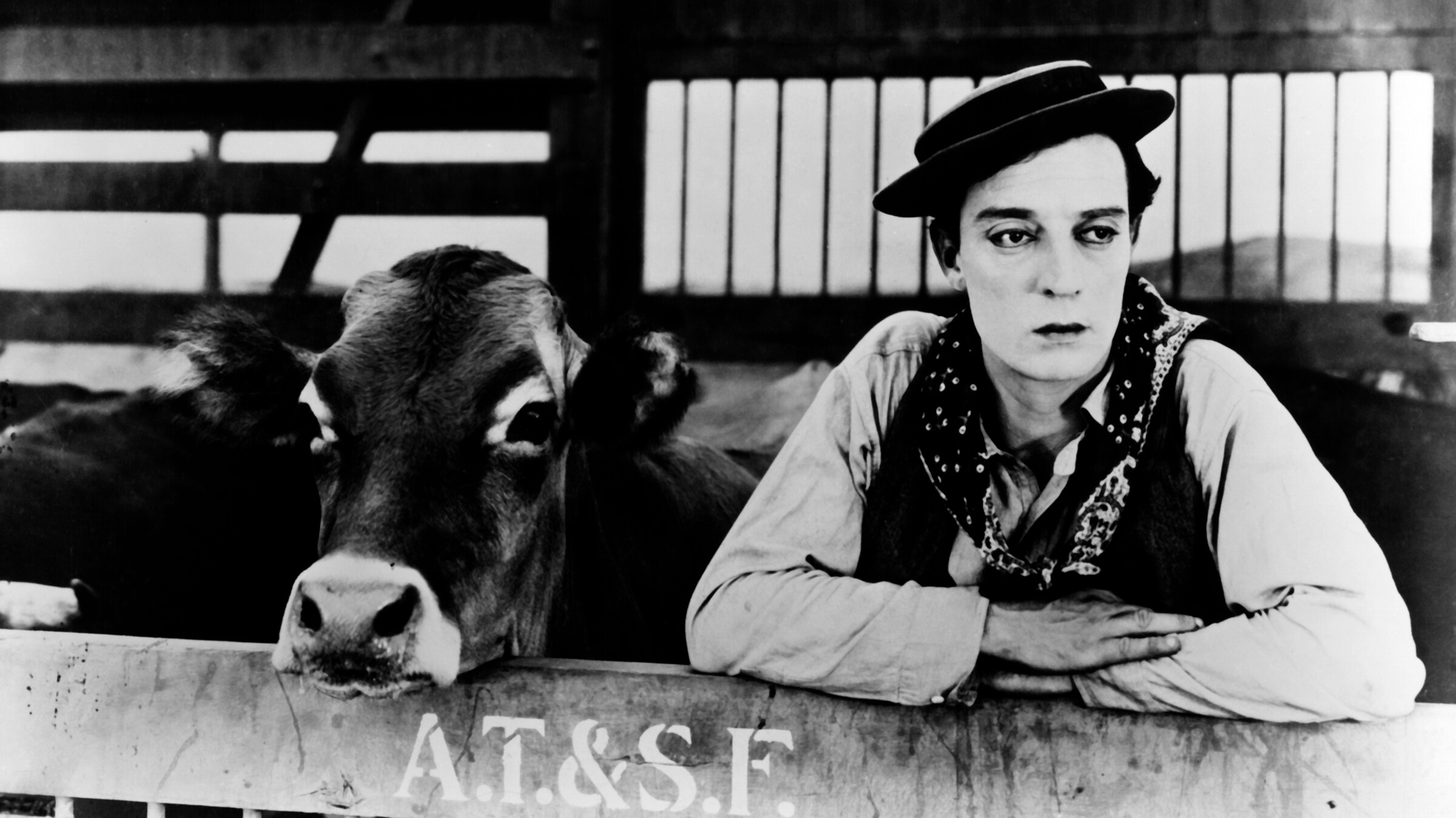
Go West is unique in Buster Keaton’s work, not only because of his most unusual “heroine,” a comely Jersey cow named Brown Eyes. It also is the only film in which “The Great Stoneface” combined comedy and pathos in a manner similar to Chaplin’s trademark approach in films such as The Gold Rush (1925). At once sentimental and a clever parody of sentimentality, Go West contains fewer gags and more dramatic scenes than Keaton’s other films, and is unquestionably his most romantic comedy.
Keaton had a great affinity for animals, and in Brown Eyes he found both an affectionate and obedient scene partner that he trained himself in a matter of days. He started working with her by using a little rope around her neck, walking her everywhere and feeding her treats. This helped him to build trust with the cow and allowed him to befriend her. By the time Keaton started filming, he no longer needed the rope and instead tied black sewing thread, undetectable to the camera, around her neck and the other end to his little finger. Everywhere he went she stayed right with him and never broke the thread. Brown Eyes became his constant companion on the set and oftentimes off as well. “I never had a more affectionate pet or a more obedient one,” Keaton remembered of Brown Eyes in his autobiography.
Keaton made Go West partly on location at George “Tap” Duncan’s Diamond Bar Ranch, about fifty miles north of Kingman, Arizona. Keaton and his crew stayed at the ranch for several weeks in the summer of 1925. (Brown Eyes as well as the mule seen in the film arrived by truck accompanied by two wranglers and a veterinarian.) The desert locale was so blisteringly hot that the crew had to pack ice around the cameras to prevent the film’s emulsion from melting. However, the desert heat did not give them as much of a problem as when Brown Eyes herself went into heat! She became disobedient, and Keaton and the crew had to wait two weeks until she recovered from her concupiscent condition.
The film begins with a wry opening title: “Some people travel through life making friends where ever they go, while others—Just travel through life.” Keaton plays a lonely drifter named Friendless (Keaton appropriated the names “Friendless” and “Brown Eyes” from characters in D.W. Griffith’s 1916 epic Intolerance). The opening sequence, in which Friendless sells all his possessions to a general store for $1.65, only to have to buy back most of it when he realizes he forgot to withhold personal items such as a photograph of his mother, wonderfully establishes his character and the droll, sentimental tone to the film. With his remaining coins, Friendless buys a loaf of bread and a sausage. He rides the boxcars, first journeying to New York City but soon following the advice popularized by journalist and political leader Horace Greely to “Go west, young man. Go west.”
Friendless arrives in Arizona, where he gets a job as a ranch hand. In a scene reminiscent of Bernard Shaw’s famous 1912 play Androcles and the Lion, Friendless sees the ostracized Brown Eyes limping and comes to her aid, removing a rock wedged in her hoof. As a result of this kind act, Friendless has now made his first, and only, friend. The ensuing pathos derives from these two unloved and inept characters finding each other. Keaton’s character is devoted to his only companion and does everything he can to keep his beloved cow from being sent to the slaughterhouse.
Keaton envisioned a magnificent visual climax to conclude Go West but, unfortunately, it did not work out according to plan. In order to save Brown Eyes at the end, Friendless unleashes a steer at the train depot, causing bovine chaos through Los Angeles as he drives the herd to the stockyard. Some of these scenes actually were photographed at a freight yard in downtown Los Angeles, where Keaton had three hundred head of steer on location. However, he actually shot much of the city sequence at his own Hollywood studio lot and the adjacent Metro Studios. What Keaton had intended, but could not create, was an actual stampede chase scene, as he led the cattle to the stockyard like the Pied Piper. Unable to rouse the herd with his white handkerchief, Friendless wanders into a costume shop looking for something red (like a matador’s cape) and instead finds a red devil’s suit. He assumes the red outfit will anger the steer, and they will run after him. But on set Keaton encountered one small problem. The steer refused to chase him. Instead, Keaton created a series of clever vignettes, including some of the bulls entering an actual china shop (Keaton’s wry sense of humor again), a dress shop, and even a Turkish bath. Cattle also wander into a barbershop, where a stray cow licks the shaving cream from a terrified customer’s lathered face (played by Keaton’s father, Joe). Keaton instructed the animal wranglers to push the animals as fast as they would go. He worried that the lack of a wild, concluding charge would hurt the film, as that was to be the big finish. Ultimately, Keaton’s cinematographers (Elgin Lessley and Bert Haines) relied on camera tricks from all angles—along with undercranking the cameras—to create the believable illusion of a stampede. Although the finished sequence remained somewhat of a disappointment to Keaton, Go West is exceptionally well made. Keaton—when he wanted or had to be—was a highly skilled film illusionist.
Working without his usual team of gag writers, Keaton engaged Lex Neal, an old friend from his childhood summers spent in Bluffton, Michigan, and Raymond Cannon to help build the comedy sequences. After the cattle chase, they decided to add a delightful coda to the ending. Friendless has singlehandedly delivered all the ranch owner’s cattle to the stockyard. In gratitude, the ranch owner tells him in an intertitle, “My home and anything I have is yours for the asking.” “I want her,” responds Friendless, pointing in the direction of the ranch owner’s pretty daughter (Kathleen Myers). Friendless then walks right past the young lady to his beloved Brown Eyes standing immediately behind her. The film ends with the rancher, his daughter, Friendless, and, of course, Brown Eyes, driving off together in the ranch owner’s car, with the happy couple—Friendless and Brown Eyes—side by side in the back seat.
Besides its most unusual romantic pairing of Keaton with a cow, Go West is memorable for its little moments. For example, when Friendless plays poker in the bunkhouse with a couple of cowboys, he points out that one player is cheating. The dishonest card player points a gun at him and demands, “When you say that—SMILE.” Buster, ever the stoic, is unable to smile, so instead he recreates the famous Lillian Gish gesture from D.W. Griffith’s 1919 drama Broken Blossoms of pushing the corners of his mouth up with two fingers.
Keaton believed that this scene would draw big laughs from audiences who would appreciate the threefold parody of his own character’s familiar deadpan expression, the reference to Lillian Gish in Broken Blossoms, and westerns in general (“When you say that—SMILE”—was a famous line from Owen Wister’s 1902 western novel The Virginian). But in previews, it did not get the reaction he had expected. Audiences just felt sorry for him. But Keaton liked the scene so much he kept it in the finished film anyway.
Go West succeeds as a character study more than as a typical Keaton gag comedy, yet contemporary reviews considered the film a lesser Keaton work when it premiered on October 25, 1925, at the Capitol Theatre in New York City. However, during the past twenty-five years, the film’s charms have become more appreciated. Although certainly not of the caliber of Keaton’s finest independently made feature films—Our Hospitality (1923), Sherlock Jr. (1924), The Navigator (1924), and The General (1926)—it retains a remarkable durability a full century after it opened. Go West will continue to be revived and enjoyed when most of Hollywood’s output from 1925 has been forgotten.
Presented at SFSFF 2025 with live musical accompaniment by Mont Alto Motion Picture Orchestra