
This feature was published in conjunction with the screening of High Treason at SFSFF 2026
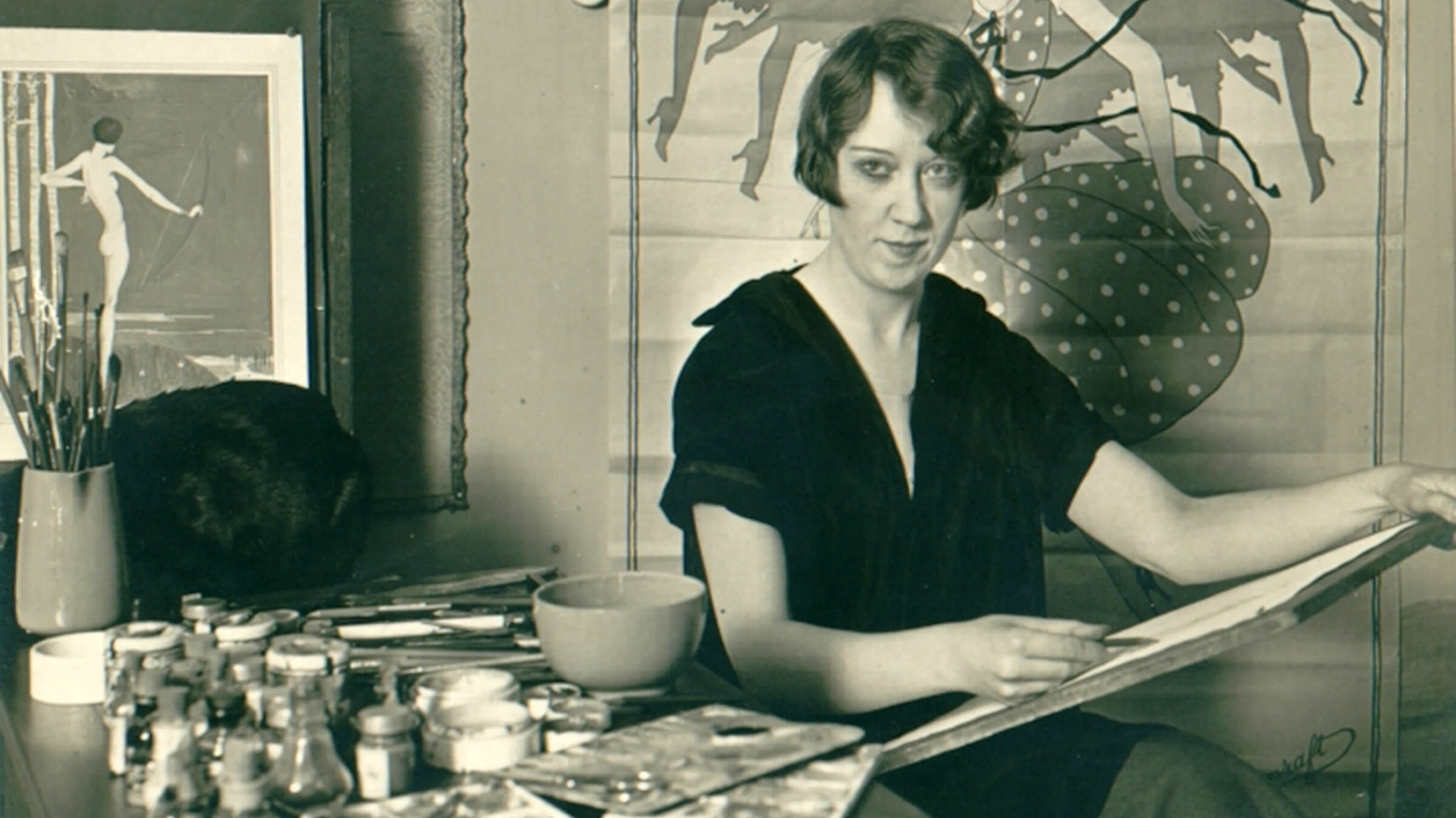
It was the dawn of a new era and Gordon Conway had arrived in time to represent. Illustrating for top fashion magazines in New York, London, and Milan, designing theater sets, window displays, and ad campaigns, dressing films stars and hundreds of extras, Conway drew from Art Nouveau, Japonisme, and Art Deco to make her mark on the Jazz Age aesthetic, all while sending a clear signal that modern woman was here to stay, if always in motion.
Born near Dallas to a family descended from both James Madison and Samuel Adams, Conway was touring Europe after graduating from a Swiss finishing school when a friend saw her sketching at a London dinner party and recommended her to Heyworth Campbell, art director for Condé Nast. When war broke out, Conway had to hustle back across the Atlantic but it meant she could meet with Campbell in New York. He was sufficiently impressed and her artwork began appearing in both Vogue and Vanity Fair in 1916.
By 1918 Conway was one of the so-called Seven Vanities, as Vanity Fair touted its leading women illustrators, starting off January with her first cover, which portrays a young redhead (like herself) in heels and a billowing black-and-green checked skirt doing semaphores in the snow with two flags adorned with a heart at their center. Her proposal for another cover, the Red Cross Girl, was not chosen but reproduced for a World War I charity auction instead.
Her advertising clients included Brentano’s bookstore and Ariel undergarments, Bobbs-Merrill and Neiman-Marcus. One commission, for the French car company Delage, led to her future husband, sales rep Blake Ozias (whom she married in 1920). She consulted on outfits for events and illustrated everything from school materials to war propaganda, some done in her soft chalky color palette, other in black silhouettes. She kept a running diary of her days, which biographer Raye Virginia Allen used to piece together her career, even those occasions she submitted designs for projects that came to naught, like a book jacket for Rafael Sabatini’s Scaramouche.
Conway also kept a kind of visual biography, drawing caricatures of an alter ego, a redhead named Zina, who was variously depicted swarmed by bees, dressed to the nines for a night out, or, once, perched in a little black dress with a knife discretely at her side lying in wait for a sexual predator. More than an enrichment of her fashion legacy, Zina is a window ajar on new pleasures and familiar perils of those times.
A perfectionist, and a tireless networker, she was well-connected in New York and began designing posters and billboard art, costumes and sets for theatrical productions and cabarets. At rehearsals for 1918’s Oh, Lady! Lady!, with music by Jerome Kern and book by P.G. Wodehouse and Guy Bolton, Conway could be found in the Princess Theatre sketching performers for the show’s poster and playbill.
She (and her mother, Tommie) also trekked over to Famous Players to try out as an extra and ended up appearing in the background four films, including Émile Chautard’s Her Final Reckoning that starred Pauline Frederick, and Paying the Piper, directed by George Fitzmaurice and starring Dorothy Dickson, a lifelong friend. But what Conway really longed for was a steady gig designing for the movies—something she finally achieved in London where Allen says, “she ran the first autonomous wardrobe department in British film history.”
When she and her hubby decamped to Europe, they kept apartments in Paris and London, though the marriage didn’t last past 1927. She never stopped working, drawing for Tatler, Eve, and La Donna and dressing cabarets like Midnight Follies at Paris’s Club Daunou. For a London André Charlot revue, she put Beatrice Lillie in a circular skirt for more picturesque pratfalls while singing on roller skates. At one production meeting, Conway took note of who was in room: “nine men and me.”
She got a call to dress Czech movie star Anny Ondra, in England to shoot Graham Cutts’s God’s Clay, taking her shopping and supervising her fittings. The first film Conway dressed entirely was another Cutts picture, 1927’s Confetti, for which, according to Allen, she also bought props and helped cast extras in the Carnival scenes. For Cutts’s Return of the Rat, she decorated the dancers’ skin with bold arabesques.
Just as in New York, she moved easily in London’s entertainment world. She lived in Marylebone in the same building as Wallis Simpson and at the same time the fellow American began her affairs with the Prince of Wales and Joachim von Ribbentrop—though Conway never wrote of her neighbor in her diaries, or of the Nazi ambassador’s daily deliveries of seventeen carnations to the sixth floor.
From 1931 to 1933, Conway was exclusive to Gaumont-British and she knew the terrain: “Light blue and a weird yellow produce a better white on the screen than white itself.” She committed to the story “not to the whims and fancies of the star.” In 1933 alone she dressed seventeen movies, but she often toiled in the shadow of art directors who got the credit. You can see her costumes not only in High Treason but in later popular talkies like Rome Express and I Was a Spy.
While other studios had dozens of workers in wardrobe (granted, usually for far more projects), Conway made due with a handful of assistants. The work took a toll (as did caring for her high-maintenance mother); she’d already had a heart attack, in 1929. In 1934 she dressed her last film and by early 1936 had returned to New York. But, at forty-two, her hustle was greatly diminished. In 1937 she inherited her family’s Mount Sion estate in Virginia and embarked on another sort of production design, restoring the house and protecting the surrounding timberlands from development until her death in 1956.