A band of evil arms-dealers plot to blow up the Channel Tunnel and bomb tall buildings in New York, driving two great superpowers to the brink of war. Will London’s Peace League be able to save the world?
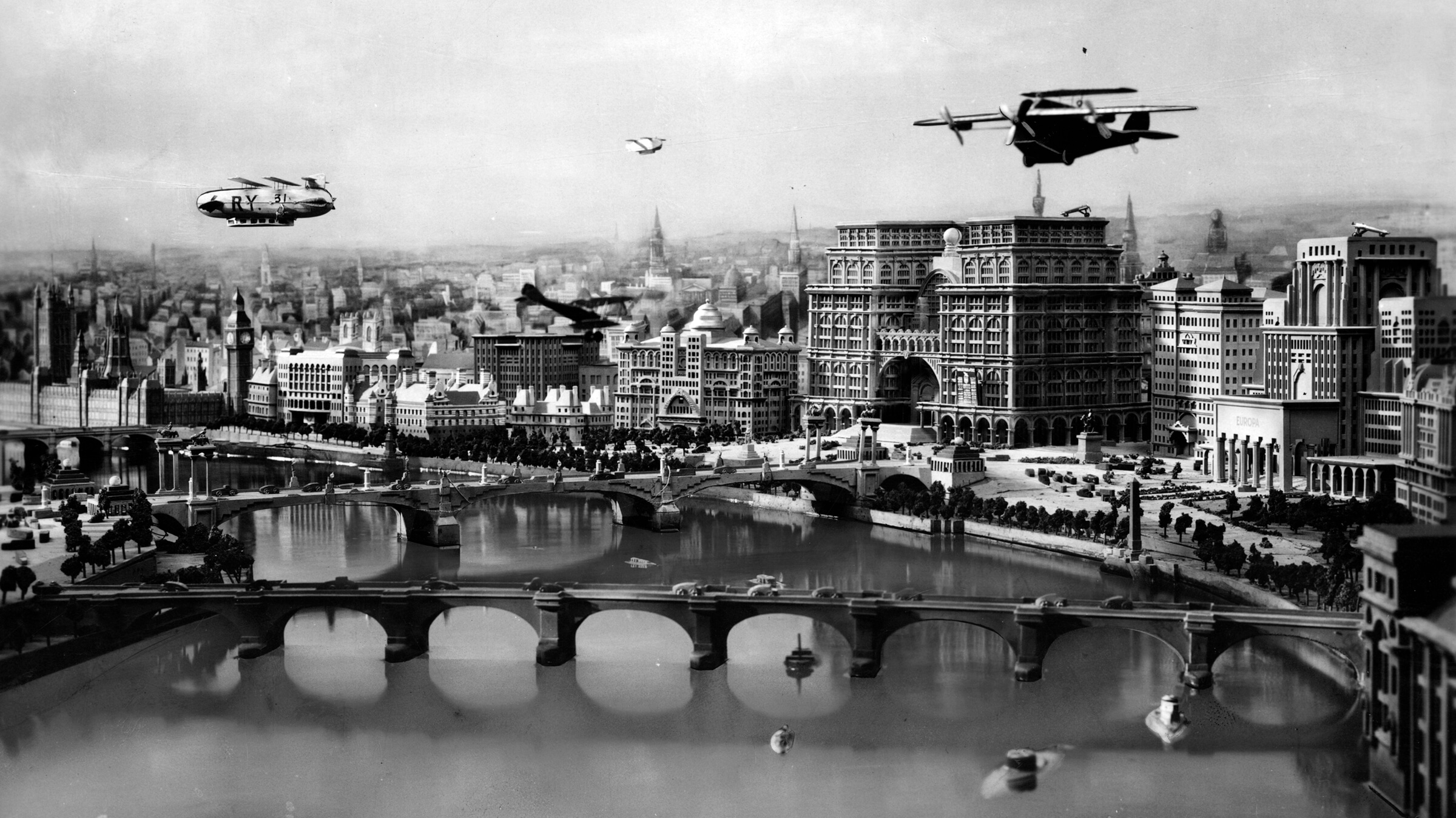
High Treason is set in the London of the future. The city’s skyline, in high Art Deco style, as designed by art director Andrew Mazzei, is strongly reminiscent of 1927’s Metropolis, with great skyscrapers, airships, and bullet trains on elevated railways; although there the similarity ends. Geoff Brown, in his 2024 book Silent to Sound: British Cinema in Transition quotes Elvey’s scriptwriter L’Estrange Fawcett as saying, “No self-respecting film man, can afford to neglect the scenic lessons taught by such a picture as Metropolis.” Based on a play by the eccentric independent British politician and inventor, Noel Pemberton-Billing, the film’s futuristic setting allows for a part playful, part philosophical debate on war versus peace, patriotism and gender equality, all preoccupations of the interwar years.
The opening title places us in 1950 (1940 in the sound version of the film) on “A continental frontier between Europe and the Atlantic States” and a minor border incident that sets two great international power blocs against each other. Britain is part of the United States of Europe, which seems to incorporate Africa, India, and Australasia, while the Empire of the Atlantic States groups together the Americas, Japan, and China. In this proto- Orwellian society, governments communicate directly to the populace via huge TV screens and speakers, and the political leaders can mobilize aerial warfare, with male and female conscripts ready to scramble, at a moment’s notice.
The futuristic technology has a lighter side, with a distinct air of luxury in the London home of Dr. Seymour, head of the Peace League, whose daughter Evelyn (played by the delightful Benita Hume, the future Mrs. Ronald Colman) makes a date with her boyfriend Michael Deane (Jameson Thomas), over a video phone. As she prepares to go out dancing, an entirely gratuitous dressing scene demonstrates the latest in shower technology that both washes and dries, and we see her dress in silver lamé, so indicative of progressive future in the 1920s. The gorgeous costumes were designed by American illustrator and couturier, Gordon Conway (she is a she), to indicate the practicality of female garments in an age of gender equality—a very stylish combination of skirts with knee breeches, which look good on the dance floor, doing the Hesitation One-Step to an automaton orchestra.
The plot turns more serious as we encounter a secret group of arms dealers who are plotting to increase sales by sparking off conflict between the two superpowers. The horrific consequences of an explosive device blowing up a train in the Channel Tunnel and the aerial bombing of New York are powerfully rendered by director Maurice Elvey. The possibility of all-out war divides the pacifist Evelyn from her lover Michael, head of the air corps, and a male/female stand-off ensues, as Evelyn’s father makes a drastic intervention to maintain peace. A young, uncredited Raymond Massey is part of the council debating for peace or war—you can see how this might have led to his being cast in authoritative roles in Things to Come (1936) and A Matter of Life and Death (1946).
Aside from its sci-fi design, High Treason’s prescience is its notable feature, and although these largely belong to the film adaptation rather than the original play, they strangely echo Pemberton- Billing’s imagination and inventiveness, which were as interesting as his politics were repugnant. He was a pioneer aviator and invented many ingenious devices in aviation, audio, and one of the most beautiful 35mm miniature cameras ever made—the LeCoultre Compass Camera—which can still sell for thousands. He was also a far-right independent MP, conspiracy theorist, and homophobe who claimed that there was a German-led campaign to degenerate the British establishment through homosexual encounters that would lead to blackmail, the details of which were contained in a Black Book. He ran a weekly paper called The Vigilante (the title specifically referencing the San Francisco Committee of Vigilance). His article of 1918, “The Cult of the Clitoris” (!), accusing erotic dancer Maud Allan, then touring with Salomé, of being a lesbian member of this conspiracy, led to a sensational libel case, for which he defended himself won. More relevant to High Treason were his beliefs in equal voting rights for men and women and in the future primacy of air power in warfare.
Despite the strange parentage of the play, the film adaptation limited any conspiracies to the perhaps-more-palatable evil international arms dealers, while retaining the prescient concern with aerial warfare as an ever increasing worldwide threat that might require a worldwide solution. The visualization of the Channel Tunnel sixty-five years before it actually opened is remarkable. The threat of terrorism there, and the bombing of skyscrapers in New York, is frankly eerie.
Critic James Agate, writing in The Tatler was full of praise for the director’s adaptation: “It was Mr. Elvey’s business to turn nonsense into film sense and he has succeeded splendidly.” He was less enthusiastic about the film’s sound work. “Since not one word of wit or wisdom escaped any of the characters, the fact that this film is a talkie is enormously against it”; and he attributes his dissatisfaction to “the absence of what used to be such a great delight at this house, to wit the orchestra.” Agate would probably have been more entertained by the silent version, which is more elegant. Few people, except those in houses still not wired for sound in 1929, would have seen the silent version which, like Blackmail, was made simultaneous to the sound version.
The film was a success in the U.K. and sold internationally to at least thirty countries and their territories. The American release handled by Tiffany was only ever the talkie version as most cinemas were already converted. Several censors objected to aspects of the film and it was banned in several major American cities, to which Tiffany’s publicists responded, “so frankly and sensational that it has been barred from exhibition in many states.” Further research may reveal their specific objections: was it the depiction of death from the air? It’s ironic to think that between the 1940 setting of the sound version and the 1950 setting of the silent version that proposition became so much more deadly.
Maurice Elvey, Britain’s most prolific director, had been beaten to first place in the race to produce Britain’s first all-talkie picture by Hitchcock’s Blackmail, but he tried to make up for it with this slightly crazy science-fiction film with a strong aesthetic presence that has captivated audiences ever since.
Presented at SFSFF 2026 with live musical accompaniment by Stephen Horne and Frank Bockius