
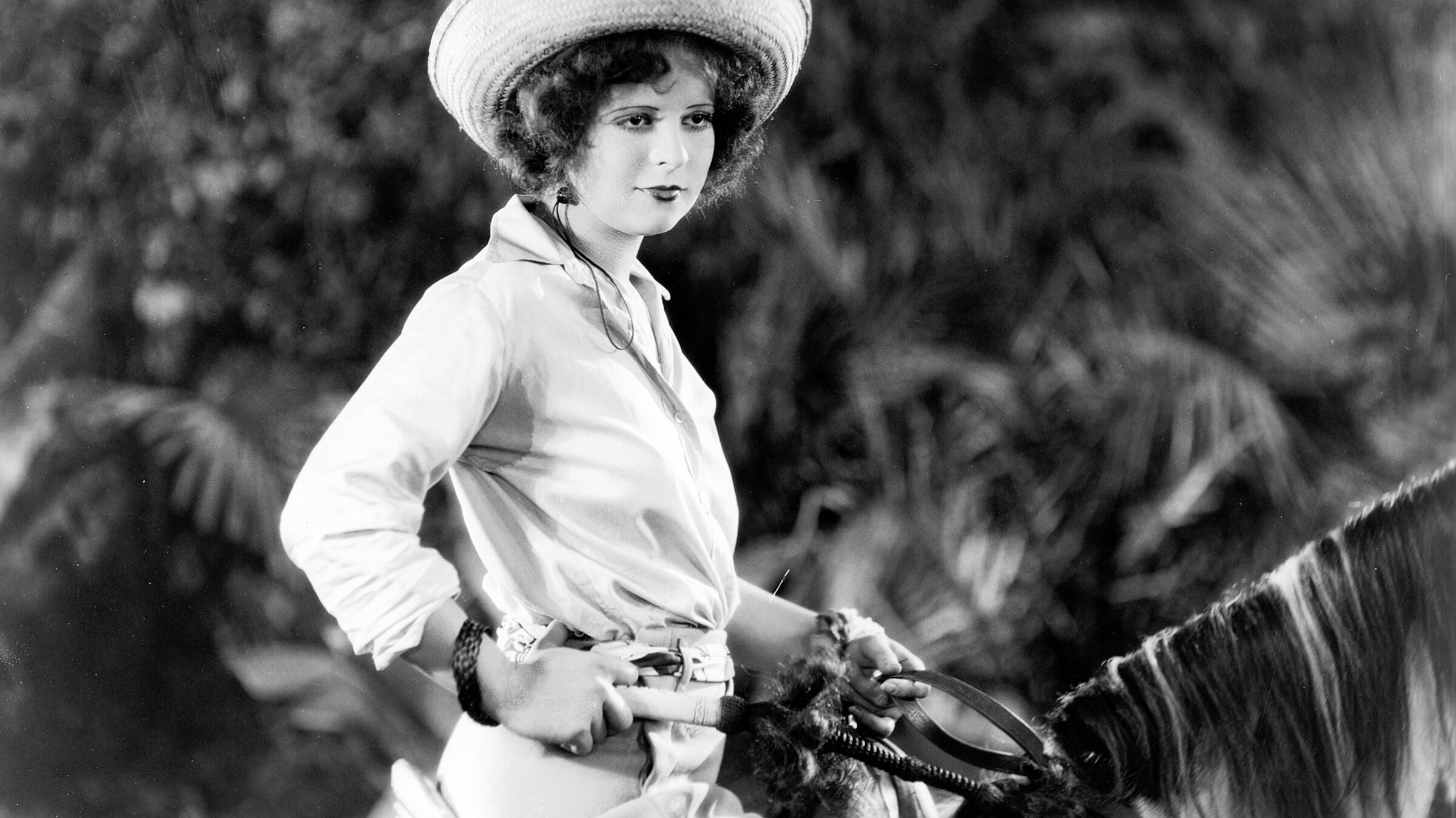
In 1927, Paramount Pictures reteamed Clara Bow, who had just been dubbed Hollywood’s first “It Girl,” with Paramount’s “just doesn’t miss” director, Victor Fleming, in Hula, the follow-up to their smash sex comedy Mantrap (1926). The duo managed to brew the same erotic white lightning they had bottled the year before. In a matter of months, the director and star, as well as being an on-and-off-again romantic item in gossip columns and fan magazines, had acquired enough luster to put a shine on any property, including one about a farmer’s daughter. In this case, she’s a Hawaiian plantation owner’s daughter, Hula Calhoun, who reaches full bloom when a handsome British engineer, Haldane (Clive Brook), arrives on the scene to supervise a lucrative irrigation project.
In his unpublished notes on Fleming, Kevin Brownlow rightly relegates this movie to the category of silent- star vehicles that resemble personality-based TV of the broadcast-network era, as if the string of movies making up “The Clara Bow Show” were a racier precursor to That Girl and The Mary Tyler Moore Show. Still, the movie has a flighty charm that suits Bow’s reckless abandon. It’s fast and fizzy entertainment.
Paramount’s executives had relentlessly promoted Bow’s box-office magnetism (putting her into eleven Paramount Pictures in 1926 and 1927, including the archetypal It and the Oscar-winning Wings). They also understood her irrepressible sensuality and popular appeal. A century ago, movies remained culturally adjacent to the vaudeville stage and the burlesque house. When Hula played at B.F. Keith’s Prospect Theater in Brooklyn, not far from Bow’s birthplace in Prospect Heights, those folded-page handouts known as “movie heralds” proclaimed, on one side, “Imagine! Clara Bow as Hula,” and, on the flip side, “Wagner Brothers Big Side Show and Their Congress of Living Freaks,” including (among many others) “Half Man and Half Woman” and “the King of the Albinos,” all also appearing at the Prospect. In those days, in that climate, studios fostered a one-on-one identification between performers and their big-screen personae: Clara Bow was “the It Girl” as much as “Orletta” of the Congress of Living Freaks was “the Bearded Lady.”
The exhibitors’ handbook for Hula highlighted “My Favorite Role, by Clara Bow,” in which she (or her publicist) declares that she read Armine Von Tempski’s (tedious) source novel “at one sitting” then “begged” Paramount production chief B.P. Schulberg “to let me have it … [Hula] would be one of my best simply because I thoroughly understood and loved the character.” As the handbook’s copywriter puts it, Hula is “happy, dashing, care-free, heartbreaking Clara dancing through life with a grass skirt”—selling Bow, and the film, a bit short. In one scene she does strip off her Western clothes, don a grass skirt and a Hawaiian bandeau, and do her charming, primitive version of a hula, which drives males wild with desire and females mad with envy. Far more often, though, Bow dresses in riding clothes and enters or exits on a horse. And rather than simply repeat herself, she pulls off a variation on a theme. In Mantrap she is a manicurist-cum-flapper bringing anarchic big-city appetites to the Canadian wilderness; in It she is a free-spirited shopgirl who entrances the department store’s owner, proving the power of the amorous charisma called “It” as a democratic force.
In the title role of Hula she’s a child of nature. Raised under the wings of a half-Hawaiian, half-Caucasian plantation manager, Kahana (Agostino Borgato), Hula embodies honest cowgirl values. She disdains both the Calhouns’ cozy hedonism and the rigid propriety of her true love, Haldane, who won’t stray from his marital vows despite being caught in a loveless marriage.
“Remember Mantrap? Recall The Rough Riders? Have you seen Emil Jannings in The Way of All Flesh? This is considered one of the greatest pictures ever turned out by Paramount. Victor Fleming again.” Apparently, Paramount had to remind exhibitors what Fleming had done even as he was emerging as a major American director. Fleming’s versatility and invisible craftsmanship may have held him back as a celebrity, but as a filmmaker he always gave his all. “We worked down on the Lucky Baldwin place,” said Hula’s assistant director Henry Hathaway, “now the Los Angeles County Arboretum in Arcadia. Beautiful location. That big old wooden house there and the lake around it, palm trees. We used the Queen Anne cottage [it also appeared in the TV show Fantasy Island] for one of those plantation-type wooden houses.” Fleming taught Hathaway that “it’s better to have one tree in a cross [light] or back light than a forest in flat light.”
A tropical wilderness movie, Hula is lush and lively, but with less satiric edge and more florid romance than Mantrap. For Bow (and for her fans), it takes a giant step into the primal. This heroine doesn’t grow out of the urban erotic renewal of jazz babies and “sheiks.” Fleming presents Hula’s rampaging pheromones and unabashed physicality as characteristics of any healthy, red-blooded girl coming of age in Hawaii, a state of nature if not yet a U.S. state. Hula’s dad and the planter elite spend their time partying and gambling. They must be “gentlemen farmers,” but we don’t see any farming and there isn’t a gentleman among them. Fleming pans around this gluttonous, inebriated crowd just as drolly as he did around the teetotalers in Mantrap. One of them, Harry Dehan (Arnold Kent), thinks he’s the man for Hula—until he sees her making googly eyes at Haldane, turned out in elegant evening clothes. The book, though not the film, describes Dehan as “half-white,” positioning him as the negative counterpart to heroic Kahana (called “Uncle Edwin” in the novel).
The movie casts Italian actors in these roles—Borgato as Kahana, and Kent, whose original name was Lido Manetti, as Dehan. Fleming does bequeath a bit part to the Hawaiian Olympic swimming champ Duke Kahanamoku, who plays a tiny but crucial role in Hula’s plan to snag Haldane.
The movie ridicules the notion that “going native” is a bad thing. By the end, Haldane gets the message that native is better. What’s memorable about the film are precisely the scenes that made it disreputable: her rump-first meet-cute with Haldane in his room, where she’s gone to fetch her antic dog from under Haldane’s bed; her hula (more of a soft-shoe improv than authentic Hawaiian hip wriggling), which she does at a wingding of a luau; and Hula’s opening skinny-dip, where she flicks at a flower with her toes only to have a bee sting her on her thigh. (Yes, silent film lip-readers, the legend is true: you can distinctly see her mouth form the words “Oh, fuck!”)
These frenetic episodes build to the quiet moment when she visits Haldane in the shack he has set up next to his dam site and puts her toothbrush next to his. Never has the urge to “shack up” been so economically expressed. Fleming’s affection for his star—and her sensitivity to it—keep the film light and limber. It’s a cinematic love letter written in the eyes and torso of the respondent. The whole affair would collapse if there were anything coy about it, but Fleming doesn’t exploit his lover; he leads her to an irresistible performance. Her boldness is unconstrained. Near the beginning, she rides her horse into her dining room; near the end, she admits that she set off dynamite to bag her man. Her movements have a speedy grace, whether she’s showing off her bee-stung thigh or fingering the cleft in Haldane’s chin or miming concern for the shaving nick she notices on his neck. Brook later said, “For all the acting I did, they might as well have poured me out of a bottle.” But Brook is a perfect foil for Bow—if this bit of British sterling melts before her, no man would have a chance if she put her mind to it.
Fleming’s fleet, observant style always gives us something piquant to look at, such as the anatomy of dam construction caught in a single deep-focus shot, or Hula’s frisky, long-suffering canine, who flaunts his scruffy appeal whether he’s slurping from a human’s soup bowl or appearing to ask, with woebegone eyes, “What’s she doing to me now?” Fleming keeps the few out-and-out “action” scenes—a river rescue, a horse chase—swift and vivid. What counts is the overall atmosphere of action. We feel that Hula can make anything happen. And if the movie’s level of comic-romantic invention isn’t sky-high, it is robust and durable. When Hula asks Haldane to kiss her where she hurts, modern audiences may think of Indiana Jones asking Marion Ravenwood to kiss him where it doesn’t hurt. (Steven Spielberg is a longtime Fleming fan.)
According to screenwriter, novelist, and nonfiction writer Budd Schulberg, his dad, B.P., had a fallback plan: if Hula flopped, he would ballyhoo Alice White as a “blonde Clara Bow.” But Hula was boffo. And White ended up being remembered, in Lew Ayres’s phrase, as “a poor man’s Clara Bow.” William Kaplan, a Paramount propman, said Bow was just a conquest for Fleming on Mantrap, but by the time they made Hula, “Vic was fascinated with her. It was a very serious thing.” Over the long run, Fleming wasn’t “social” or maybe “showy” enough for Bow, and Bow was too much of a sexual gadabout for Fleming. A few years later, Bow mused that he was “too much older” and “gosh, he was too subtle.” But when Fleming and Bow clicked, their chemistry ignited the quality of “It” squared.
Presented at SFSFF 2026 with live musical accompaniment by Stephen Horne