Pre-World War II Polish cinema remains a largely unknown quantity for two reasons: the cruelty of history and the blinkered viewpoint of much 20th century film scholarship. Poland’s tragic decimation during World War II resulted in the loss of most of her cinema output—ninety-five percent of all Polish silent films are gone—as well as much of the documentation that would have at least allowed us the means to study what could no longer be seen. Then with the arrival of the Polish Film School movement in the late 1950s came a general dismissal of everything that went before, and subsequently most film historians, until very recently, simply wrote off the first four decades of film production, rarely bothering to delve into what remained of contemporary accounts to try to assess what had been a small but vibrant industry absorbing influences from Russia, Germany, Scandinavia, and the U.S. Things have begun to change, thanks in no small part to the excellent work being done at the National Film Archive in Warsaw. The delightful 1930 feature Janko the Musician is the best possible illustration of why Polish film from this era deserves reappraisal.
The source material comes from Nobel Prize winner Henryk Sienkiewicz, still remembered today internationally for the novel (and its many cinematic adaptations) Quo Vadis. In 1881, fourteen years before that blockbuster, he published the short story “Janko muzykant,” a slip of a tale immersed in late 19th-century notions of holy innocents and the sacredness of peasant life versus the apathetic entitlement of the landed gentry. In the story, Janko is an emaciated ten-year-old boy with a stomach distended from starvation (the opening line is “It came into the world frail, weak,” not even according him a gendered pronoun). His one source of comfort is music, and he steals a violin from the local nabob; he’s caught, flogged, and dies three days later, with his last words asking his not overly sympathetic mother if Jesus will give him a fiddle in heaven. Though the language is rich and full of attractive bucolic imagery in keeping with the Polish intelligentsia’s foregrounding of rural life as a rallying cry for independence, the story reads today as sentimental and pathetic. Scholars attribute the first English publication to an anonymous 1891 translation in The Strand Magazine, but I’ve discovered that an abridged version was distributed by the McClure Syndicate in late 1886–early 1887 as “Janko, the Musician,” with the authorship disingenuously given to a John Nitchie.
Fast forward to the late silent film period, and the studio Muza-Film assigned the material to noted novelist Ferdynand Goetel, who’d already deftly re-packaged Poland’s national epic Pan Tadeusz into a blockbuster film in 1928. Goetel dumped most of the religious imagery, significantly toned down the pathos and relegated the Sienkiewicz storyline to just the first twenty-five minutes of the movie, modernizing the tale so that little Janko doesn’t die but rather is sent to juvenile detention, from which he escapes as a young man and develops his musical abilities while falling in love with a glamorous singer. If you think it sounds a little Hollywood-ized, you’re not alone: critics of the time noted the way the film seemed to channel American productions with a mix of drama, comedy, and music.
Yes, music. Janko the Musician straddles the period between silent and sound, when the industry scrambled to keep up with the revolution by adding sound to films originally conceived as silent. In his memoir My Warsaw, the comic actor Kazimierz Krukowski recalled how the producers needed to round up the cast after the film was completed and bring them to Berlin to record the soundtrack, as there were no sound studios in Warsaw at the time. Krukowski and his fellow actor Adolf Dymsza were busy with theater engagements and couldn’t make the journey, so other performers dubbed their voices. “Fortunately, the recordings were, to put it mildly, so imprecise that the audience not only didn’t realize we were speaking with other people’s voices, but they didn’t understand a word at all.” In the end silent and sound versions were made to ensure that cinemas not yet equipped for the new technology could still present the latest releases (U.S. trade publications in the summer and autumn of 1930 claimed that Muza-Film was preparing Polish, German, English, and French sound versions, though it’s unclear if these were ever actually realized). Until very recently it was believed that only the silent version existed, in a Polish copy that miraculously survived the war (a nitrate print with Czech intertitles was also known). In 2020, however, sound discs were discovered in Italy, which include the original compositions by composers Grzegorz Fitelberg and Leon Schiller, with lyrics by Konrad Tom. For this screening the archive consulted with accompanist Guenter Buchwald on a silent-sound hybrid version.
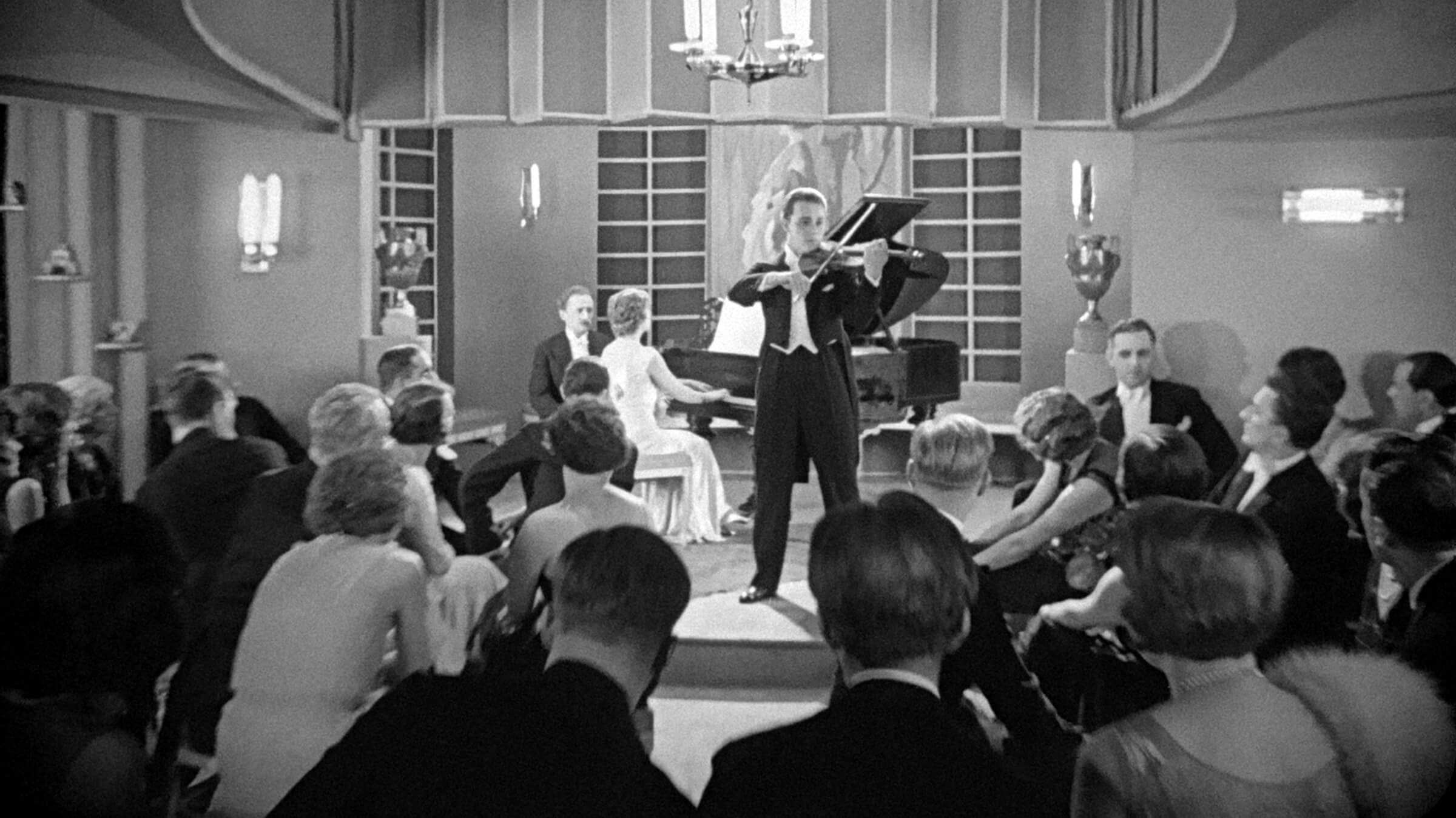
While it will be fascinating to hear the original recordings, no sound is needed to appreciate the film’s visual artistry: “It resonates with poetry,” wrote Leon Brun in his review for Kino magazine. Director Ryszard Ordyński and cinematographer Zbigniew Gniazdowski immediately capture the viewer’s attention with fluid, sophisticated camerawork that both draws us in and foregrounds the idyllic Polish landscape. Intrigued, we become completely hooked with the first shot of young Janko, played by the ethereally beautiful twelve-year-old Stefan Rogulski, whose on-screen career sadly only lasted until 1932. As a young man, Janko is played by actor-violinist Witold Conti. a newcomer, who rumor has it, was suggested for the role by his then-lover Leopold Brodziński, at one time Pola Negri’s secretary (it’s likely shortly after this that Conti began a relationship with composer Karol Szymanowski). Janko’s love interest in the film is played by stage star Maria Malicka, while comic relief is provided by the popular duo of Krukowski and Dymsza, whose performances were singled out for special praise in the press of the era.
It’s disturbing how quickly director Ryszard Ordyński has been forgotten, given his prominent role in the cultural life not just of Poland, but also of Germany and the U.S. He began as a theater critic before meeting Max Reinhardt in Berlin sometime around 1909, at which point he became the great impresario’s assistant before moving on to directing under Reinhardt’s tutelage. Soon after war was declared he sailed for New York and in late 1916 moved to Los Angeles where he was directing plays at Aline Barnsdall’s Little Theatre until their affair went sour and he returned to New York. It appears that the bisexual Ordyński met Theda Bara around this time through his putative lover, the set designer George James Hopkins (romantically linked to William Desmond Taylor!), and he not only wrote Bara’s film The Rose of Blood (1917) but also appeared as her costar. More notable was his work as stage director at the Metropolitan Opera, where he took charge of an astonishing number of operas that featured Enrico Caruso, Geraldine Farrar, John McCormack, Frieda Hempel, Giovanni Martinelli, Claudia Muzio, and Giuseppe De Luca (he was also the director when Rosa Ponselle made her debut, with Caruso and De Luca, in La forza del destino). Keen to contribute to the cultural revival of the nascent Polish state, Ordyński resigned from his post and returned to Warsaw in 1920; over the coming decades he shuttled back and forth between Europe and the U.S., becoming well-known for his Shakespeare productions as well as translations and stagings of plays by Eugene O’Neill, George Bernard Shaw, Booth Tarkington, Tennessee Williams, and others. As film director he made his debut in Poland in 1927 and, soon after Janko the Musician, was hired to direct Polish-language versions of Paramount titles in Paris. With the outbreak of World War II, he returned to the U.S. once again, and in 1941 Ernst Lubitsch hired him as technical advisor on To Be or Not to Be. In late 1946 Ordyński returned to Warsaw and theater directing; he died in 1953. A posthumous edition of his aptly titled 1939 memoir Z mojej włóczęgi (“My Vagabond Life”) was published in 1956; it has never been translated.
Sienkiewicz’s story subsequently became the source for a number of adaptations: as a short in 1949 (Skrzypki); a humorous piece of animation by Jan Lenica (Nowy Janko Muzykant) in 1960; and a 1992 TV movie (Janko Muzykant). Composer Witold Rudziński premiered his opera based on the tale in 1953, and a ballet with music by Vladimir Mikhailovich Yurovsky (a.k.a. Jurowski) was performed in 1961.
Presented at SFSFF 2025 with live musical accompaniment by Guenter Buchwald
The 2026 SFSFF Award for commitment to the preservation and presentation of silent cinema was presented to Elzbieta Wysocka of Filmoteka Narodowa at this screening