
Until recent years, the films Ernst Lubitsch directed in Germany have been little known in this country except for the post-World War I spectacles that made him prominent as an international director and led to Hollywood importing him in 1922. Even Lubitsch’s chief disciple, Billy Wilder, was under the impression that Lubitsch “didn’t do any comedies in Germany, he did great big expensive historical pictures.” But in the eight years following his directorial debut in 1914, Lubitsch experimented with a wide variety of genres, including both comedies and dramas as well as spectacles and so-called “Orientalist” melodramas. He even “invented the musical,” as the French critic Jean Douchet put it, with the uproarious “Foxtrot Epidemic” sequence in his surrealistic 1919 satire The Oyster Princess, the film with which Lubitsch felt he had discovered his style.
One of his most popular German films is also among his most obscure in the U.S., Kohlhiesel’s Daughters, a 1920 sex farce set in the Bavarian mountains and replete with hilarious low-comedy sight gags. In recent years, some of Lubitsch’s surviving German films have been released on home video here by Kino Lorber and other companies. But this delightful comedy has never been distributed theatrically in the U.S. or on home video, although it appeared on YouTube before this recent restoration. The reason Kohlhiesel’s Daughters was seen as unsuitable for export at the time of its release probably was partly due to the informal taboo on exhibiting German films in the U.S. in the aftermath of the Great War, which was finally broken in December 1920 by Lubitsch’s highly sexualized 1919 spectacle about the French Revolution starring Pola Negri, Madame DuBarry, retitled Passion in the U.S.
But the rustic humor of Kohlhiesel’s Daughters was also mistakenly considered too provincial to send abroad (Lubitsch himself called the film “typical German”), despite its casual derivation from Shakespeare’s The Taming of the Shrew by the writer-director and his favorite screenwriter in the silent period, Hanns Kräly. Lubitsch played comical supporting roles in Shakespeare productions for his theatrical mentor Max Reinhardt and paid heartfelt tribute to the Bard with To Be or Not to Be, his 1942 black comedy classic about a Polish theatrical company performing Hamlet and outwitting the Nazis. Lubitsch’s follow-up to Kohlhiesel’s Daughters in 1920 was another Shakespearean takeoff, Romeo and Juliet in the Snow, also set in Bavaria, where he liked to vacation and practice his favorite sport of mountaineering.
In Bluebeard’s Eighth Wife, playboy lady-killer Gary Cooper consults The Taming of the Shrew for advice on how to deal with his feisty new bride, Claudette Colbert. That uncharacteristic Lubitsch film is an especially nasty example of the screwball comedy genre, an outgrowth of the recently activated Production Code that caused filmmakers to substitute violence between the sexes for the forbidden pleasures of actual sex. Kohlhiesel’s Daughters has elements that anticipate screwball comedy, including plenty of roughhousing foreplay, but its humor is amiable and genuinely jolly. In what he considered one of “the three most outstanding comedies I made as a director in Germany” (the others were The Oyster Princess and The Doll), Lubitsch treats all his characters with his characteristic generosity along with this Jewish filmmaker’s identification with social outsiders.
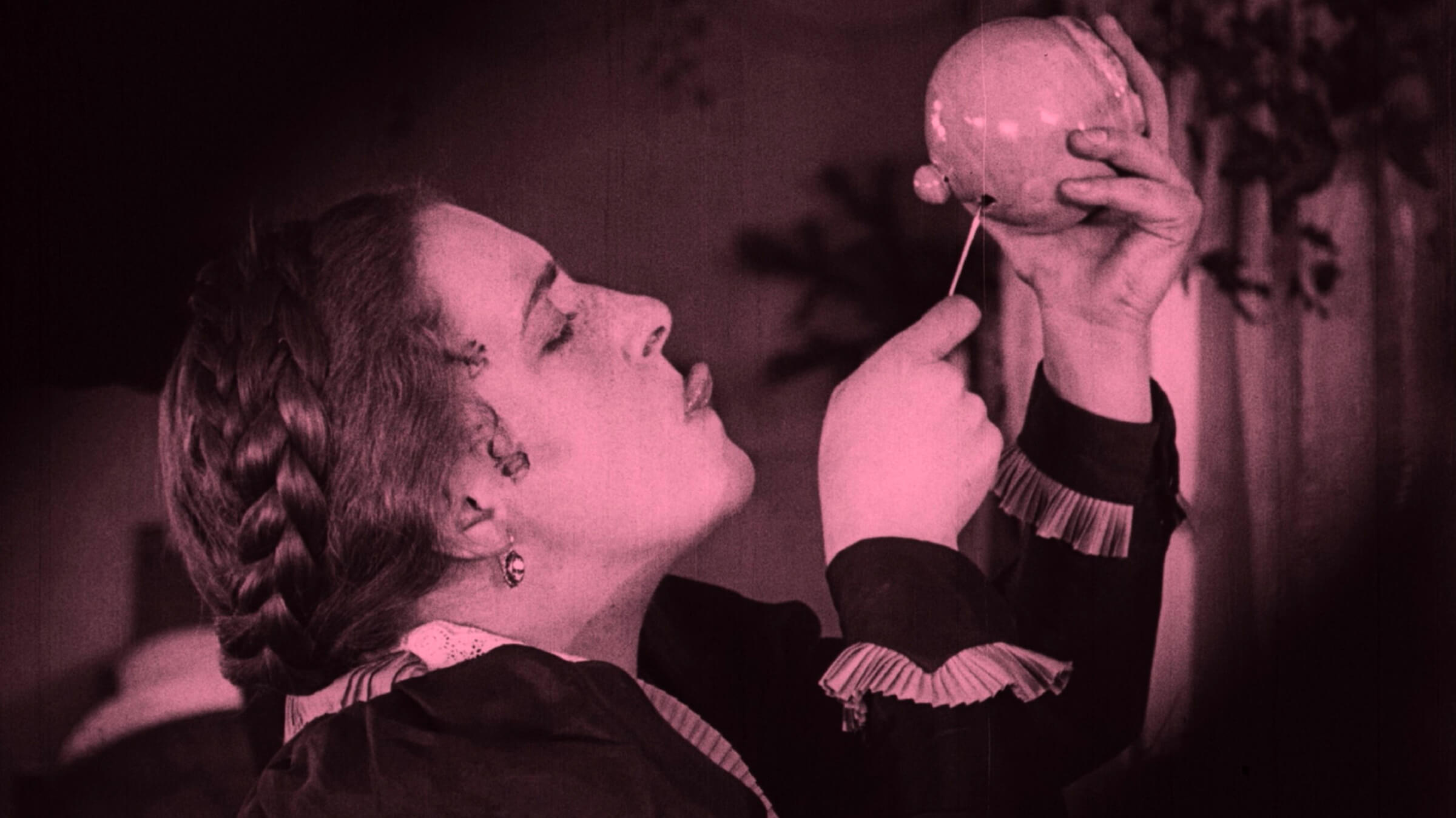
Germany’s leading star of its day and archetype of its womanly ideal, Henny Porten, pulls off a breathtaking tour de force as both pretty and homely sisters working as bartenders for their father in a mountain village and romancing the same man in turn. Porten’s versatility is shown in her utterly convincing portrayal of these wildly disparate sisters (shown together in double exposures by ace cinematographer Theodor Sparkuhl) as well as in her title role later that year in Anna Boleyn, the director’s starkly tragic film about an executed wife of England’s King Henry VIII. Porten later made a 1930 talkie version of Kohlhiesel’s Daughters, the first of four remakes, which include a 1979 sex film, Kohlpiesels Töchter. Porten tried to leave Germany during the Nazi regime with her Jewish husband but was blocked from emigrating and continued making films there during the war; her film career spanned from 1906 to 1955.
Her leading man in Kohlhiesel’s Daughters is Lubitsch favorite Emil Jannings in a surprisingly lighthearted turn as Xaver, the hearty peasant who pursues the sweet Gretel but gradually becomes enamored of the rebellious and foul-tempered Liesel. Best known today for his ponderous dramatic roles in Murnau’s The Last Laugh and Sternberg’s The Blue Angel, Jannings, who was Swiss, had also been a Reinhardt actor before appearing in several Lubitsch movies. His 1917 comical role in The Merry Jail is laborious, but he is deft in that year’s romantic comedy When Four Do the Same and later starred in operatic roles in The Eyes of the Mummy Ma, Madame DuBarry, Anna Boleyn, and The Wife of Pharaoh (a.k.a. The Loves of Pharaoh).
Jannings followed Lubitsch and other filmmakers to Hollywood and starred in the director’s 1928 film set in tsarist Russia, The Patriot, the only nominee for the best-picture Academy Award that is mostly lost. Jannings became the first winner of the Oscar as best actor for two other films in 1927–28, The Last Command and The Way of All Flesh. His reputation was blighted after he left Hollywood due to the coming of sound and became a mainstay of Nazi cinema as the officially designated “Artist of the State.” When Allied troops arrived at Jannings’s home in 1945, he pathetically came running out waving his Oscar in hopes of validation.
Audiences for the silent Kohlhiesel’s Daughters naturally gravitate less to the placid Gretel and more toward the rowdy and rebellious Liesel, who resents her life as a drudge in her father’s establishment and the disdainful way she is treated by men. Besides milking the cows and tending bar, she also serves as a bouncer, so the butch Liesel is more than handy at taking care of herself but goes through life with a perpetual sneer and barely restrained violence. Since the custom in this hidebound region is that the younger daughter can’t marry until the older one is taken care of, Xaver schemes to marry Liesel only so he can divorce her and turn back to the traditionally matronly Gretel.
But the two rowdy characters discover a mutual affinity when an argument over Xaver’s dislike of Liesel’s cooking turns into a furniture-hurling tantrum. Lubitsch’s fondness for comical and suggestive elliptical doorway shots is put to good use as we watch from the hallway as the contents of the room fly out while Liesel tries to find a refuge. Porten recalled the scene as full of spontaneous improvisation on Jannings’s part. When she “wasn’t able to sit for days” afterward, the actor came to her “terribly upset,” saying, “Heavenly woman, can you forgive me?” Liesel nevertheless is charmed to find someone as uncouth and bluntly emotional as herself. In an echo of Ossi Oswalda’s habit of orgasmically smashing rooms in The Oyster Princess, this stormy expression of pent-up erotic energies clears the air for true romance, while Gretel finds a more fitting partner in a fawning admirer (Gustav von Wangenheim) hanging around for his opportunity.
Porten recalled that after Lubitsch told her what he wanted from her dual role, “I locked myself in my dressing room, and Liesel Kohlhiesel was formed. When I opened the door and entered the studio, Lubitsch stared at me with wide-open eyes. As the Berliners say, he was absolutely flabbergasted. And then he broke out in uncontrollable laughter, slapped himself on the thighs and laughed until tears came to his eyes. And that was the birth of the ugly Liesel Kohlhiesel, who was later seen by millions of people who laughed about her and perhaps also cried a bit for her.”
By showing how an actor can express such conflicting sides of her personality so truthfully, how both women can be appealing in their different ways, and placing them in a charming romantic context with a strongly subversive undertone, Lubitsch was exploring what would become the great thematic concern of his work in both Germany and the U.S., how men and women should treat each other.
Presented at SFSFF 2025 with live musical accompaniment by Stephen Horne and Frank Bockius