Koko the Clown films: Jumping Beans (1922); It’s the Cats (1926); KoKo at the Circus (1926); KoKo in 1999 (1927); KoKo’s Kane (1927); KoKo’s Klock (1927); KoKo’s Kink (1928); KoKo’s Earth Control (1928)
Max Fleischer’s name is hallowed among animation fans and devotees; after all, he produced the wonderful Popeye and Betty Boop cartoons from the 1930s that we still cherish and the impressive Superman animated shorts of the early 1940s. But he and his brother Dave were also inventors. They held several patents, and one of them led to the series of cartoons we celebrate here.
Max was born in Krakow and emigrated to the U.S. at the age of four in 1887. His father made a good living as a tailor in “the old country,” but the family’s fortunes rose and fell as they settled in the borough of Brooklyn in New York City. Young Max liked to draw and took lessons at Cooper Union and the Art Students League in Manhattan. His first job was at the Brooklyn Daily Eagle, where he worked his way up the ladder to a position as editorial cartoonist and creator of comic strips. A later gig as art editor at Popular Science magazine took advantage of his innate abilities and vast curiosity.
Like many of his contemporaries, he was inspired by the work of Winsor McCay, the dean of newspaper cartoonists and their ultimate role model. McCay brought some of his fanciful characters to life in Little Nemo (1911), created the illusion of reality in The Sinking of the Lusitania (1918), and made the impossible come to vivid life when he introduced Gertie the Dinosaur (1914). His deceptively simple line drawing had real personality, conveyed through facial expressions and body language.
Gertie inspired a generation of pen-and-ink artists to give animation a try, but while McCay drew his cartoons freehand, Max pursued a more scientific approach. Why not shoot live-action footage—say, his brother Dave cavorting in a clown suit—and trace his movements frame by frame? This wouldn’t simulate movement—it would replicate it. After experimenting with Dave and their brother Joe, he submitted the idea and was awarded a patent in 1917. And while the process has changed radically since then, today’s CGI artists still use the name Fleischer gave it: Rotoscoping. (A follow-up device was called the Rotograph.)
Having met John Randolph Bray in his newspaper days, Max brought his first finished reel to Bray, who had become a supplier of short subjects to Paramount Pictures. He was duly impressed with the lifelike movements of the clown but when he learned how long it took to complete one reel he told the Fleischers that their process was utterly impractical in the commercial marketplace.
Back to the drawing board—literally and figuratively—they went, discouraged but not willing to give up. They simply modified their modus operandi and hired men who could draw freehand as well as trace. On this basis, Bray incorporated Fleischer shorts into the Paramount Screen Magazine.
On April 21, 1919, an anonymous reviewer for the New York Times wrote, “One’s first reaction after seeing this bit of work is, ‘Why doesn’t Mr. Fleischer do more?’ After a deluge of pen-and-ink ‘comedies’ in which the figures move with mechanical jerks with little or no wit to guide them, it is a treat to watch the smooth motion of Mr. Fleischer’s figure and enjoy the cleverness that animates it.”
Again like Winsor McCay, who had appeared on screen alongside his animated dinosaur, Max took on another role for which he seldom receives proper credit: actor. For the next decade, he portrayed himself in every short as the man at the drawing board who is nettled by the circus clown that emerges from his inkwell. (Does anybody in the 21st century even know what an inkwell looks like?)
Nothing succeeds like success, especially in the world of movies. Animator Walter Lantz unabashedly imitated Max Fleischer in his Dinky Doodle cartoons, and when pitching his Alice series Walt Disney described them as the inversion of the Inkwell shorts: instead of a cartoon figure invading the live-action world, his films featured a live little girl playing in an animated environment.
The animation business was small enough that anyone with even modest skills could get work and might even find themselves being wooed by a rival studio. One of the leading lights of Inkwell Studios in the mid-to-late 1920s was Dick Huemer, a virtual one-man walking history of American animation. His most enduring credit is co-authorship of Walt Disney’s Dumbo with his partner Joe Grant. Huemer streamlined the design of Ko-ko, or Koko as he was later known, gave him his name (long overdue), and introduced a canine sidekick called Fitz. His assistant was Art Davis, who like Huemer spent decades making animated films in Hollywood.
One of the most striking aspects of the Out of the Inkwell shorts is their seemingly bottomless bag of tricks. No two entries introduce Koko in the same way. One can picture the tiny studio staff pitching new ideas on how to reveal their star from one film to the next. And considering that Max Fleischer had no particular desire to become an actor, let alone a slapstick comedian, he threw himself into the job of playing Max with gusto.
Dave Fleischer was appointed director, which meant it was his job to assign scenes to each of the staff animators. Since there were no scripts, this was an informal and even haphazard affair. How else could one explain a short titled Jumping Beans that sends Koko to outer space? Dave had gained valuable experience as a film editor (then referred to as a cutter) working first for Pathé and then for Uncle Sam during World War I, but this didn’t prevent him from stuffing as many gags into a scene as humanly possible. Today, Fleischer fans feast on such clutter.
Without meaning to, the Fleischer brothers were toying with Surrealism, a movement which began in France during the 1920s. Various manifestos were issued, one of them stating that the process was “Pure psychic automatism, by which one proposes to express, either verbally, in writing, or by any other manner, the real functioning of thought … based on the belief in … the superior omnipotence of dream, in the disinterested play of thought.” The author, André Breton, could have been describing the preparation and execution of an Out of the Inkwell cartoon. Each animator was told the general premise of the latest cartoon and then tasked with drawing a portion of the story. Sometimes the pieces would fit together seamlessly but more often they unfolded like a crazy quilt. No wonder the quality of animated shorts changed so drastically when Walt Disney introduced the concept of the storyboard in the early 1930s.
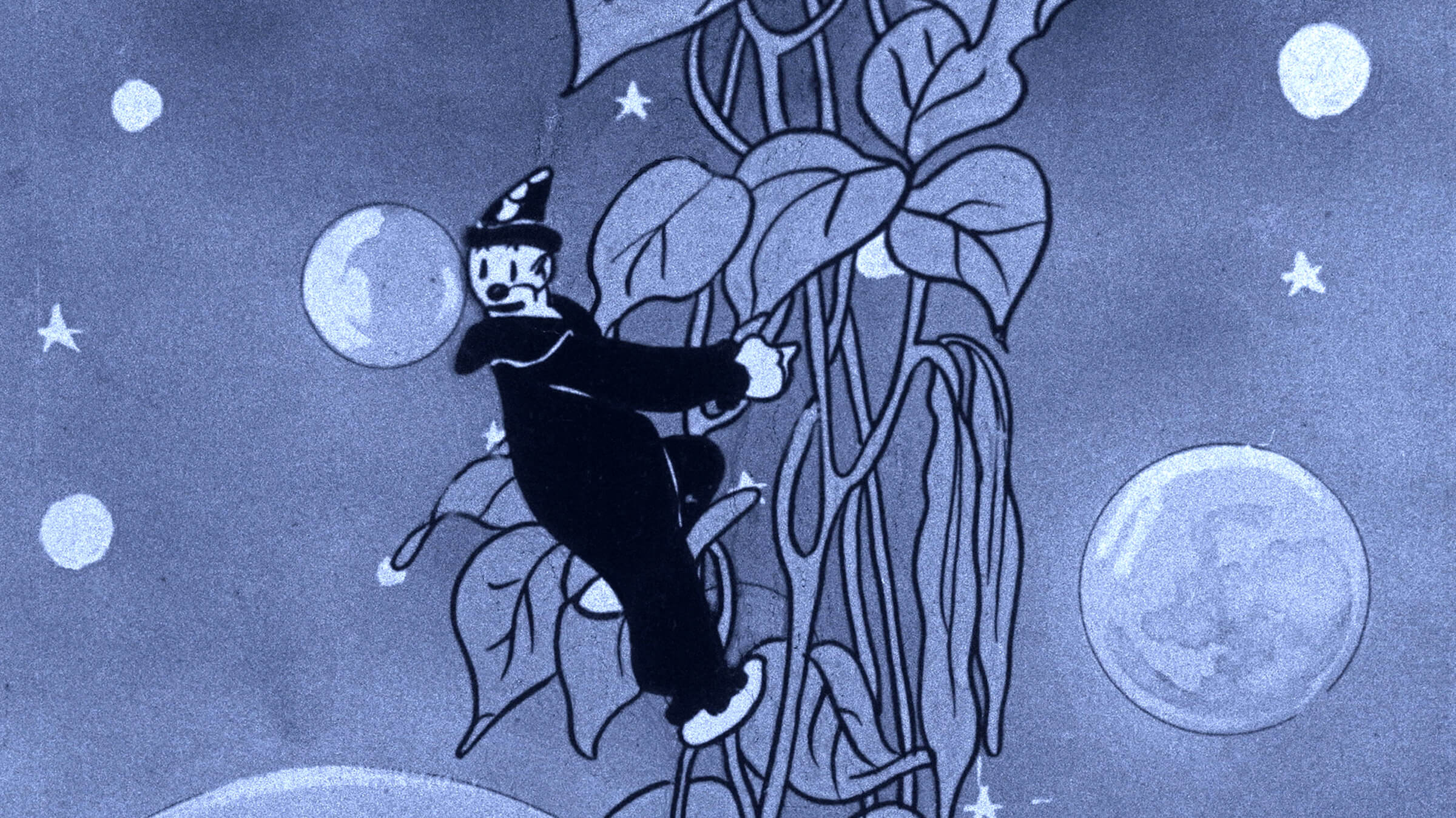
Coherent or not, the Out of the Inkwell shorts are consistently ingenious. They overflow with visual gags that require little explanation even to the youngest viewer. The creativity involved in a film like Jumping Beans is staggering: a lasso emanating from the nib of Max’s fountain pen becomes the outline of Koko walking along. At one point he plants a bean, which Max waters with an eye-dropper, and it grows into a beanstalk that reaches up into the heavens—with imposing point-of-view shots of our Earth thousands of miles away.
The rights to these films scattered to the four winds decades ago; some have no copyright protection while others belong to their original distributor, Paramount. In any event, they were not properly catalogued or preserved, although efforts are now underway to correct that situation, fired in part by Max Fleischer’s granddaughter Jane Fleischer Reid. In the meantime, enjoy this sampling of shorts that come to you directly from out of the inkwell.
Presented at SFSFF 2025 with live musical accompaniment by Wayne Barker and Nicholas White