
THE BATTLE OF THE CENTURY
Directed by Clyde Bruckman, USA, 1927
Cast Noah Young, Charlie Hall, Budd Fine, Eugene Pallette, and Anita Garvin
Source: FPA Classics
THE FINISHING TOUCH
Directed by Clyde Bruckman, USA, 1928
Cast: Edgar Kennedy, Dorothy Coburn, and Sam Lufkin
Source: FPA Classics
LIBERTY
Directed by Leo McCarey, USA, 1929
Cast: Tom Kennedy, Sam Lufkin, Jean Harlow, and James Finlayson
Source: FPA Classics
BIG BUSINESS
Directed by James W. Horne, USA, 1929
Cast: James Finlayson, Tiny Sandford, and Lyle Tayo
Source: FPA Classics
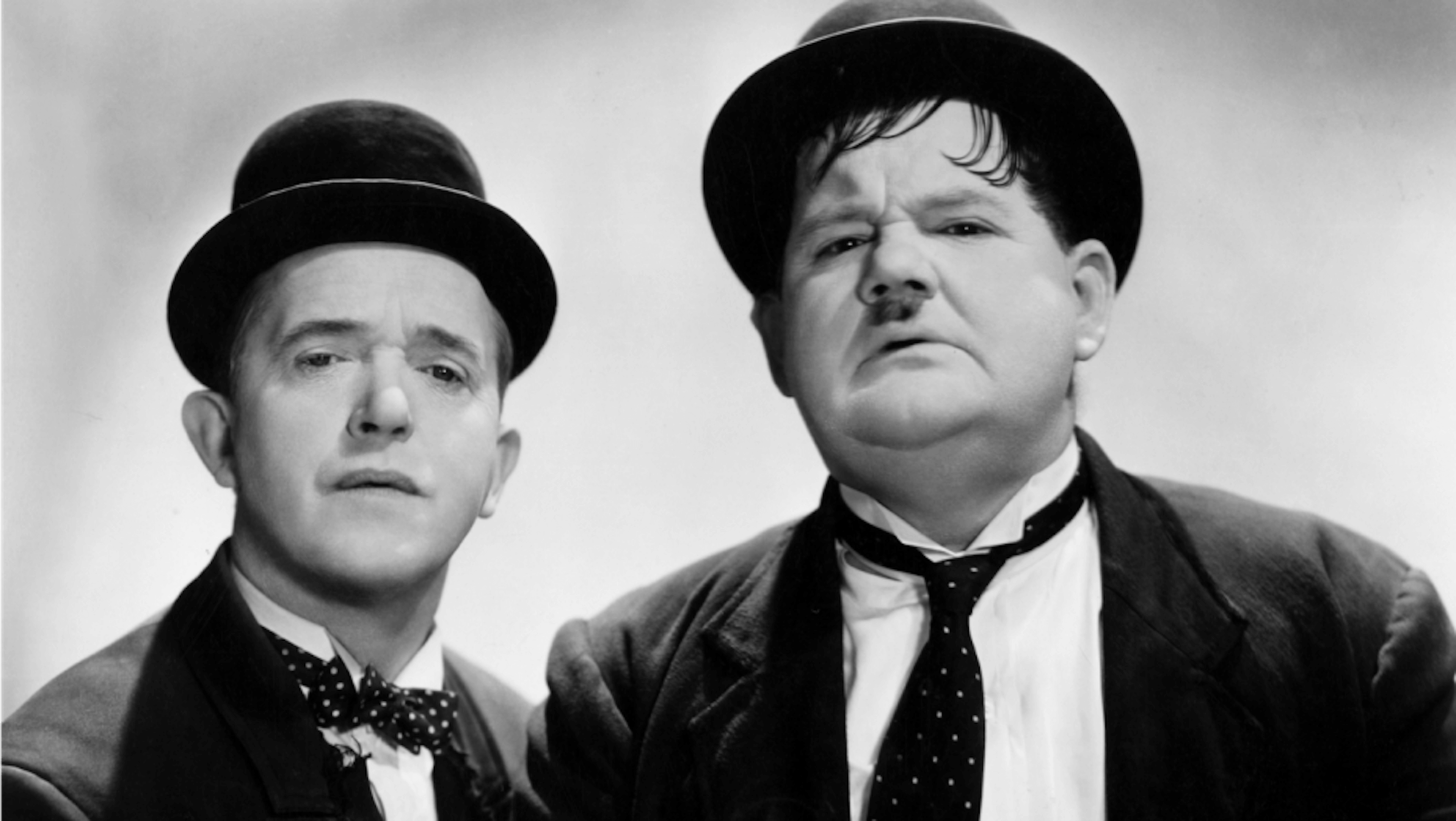
To us today Laurel and Hardy are a completely inseparable entity like “pork and beans” or “Sodom and Gomorrah,” so it’s hard to realize that their pairing had an actual beginning—it seems as if they must have been born on the same day and shared the same nursery crib. We also forget that their teamwork had to develop, and that other people made important contributions to their screen partnership.
When they both ended up on the Hal Roach lot in 1925, they had each been in the movies for almost ten years, and all those years of experience came together to create the ultimate screen team—a perfect whole. Stan had a long background in the English music hall and American vaudeville, leading to his days as a star comic for Universal, Roach, G.M. Anderson, Roach, Joe Rock, and then Roach for a third time. Oliver Hardy on the other hand had never been a stage comic but instead performed as a singer and joined the movies early in 1914 and worked at Lubin (later Vim). A natural comic and scene stealer, he became a top supporting comic for Billy West, Jimmy Aubrey, and Larry Semon. The two actually first appeared together when Ollie supported Stan in the 1921 two-reeler The Lucky Dog at Anderson’s outfit. Neither was looking for a partner and they went their separate ways.
It was movie kismet that their careers intersected at the Hal Roach Studio. In 1925 the lot was a petri dish of slapstick comedy fermentation—the way Mack Sennett’s Keystone Studio had operated in 1912 to 1918—an innovative assemblage of in-front-of and behind-the-camera comedy talents and intellects. This group at Roach ushered in the final peak of silent comedy, with Laurel and Hardy front and center.
Besides the duo’s own talents, they had the examples of protean comedy minds like Charley Chase, Robert McGowan, F. Richard Jones, H.M. Walker, and Hal Roach himself. A former extra who carved out a place in Hollywood thanks to his work with Harold Lloyd, Roach was a shrewd businessman but also had a keen eye and respect for comic talent. Following the Sennett example, he assembled a well-oiled machine where the comedy inmates ran the asylum. Two out of the assembled crew who made the four films in this program particularly shaped the Laurel and Hardy phenomenon: Leo McCarey and Clyde Bruckman.
According to Roach writer Frank Butler, it was Leo McCarey who first noticed and developed their screen rapport. After Stan and Ollie’s official teaming, it was large helpings of McCarey and Stan Laurel that defined their characters and comic universe. McCarey in particular gets credit for slowing down the tempo of their films, feeling that silent comedy was too frenetic; and he also exploited comic stillness and nonreaction for maximum effect. McCarey was something of a savant of screen comedy. He joined the Roach organization in 1924 to write gags for Our Gang, graduating to directing Charley Chase and creating masterpieces like His Wooden Wedding (1925) and Mighty Like a Moose (1926). By the end of 1926, he was director-general and vice-president of the studio.
McCarey also developed what he later called “the ineluctability of incidents,” whereby mole hills became mountains as the quirks, foibles, and peccadilloes of the characters bounced off each other and created a comic chain of events. This is well illustrated by both Battle of the Century and Big Business with their sequences of “eye for an eye” reciprocal chaos where everyone waits their turn to methodically inflict the next round of destruction. Other prime examples include You’re Darn Tootin’ and Two Tars (both 1928). Although he was busy overseeing the entire studio output, McCarey still found the time to personally direct three of their shorts: We Faw Down (1928), Wrong Again (1929), and today’s Liberty.
Clyde Bruckman is primarily remembered for his time with Buster Keaton and Harold Lloyd; his work with the nascent Laurel and Hardy is hardly ever noted. Coming from a sports and newspaper background, Bruckman became a writer and gagman in 1919 for Lyons and Moran and Monty Banks. He quickly joined Buster Keaton’s writing staff of idea men and was one of his key collaborators until he began freelancing with Harold Lloyd and Sennett in 1925. His career as a director was jump-started when he brought Keaton a copy of the book The Great Locomotive Chase. This was the inspiration for The General (1926) and Keaton tapped Bruckman to codirect. He then moved on to piloting the Monty Banks features Horse Shoes (1927) and A Perfect Gentleman (1928) and took a position with the Roach unit.
Long experienced in working with star comics and tailoring material to their needs, Bruckman was able to do the same for Laurel and Hardy, implementing and developing the themes that McCarey and Laurel had created. He worked extremely well with them but left Roach to reunite with Keaton for The Cameraman (1928). His four Laurel and Hardy shorts (Battle of the Century, The Finishing Touch, Putting Pants on Philip, and Leave ’Em Laughing) solidified the characters’ screen relationship and worldview and enabled other directors like James W. Horne and James Parrott to successfully continue the franchise.
Sadly, this turned out to be the peak of Bruckman’s career. Because of extreme alcoholism the great collaborator of the 1920s became the great recycler of the 1940s. In his later years he repurposed material that he had helped create for Keaton and Lloyd to suit the Three Stooges and the Andrew Sisters. This is how he’s remembered today, not for his halcyon early days. When Harold Lloyd sued him for plagiarism, his career ended. Bruckman borrowed a gun from Keaton and killed himself. A few months before, he had been interviewed by author Rudy Blesh and said, “I often wish I was back there, with Buster and the gang in that Hollywood. But I don’t have the lamp to rub.”
Leo McCarey on the other hand moved from the Roach studio in 1929 to greater and greater success, collecting accolades (that include three) Oscars as the director and producer of films such as Duck Soup (1933), Ruggles of Red Gap (1935), The Awful Truth (1937), Love Affair (1939), Going My Way (1944), and An Affair to Remember (1957). Almost as soon as Laurel and Hardy hit their stride with the pictures in this program, talkies arrived. But they made the transition with ease. The leisurely tempo McCarey helped Laurel and Hardy develop was perfect for the slower speed of sound films; they also used sound effects creatively and each of their unique voices added extra dimensions to their characters. But it was their on-screen relationship that made them such a durable team—the devotion that they show to each other through all their misadventures puts Romeo and Juliet to shame. This, combined with the warmth of their personas, is what kept them busy on film and stage until the 1950s, and what makes their appeal so timeless.
Presented at SFSFF with live musical accompaniment by Wayne Barker and Frank Bockius