
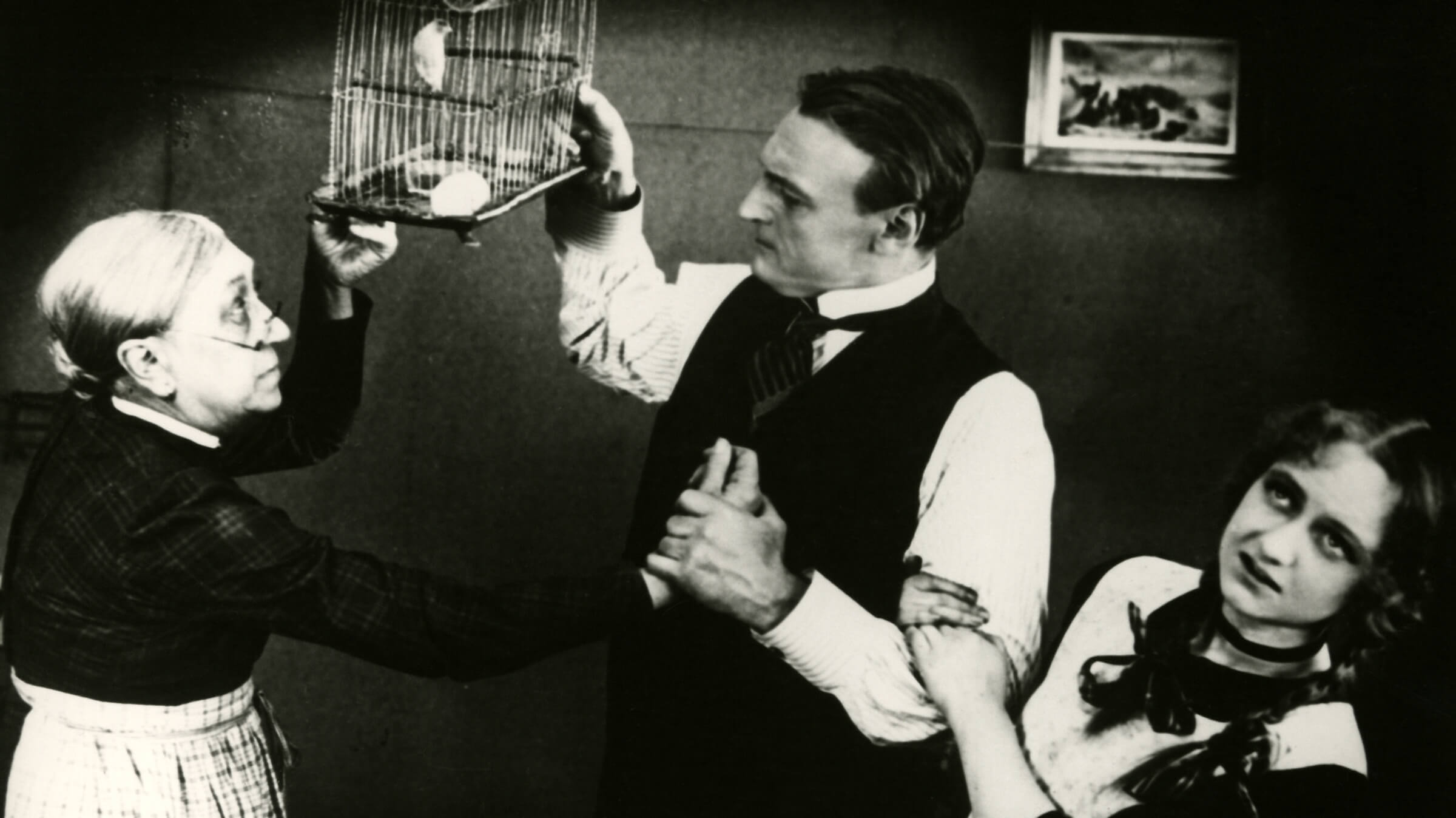
Be careful: just because Master of the House is a hundred years old, often very funny, and capable of being thought “charming,” stay on guard. This is a dangerous film; it might rip apart some assumptions in your own household, and its various forms of domestic tyranny. Just because this festival is a celebration of yesterdays doesn’t mean it can’t bite now.
To begin, we are in a modest flat in Copenhagen. It feels actual because the director, Carl Theodor Dreyer, asked for the place to be rebuilt in the studio, accurate in every detail. He was meticulous; he was widely referred to as “a tyrant” on set. So it’s not chance that the main room of the flat is so constructed that we are not looking at a flat, stage set, but into a corner of the room. And the corner is vital.
It’s morning in the flat. The wife and mother is up first, she has jobs to do: warming her man’s slippers, preparing coffee and porridge—make sure the coffee’s hot, and the oatmeal is smooth—all before the man wakes up. He doesn’t like mistakes. His name is Viktor. His wife is Ida. She has three children to care for (as well as Viktor). She is pretty, demure or yielding; she has a life of being under orders. He is handsome, severe, a little like a John Barrymore. He seems commanding, accustomed to being obeyed. When his son is naughty, Viktor tells him to stand in the corner, his face to the wall. But when Viktor leaves the flat he just walks the street and retires to a cafe. He lost his business a while ago. So his authority is entirely domestic.
The routine in the flat is comic; you may start to laugh at the patriarchal rule. But the man has no humor or kindness, and it does seem possible that Ida is being made ill by what is expected of her. The job the man had is not explained; after all, Viktors do not think their wives would understand the burdens they carry. You realize, this was a hundred years ago. That’s part of the danger in the film’s humor, for you can believe—if you wish—that this sort of tyranny is old-fashioned. Unless it reminds you of something.
The sharp satire in the point of view was not general in silent cinema—it’s still uncommon. But it’s easy to respect the precise and controlled way in which Dreyer filmed the household activity, the tight shots selected and edited together so that the film moves swiftly. This has the effect of turning the comic disaster of life in the flat into a kind of mathematical diagram. It could even be a case study in a tyrant’s control.
Then the story turns. Ida employs a seamstress to come in to help. Her name is Mads and she was Viktor’s nanny when he was a child. So she knows the jerk he was, and she remembers how she used to box his ears. Thus it is, in despair at Viktor and stirred to save Ida, Mads and Ida’s mother see the desperate situation. They will remove Ida from the household—truly she is ill. Then Mads will set about taking the odious Viktor in hand.
If so inclined, you can tell yourself this all works out for the best. Viktor is humbled; he gets an education in how laundry operates in the flat; he may realize how Ida has been buttering his bread lightly because there isn’t enough butter to go around; he learns to change his baby’s diapers—not the sort of thing expected in a Hollywood film of 1925. He even cottons to the notion that he is seen as being in the wrong, so that he learns in that quick male way how to regain control—at one point he reckons to bribe his daughter to find out where Ida has gone.
In all of this, Johannes Meyer gives a very clever performance as Viktor. There are searching close-ups in which he begins to see the light. There is even a true darkening of loss and regret. But Dreyer does not simply fall for cunning actors. And so the suspicion arises that Viktor is a real man, or so devious that he understands the need to pretend to be a reformed character to regain his superior life.
That’s where we can feel the film’s bite. It seems to end happily. The family is reunited in a group at the dining table. There is a rousing title that says, of course, it has always been the case that women are masters of the household. Isn’t it pretty to think so? And Viktor seems to be restored: not just having Ida home again, but flying—his mother-in-law has given him a check with which he can purchase a new business. Male enterprise is back in charge.
That may seem too searching or even subversive if you believe that a film about a family deserves a positive conclusion. I’d be wary. Dreyer was a very promising director in Denmark, several years before The Passion of Joan of Arc and Vampyr. But his creative personality was already very precise and demanding over sentimental matters. Carl Theodor Dreyer was not his birth name. He was Swedish and illegitimate and put up for adoption. Brilliant but not quite one of us. So while he had a very humane eye—just think of Falconetti as Joan—he was not a ready believer in the cozy clichés that attached themselves to cinema and which have never gone away.
How many viewers today will find the settled ending of 1925 convincing? Or feel confident that Viktor has given up the echo of his name. Subtle men are so accomplished at persuading women that they take their point of view seriously. Decades later, in his last film, Gertrud (1964), Dreyer observed a mature woman who simply cannot rely on the presence or the promises of men. She has to learn to be on her own—the very way in which men think of themselves. And which makes them so insecure.
So the happy ending of 1925 seems a begging question now, and a threshold to modern intelligence. As I watched it, I was reminded of the movie voted the best ever in the 2022 Sight and Sound poll of film critics: Jeanne Dielman, 23 Commerce Quay, 1080 Brussels, made by Chantal Akerman, in 1975. This is an intense yet impassive study of domestic tyranny in which a woman makes meals for herself and her teenage son, and works as a prostitute in the empty afternoons. Akerman took much longer to dwell in kitchen routine than Dreyer allowed himself. But the two films could make a fascinating double bill (if you had five hours free). But if you happen to be a woman bound to the habits of her household, making the beds you are cast to lie in, then five hours can be a critical test.
Is this taking Master of the House too seriously? Or looking at a picture Dreyer did not intend? Perhaps. But if it is fixed on matters we still recognize, then we owe it to ourselves to stay awake to its inner meanings, and to the ironies that lie in wait in the title. Silent cinema is not an isolated nostalgia. It is a step in a journey. Jeanne Dielman was made fifty years after Master of the House—and that was another fifty years ago now.
At this screening, Thomas Christensen, curator of silent film at the Danish Film Institute (DFI), received the 2025 San Francisco Silent Film Festival Award honoring his contribution to silent film preservation. Read an interview with Christensen on the following pages.
Presented at SFSFF 2025 with live musical accompaniment by Guenter Buchwald