
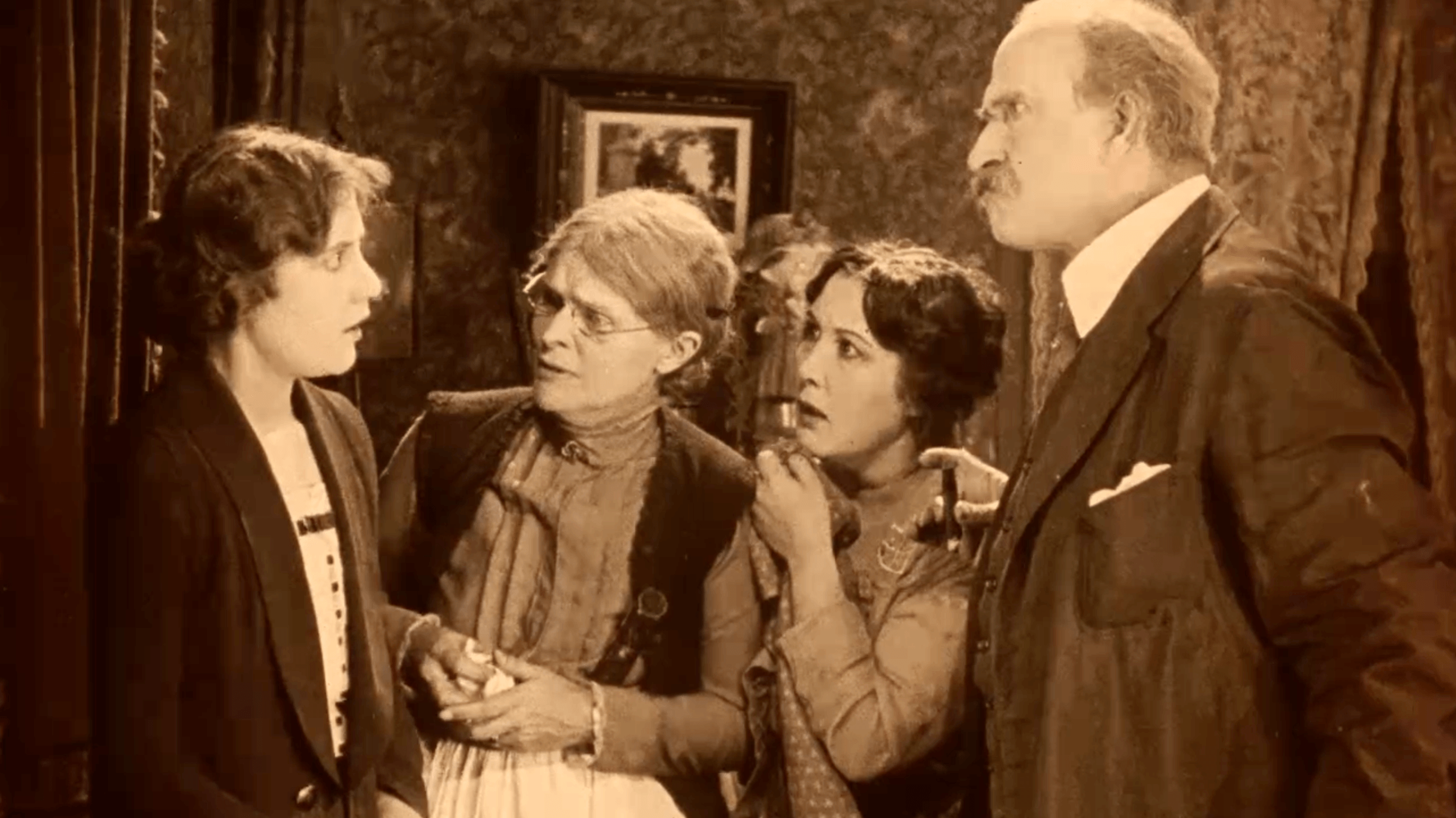
Four versions of Miss Lulu Bett—novel, play, revised play, and film—bounced out between 1920 and 1921 in such rapid succession they practically collided. Zona Gale’s book earned a rave in the New York Times in March of 1920, the theatrical adaptation (again by Gale) won a Pulitzer the following spring amid a storm of controversy over the revised ending, and the movie premiered at Grauman’s in late fall, accompanied by a movie tie-in edition of the novel that started it all. “The Book! The Play! And now … Miss Lulu Bett the Picture!” blared an ad in the Exhibitors Herald.
Each successive narrative variant recounts the consciousness-raising of Lulu Bett, a drab unmarried drudge who is trapped in unpaid servitude to her sister Ina and obnoxious brother-in-law Dwight Deacon, who, in 19th century parlance, “provide her a home.” And each version provides Lulu with a different fate. This repeated tweaking was the natural result of attempts to combine the author’s critique of marriage and domestic economics with something crowd-pleasing. Zona Gale herself led the way, first having Lulu storm off to an independent (if vague) future, then marrying her off two weeks later in response to audience grumblings—Gale was pragmatic as well as progressive. The film version does the best job of reconciling the satiric novel’s feminist underpinnings with a conventional marriage plot. For that, credit is due to director William de Mille and scenarist Clara Beranger.
Moviemaking was William’s second act in show biz. He’d been a successful playwright on Broadway before joining his younger brother Cecil in Hollywood in 1913 to work for the Jesse L. Lasky Feature Play Company, which his brother had helped found. William started as a scenario writer but by the time he embarked on Lulu he had some two dozen films to his credit, building a repertoire that demonstrated his knack for small, intimate dramas—the antithesis of brother Cecil’s growing taste for grand spectacles. William and Cecil are typically presented as flip sides of a coin: William was “subtle, dainty, a bit poetic,” according to a 1925 Los Angeles Times article, whereas Cecil was “majestic, flamboyant, sensational, full of wallops.” William spent time rehearsing and coaxing performances out of his actors, Cecil directed by megaphone. Cecil changed the spelling of his name to “DeMille,” William stuck with the small “d.” They were entwined personally and professionally, and their relationship seemed built on an uncertain mix of brotherly loyalty and anxiety of influence. “While the critics thought DeMille was declining to bread and circuses, those same critics thought that William was doing the finest work of his life,” writes DeMille biographer Scott Eyman. William commented, “I wish the critics would stop using me as a hammer with which to whack Cecil.” For his part, Cecil anxiously telegraphed Zukor on the need to “differentiate William de Mille’s brand from my own.”
Cecil was also the more socially conservative and Gale’s novel, which replaces the sentimental fantasies surrounding hearth and home with ruthless realism, was not his cup of tea. The film adaptation doubles down on the novel’s casual, almost comic, treatment of marriage. Lulu finds herself married to Dwight’s brother Ninian by accident, the result of dinner-table kidding. When Ninian (Clarence Burton) confesses on their honeymoon that he might already have a wife, Lulu’s more sorrowful than angry—after all, her bigamist husband is the first person to treat her like a human being. On Lulu’s return to the Deacon home, her mother and sister are shocked by the fact that unmarried (again) Lulu’s been living with a man, but Lulu is more concerned that the townsfolk know that she wasn’t thrown out, she chose to leave her not-husband. She’s eager to tell the world about her bigamous marriage, while Dwight is determined to hush up his brother’s bad behavior.
Behind the camera, William was grappling with his own scandal. Long married, the director was also a serial philanderer, with a penchant for members of the Lasky scenario department. Lulu Bett’s production coincided with the pregnancy of William’s ex-mistress, screenwriter Lorna Moon; the pair’s son Richard was born a few months after Lulu was released. When Moon was unable to keep the child (she had tuberculosis on top of her other problems), Cecil helped with the cover-up by adopting the boy, pretending he’d found him in his car. William’s marriage eventually fell apart anyway and he later married Lulu Bett scenario writer Beranger, who’d become both a professional and romantic partner. Cecil, whose trio of mistresses was an open secret, disapproved. “When a man has been married 23 years … he must not leave his wife,” he wrote William. For Cecil, marriage was sacred—lovers and secretly adopted illegitimate children notwithstanding.
None of this reached the press and how much William’s personal clash with convention fed the film we’ll never know. What’s noticeable in Lulu is the director’s painstaking eye for detail and the lovely ensemble work of his actors. Lasky veterans Theodore Roberts and Mabel Van Buren bluster and simper respectively as husband and wife Dwight and Ina, while Helen Ferguson (who became a powerful press agent in the sound era) sighs and rolls her eyes heavenward as their discontented flapper daughter. The whole family is spot on, from tantrum-prone Grandma Bett (Ethel Wales) to the bored younger daughter, banging the piano with her elbows. A former beauty contest winner, Lois Wilson tones down her good looks (somewhat) and plays Lulu with a wide-eyed naïveté that is ignorant, but not dumb. Critics were unanimous in praising her performance.
De Mille was a stickler for realism, and he gives his cast a meticulous recreation of a middlebrow, small-town home to work with. In the opening scene the camera inspects the Deacon’s dining room, showing us stuffed ducks and highly polished silver, finally landing on an encrusted bit of flypaper. Later, de Mille gives us more bugs in a bit of kitchen sink realism: a pile of dirty dishes swarming with ants, as Lulu returns dolefully to the Deacon kitchen after her brief escape. This was apparently an opportunistic shot. A reporter from Picture-Play magazine wrote that real food was used in the kitchen scenes and that “busy little California ants” found their way to the set, and exclaimed, “De Mille took a close up of the ants!”
The appeal of Gale’s novel and play, critics agreed, was its realism, and the film delivered the goods. “It is within the experience of ninety per cent of the audience,” wrote Camera, with Billboard concurring, “Because of its realism the public will derive much pleasure for the reason that it strikes home to the majority.” Here at last was a film that showed a teenager yelling, “I hate the whole family!”; a child refusing to eat dinner; a father making mean jokes. But realism could be a problem, too—Motion Picture News wondered if the film wasn’t “too real—too human to succeed as a great box office magnet.” Viewers, then as now, wanted their realism leavened by fantasy.
Lulu’s several endings oscillate between social critique and romantic convention. In the book Lulu marries Neil Cornish, the proprietor of a failing piano store, a rather downbeat ending, since Lulu will obviously be drudging in Neil’s kitchen soon. Gale’s first version of her play gives Lulu a more upbeat, Doll’s House-style exit line: “I’m going I don’t know where—to work at I don’t know what. But I’m going from choice!” The revision that followed two weeks later retreated from that declaration of independence, a concession to audience members who couldn’t get past the bigamy: instead Ninian returns with the news that his first wife is dead and their marriage is legitimate; Lulu forgives him.
De Mille and Beranger’s version takes the have-your-cake-and-eat-it approach, and it’s sneakily satisfying. If the film de-emphasizes Gale’s progressive views by making Dwight the villain rather than say, a symbol of gender inequities, moments of critique remain. In the scene where Lulu finally stands up to Dwight and then destroys the kitchen in a cathartic frenzy of smashed dishes, she shouts, “My work’s paid for these!” Equally satisfying, Lulu achieves (offscreen) independence as a wage-earning woman before reuniting with her pining beau Cornish, whom the film has transformed from unsuccessful storekeeper into respectable schoolteacher. This version of Neil Cornish is an obvious fantasy, especially as played by Milton Sills, the thinking-woman’s heartthrob. One critic wrote that he looked too “citified” to be a small town schoolteacher. An even better fantasy is the romantic encounter between Cornish and Lulu that begins with a close-up of their two pairs of hands—doing the dishes! The film provided fodder for the daydreams of the modern early 20th century woman: independence combined with romantic happiness—and a husband who helps around the house.
Presented at SFSFF 2026 with live musical accompaniment by Mont Alto Motion Picture Archive