For decades, the silent films of Evgenii Cherviakov were but a legend. Raving contemporary reviews from the 1920s (including those by Oleksandr Dovzhenko and Asta Nielsen) and poetic memoirs about “the father of lyrical cinema” whetted the appetite of scholars and cinephiles, yet the films themselves were no longer available, and it was difficult to imagine what exactly contemporaries defined as lyrical cinema. To make things worse, most of Cherviakov’s existing films suggested nothing innovative: his 1936 “optimistic drama” Prisoners, which praised the “reeducation of class-alien elements” of the Gulag or the 1939 comedy Far-off Cossack Village, with its idyllic portrayal of a collective farm, were professionally made, but no more than that. Yet, those who knew his works insisted: this is not the real Cherviakov.
The three films of his that marked an era in Soviet cinema were The Girl from a Distant River (1928), My Son (1928), and The Golden Beak (1929). After the release of the first two, Adrian Piotrovsky, one of the country’s leading art critics, wrote: “Cherviakov deserves every new film of his to be met with double attention, not as an ordinary cinematic premiere, but as a significant event in our cinematic life … His work in Soviet cinema is of undeniable fundamental importance, far beyond the success or failure of an individual film.” It’s worth noting that this was written in 1929, the year of Vertov’s The Man with a Movie Camera, Eisenstein’s The General Line, Ermler’s Fragment of an Empire, Dovzhenko’s Arsenal, Kozintsev and Trauberg’s The New Babylon—the golden year of Soviet silent cinema.
All three films were considered lost during World War II, until, in 2008, a copy of My Son was located by Fernando Martín Peña and Paula Félix-Didier at Museo del Cine Pablo Ducrós Hicken in Buenos Aires, shortly after their famous discovery of the complete Metropolis. It was a 16mm dupe negative of the heavily reedited Argentinean release version, hastily transferred from a now-lost nitrate print sometime in the 1970s, scratched, cropped, and missing about twenty minutes of footage. Nevertheless, this is often referred to as the most important discovery of a Russian or Soviet film since 1958 (when the banned second part of Eisenstein’s Ivan the Terrible was finally released).
Scholars and cinephiles of today can decide for themselves whether My Son is a masterpiece or merely an oddity, but one thing is clear: there was hardly anything like it in Soviet silent cinema. While the majority of Soviet avant-garde filmmakers were trying to capture the behavior and psychology of the masses, Cherviakov dissociated himself from society. “My main task was to show, by means of cinema, anger, love, despair, jealousy—in short, the entire complex of emotional phenomena that is called ‘human passions,’” he wrote in relation to My Son. “To show it outside any historical, mundane, industrial, or any other accessories … The second task is people. Not objects, masses, beautiful views and sophisticated montage tricks, but people.”
A radical difference in ideology led to an equally radical choice of cinematic language. The Soviet avant-garde believed in the power of typecasting nonprofessional performers; acting was often supposed to be substituted by montage. This “typage-montage” school was juxtaposed with the classical “actors’” cinema, supported by the older generation of filmmakers, who, in turn, heavily relied on performers from the legitimate theater. A few tried to blend these, most notably, Vsevolod Pudovkin, who was often placed by the critics in the same camp with Cherviakov. The latter, however, seemed to defy any of the existing formats or categories.
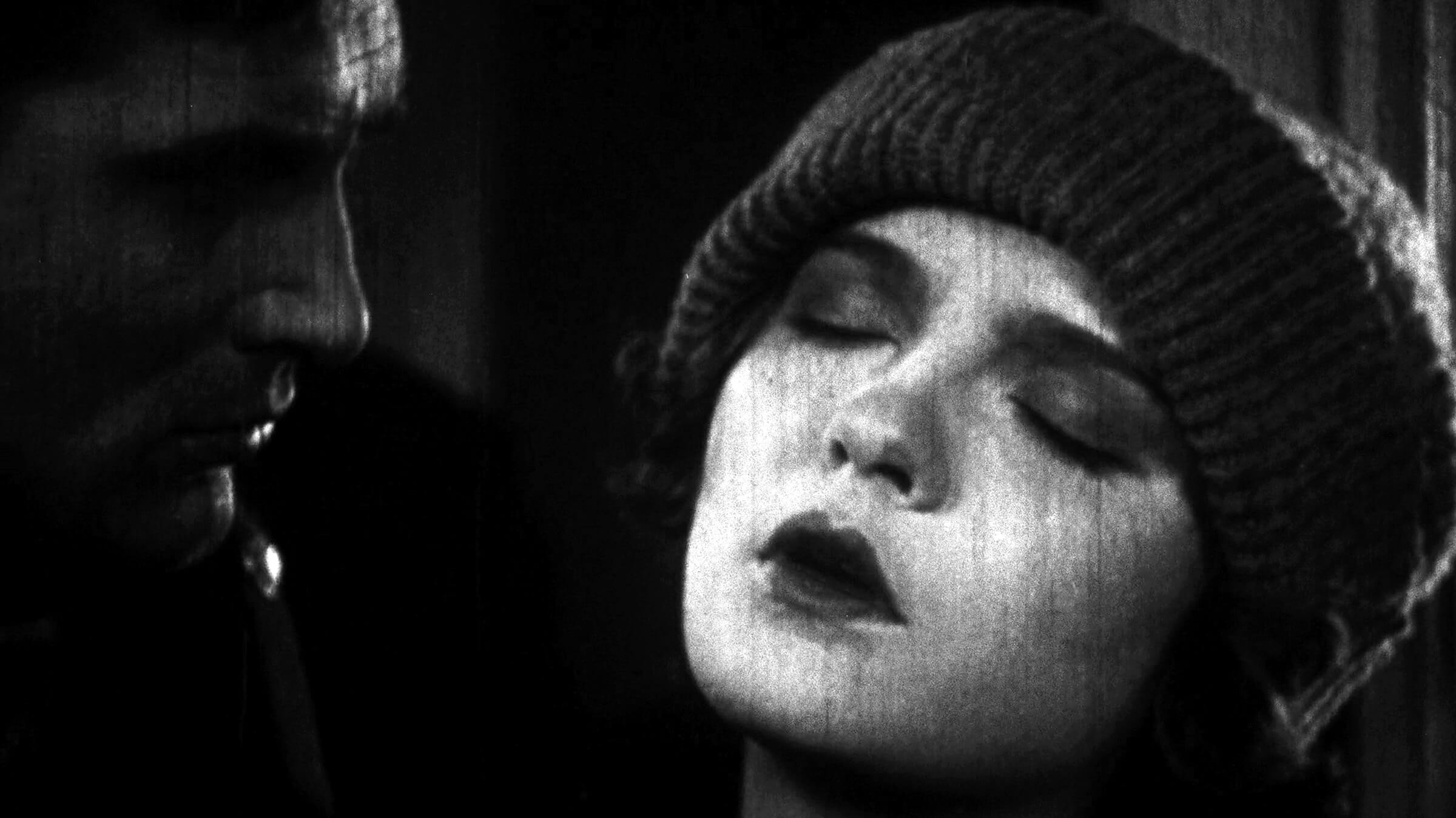
In My Son, a leading actor of the Bolshoi Drama Theater in Leningrad, Gennadii Michurin; a popular film star, Anna Sten (who brilliantly continued her career in Germany and then flopped in the U.S., in spite of good reviews, following one of the most extravagant publicity campaigns in the history of Hollywood); a drama school student, Piotr Beriozov; and a bit player of the Leningrad Sovkino film factory, Elena Volyntseva, who hardly ever received any screen credit, form a polyphonic ensemble, and one could hardly determine the difference of their backgrounds. There are several impressive sequences of rapid cutting and some beautifully disturbing and unexpected camera angle shots, but these are dramatic codas or exclamation marks. By and large, Cherviakov tried to minimize cinematic effects. He considered the human face to be “the true center of any lyric picture” and “the most perfect ‘instrument’ of production.” So extensive are the close-ups in My Son and so ascetic are the medium shots and the few long shots that the viewer is forced to observe every sign of life as closely as possible, and the slightest movement becomes significant. Cherviakov wanted his actors to convey their emotional state solely through the eyes, without the aid of mime or gesture. And one should not underestimate the roles of his constant cinematographer Sviatoslav Beliaev and art director Semion Meinkin. The relationship was so harmonious, that colleagues jokingly referred to them as “the three behind the camera.”
My Son is, formally, a melodrama. In the very first scene, the wife confesses to her husband that their newborn son is not his. How the couple lived before, and what led to the wife’s infidelity is irrelevant, as is their long-term future. The screenplay was loosely based on a short courtroom story, but very few events in the film are tangible enough for court evidence. What matters here are the husband’s emotions and anxieties, and the wife who must live through this period of their lives, be it days, months, or years. There are not too many intertitles, and only a couple dozen of them are lines of dialogue. Words are not of particular importance; in a situation when a household is falling apart, every little gesture, every insignificant detail becomes an aggravator.
The celebrated film theorist Rudolf Arnheim (at the time a film critic in Germany) described this beautifully: “Anna Sten … does not spare her noble face from the rigors of dramatic action. She portrays the hasty chatter of a fearful sinner just as credibly as the rigidity of a pale death mask, and once, surprisingly, from so much seriousness, the blossoming sweetness of a motherly smile breaks out. Her partner Gennadii Michurin … displays a strangely complex expression even in the most ‘basic positions’ of his facial gestures: a sad stupor in the eyes and, at the same time, a smile in the corners of the mouth that no one knows about. He uses his close-ups primarily to stare blankly into space, and he does this so shockingly that one feels that it is not the enigmatic behavior of his wife but that of the whole world that serves as the sublime problem for his reflections.”
The Soviet press, somewhat naïvely, noted that “the topic of The Civil War is still waiting for its Cherviakov.” What followed was predictable. In Cherviakov’s last silent film, Cities and Years (1930), the Civil War and the October Revolution were portrayed as tragic cataclysms that can only crush the weak and dehumanize the strong. The film was heavily censored and large sections of it had to be reshot. What remains today is a strange mixture of embarrassingly conventional filmmaking with scenes of gripping power. The situation repeated five years later with Prisoners, but on a larger scale: all the footage that Cherviakov filmed on location in a gulag was destroyed, and the director was ordered to shoot everything from scratch, on studio sets and in a more optimistic key. This project brought him excellent reviews in the official Stalinist press, in addition to severe alcoholism. He made two more films with little enthusiasm and, in August 1941, volunteered for the frontline, to get killed, as his family believed. Ironically, at the front, he became his old self; for the first time in more than a decade he felt that he was doing something worthwhile. On February 17, 1942, he was killed in combat. His cameraman, Sviatoslav Beliaev, perished at the frontline five days later. Less than a month earlier, their art director, Semion Meinkin, died of hunger during the Siege of Leningrad. Around the same time, the vault with the camera negatives of their silent films burned down after a German air raid.
My Son was preceded by the fragment, Your Aquaintance (Vasha znakomaia, USSR, 1927), directed by Lev Kuleshov and starring Aleksandra Khokhlova.
Presented at SFSFF 2025 with live musical accompaniment by Stephen Horne and Amber Lamprecht