
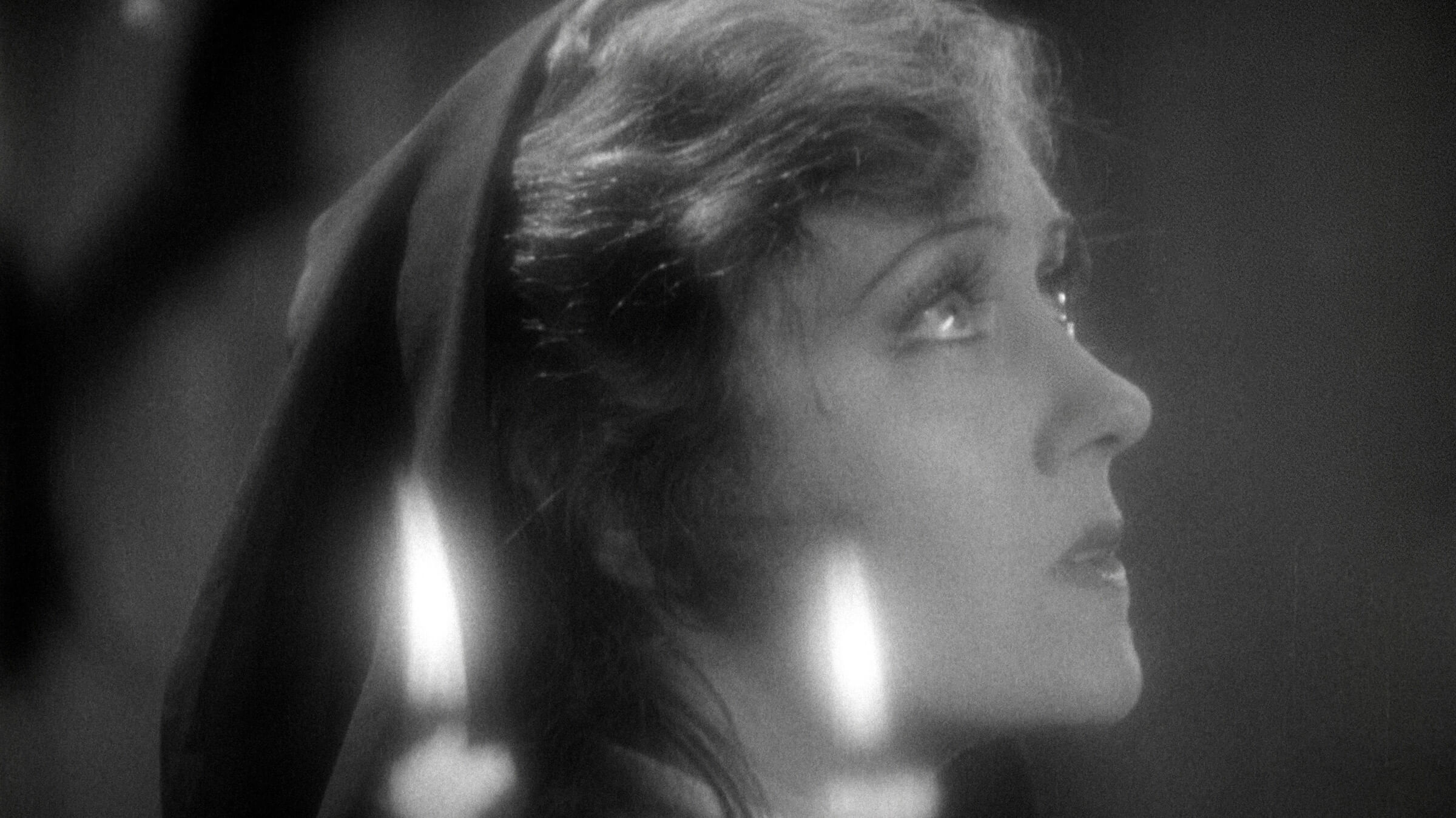
Where do you begin with an epic such as Queen Kelly? Let us try starting at the end. In January 1929, after three months of filming with barely a break, the film’s star and producer Gloria Swanson walked off set to make a phone call to her lover and fellow producer Joseph P. Kennedy. “Our director is a madman,” she told him. “It’s ruined! And—awful!” Very shortly that director, Erich von Stroheim, Hollywood’s perfectionist genius, was fired and never returned to the set.
Swanson and Kennedy were left with an unfinished film, which despite their best efforts—completing it as a talkie, as a musical—would never be released in the States and had cost nearly $800,000. It remains one of the most notorious production disasters in film history. Had the film ever been released, it could have been embraced as a masterpiece, or castigated for its controversial content. Probably both.
Nearly a century later, Queen Kelly is back on her throne. This “reimagining” of the film by Dennis Doros and Amy Heller of Milestone Films represents almost everything that was shot up to the point that the fateful call was made. We are in the world of Ruritanian romance, with a budding love affair between a convent girl and a debauched prince who is engaged to a mad and vengeful queen. When they are separated, the girl flees to her aunt’s deathbed, thousands of miles away in Africa … It’s a wild ride, and there were more, and more shocking, scenes left to be filmed, or that were cut, absences that this reconstruction covers ingeniously. Milestone even found a way to give the film something of the triumphal ending that Stroheim and Swanson planned for it. This 4K restoration, based on the best sources, including nitrate, honors Stroheim’s gorgeous, risqué vignettes of Mittel- european decadence and Swanson’s sensual performance as a young woman in love—it looks stunning. The newly composed orchestral score by Eli Denson carries the audience along from the delicious throes of forbidden passion to the horrors that await our heroine abroad.
The story of Queen Kelly really begins in the autumn of 1927 when Swanson first met Kennedy. She had recently started producing her own films, under a deal with United Artists, and had just faced down the Hays Office and much of Hollywood to make the sexually candid, emotionally devastating Sadie Thompson with Raoul Walsh. It turned out to be one of her very best silents, but it had cost her a lot of money, so she took the opportunity to dine with Kennedy, a renowned banker, now the head of a budget studio, and to ask him for financial advice. Kennedy had more than just advice to offer. He suggested a complete reworking of her money affairs, a new company, and that they should join forces on a prestige project: a masterpiece of lasting value, which they would make with Hollywood’s resident master, the one they called “Filmland’s greatest luxury”: Erich von Stroheim. Swanson agreed, and soon her career was in Kennedy’s hands. More than that, they embarked on an affair, even though both were married. Swanson, to the man she would always remember as her favorite husband, Marquis Henri de la Falaise, and Kennedy to Rose, the mother of his nine children, the consequential Kennedy clan.
Erich von Stroheim was indeed a genius, but also something of a risky bet, especially for two inexperienced producers. He was acclaimed for the brilliance of his filmmaking, but also widely known for overstepping budgets and shooting schedules, for going to extreme lengths in the name of realism: filling the sets with expensive props and ordering silk underwear for the extras, emphasizing the sordid and seedy, and pushing his actors beyond their endurance. He had been sacked from several films already, either during production, as with 1923’s Merry-Go-Round (replaced by Rupert Julian), or during the editing process when his epics were cut down to shadows of their former selves.
Even riskier was the story that Stroheim wrote for Swanson about Queen Kelly, the imperious proprietor of a bordello in German-occupied East Africa, who marries a vile rancher but refuses to sleep with him. One day she meets a German prince and they fall instantly in love … It was a scenario that was bound to cause problems with the Hays Office, even though it went through several revisions before the cameras began to turn.
By the time Swanson and Stroheim were ready to start filming, the story had been extended back in time. Now, the love affair began in Europe, in “the imaginary state of Cobourg-Nassau in the German Empire.” Swanson plays convent girl Patricia Kelly and English actor Walter Byron is the dashing Prince Wolfram who meets her one day on the road. Patricia curtseys—and her bloomers fall to the floor, setting a tone of sexual innuendo, nudity, and audaciously wicked humor that the film builds on. Wolfram abducts Patricia from her convent dormitory and brings her back to the palace he shares with the actual queen, where they can confess their love. This queen, who is mad indeed, is played brilliantly by Seena Owen who froths at the mouth when she discovers the lovers in the prince’s private apartments. In one of the film’s most famous scenes, she lashes out at Patricia with a whip as she chases her down the palace stairs, throwing her out into the cold.
The palace settings are lavish, with vast rooms filled with elaborate décor and works of art, the tables piled high with gourmet food and copious champagne for everyone. The convent is humbler in scale, but similarly lit by scores of flickering candles that crowd the frame, seeming to set the film alight. After Patricia flees the castle, the action moves to Tanzania, and the sleazy establishment known as the Swamp, where she is greeted by two of her aunt’s employees, the tubercular Coughdrops (Rae Daggett) and the incessantly smiling Kali Sana (Nellie Crawford Conley, a.k.a. Madame Sul-Te-Wan). They introduce Patricia to Poto-Poto Jan, a leering Tully Marshall on crutches, who has nefarious designs on the new arrival. Here Stroheim achieves a grittier kind of realism, leaving the audience in no doubt that the business of this place is sex.
It was while filming these scenes that Swanson hit her breaking point. They were way over budget and over schedule, but more important she wasn’t comfortable with what they were filming, especially when Stroheim instructed Marshall to drool tobacco juice on her hand—and she knew these scenes would never get past the Hays Office. She later told Kevin Brownlow: “There had been a couple of days when I had watched with some trepidation and I thought, ‘Oh well, maybe we can get around this by trying to cut it,’ but this particular morning it was too much for me to take—because I knew it would be on the cutting-room floor.”
Stroheim was out, but Swanson fought for years to save Queen Kelly, screening it, championing it, and telling its story right until the end of her life. And she could, because her fame endured, far longer than many of her silent-era peers, despite the catastrophe of Queen Kelly and the abrupt end of her talkie career in the mid-1930s. Now, it’s almost impossible to think of Swanson without thinking of her magnificent, career-reviving performance in 1950 as Norma Desmond, the deranged silent star fighting her own obsolescence in Billy Wilder’s Sunset Boulevard. That wonderful film is notable for many things, not least that it reunited Swanson with Stroheim, and with their illicit, candlelit beauty Queen Kelly, seen for a few glorious seconds on Norma’s home-projector screen. Sunset Boulevard was a story, Wilder said, about a “dethroned Queen.” Well, now one queen is back on her throne for good, thanks to this glorious reconstruction of one of the silent era’s most fascinating films.
Presented at SFSFF 2026 with live musical accompaniment by Eli Denson conducting the SF Conservatory of Music Orchestra