
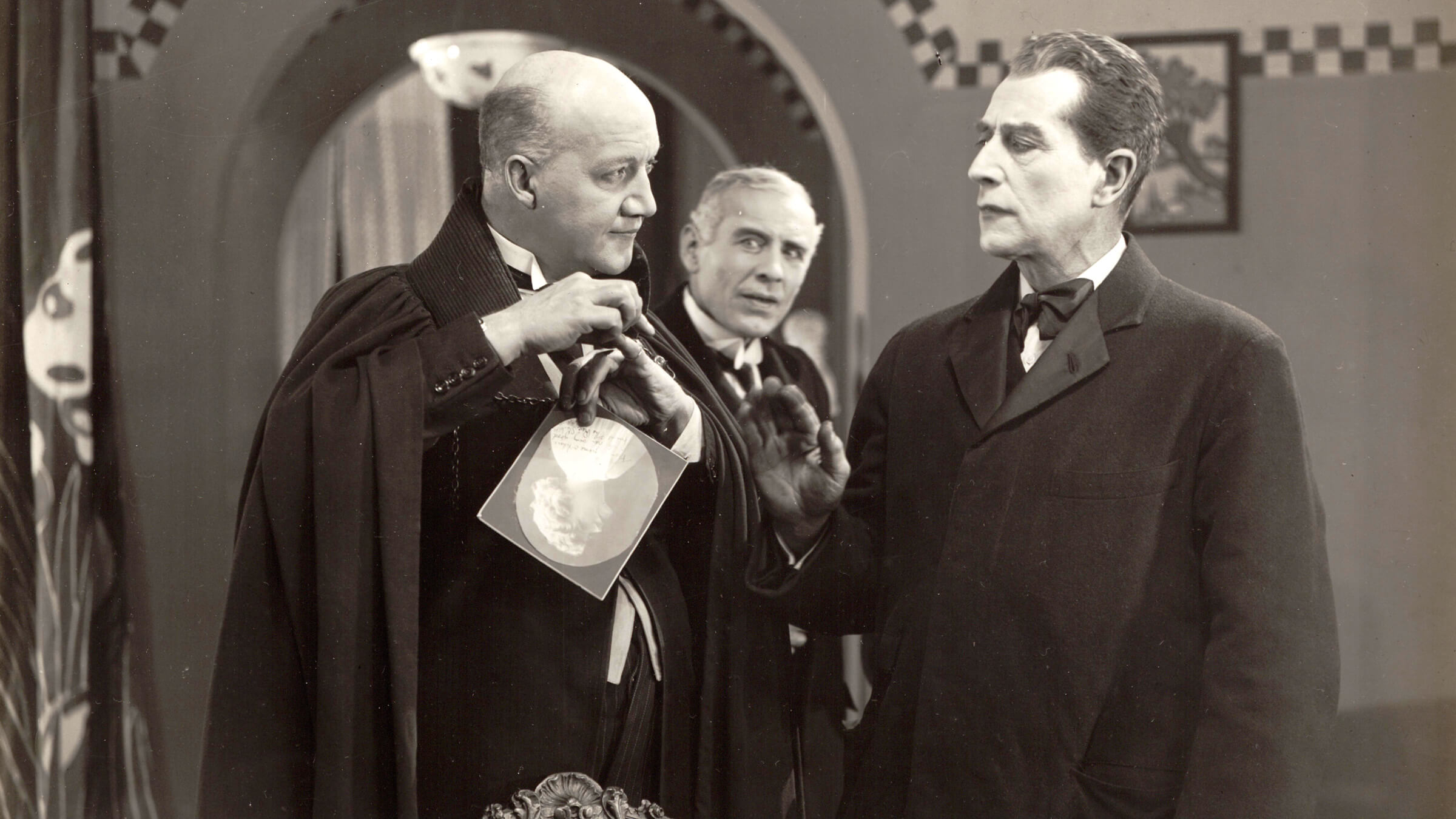
A SCANDAL IN BOHEMIA (1921), directed by Maurice Elvey, THE GOLDEN PINCE-NEZ (1922) and THE FINAL PROBLEM (1923), directed by George Ridgwell
The San Francisco Silent Film Festival’s love affair with Sherlock Holmes continues, albeit without one of its champions, the late Russell Merritt, to whose memory I would like to dedicate the screening of this trio of episodes from BFI’s ongoing restoration of the final, surviving Sherlock film adaptations from the silent era not yet accessible to the great detective’s many fans. SFSFF has been instrumental in the rediscovery and restoration of silent Sherlock films—the William Gillette Sherlock Holmes (1916) and the German Der Hund von Baskerville (1929). In 2014 SFSFF screened 1923’s The Sign of Four (now also being restored by the BFI National Archive), which is a feature-length film made by Stoll, the same company that made the series, The Adventures of Sherlock Holmes, from which these “Three Classic Cases” are taken. The feature and all forty-five episodes of the Adventures star Eille Norwood, the most prolific screen Holmes until Jonny Lee Miller in Elementary (2012 to 2019). They were produced in a short time-frame, the equivalent of fourteen feature-length films in three years! Norwood’s portrayal of the character was much admired by Arthur Conan Doyle who licensed the stories to Stoll, having bought the rights back himself from the French Éclair company to facilitate this more lucrative deal.
Forty-five of the fifty-six stories and two of the four novels were licensed directly from the author, and Stoll made a point of using Conan Doyle to endorse the series and feature films. The contract signing was celebrated in 1921 with a great dinner at London’s Trocadero restaurant with all the press in attendance. In the reports, there are quotes and photographs of the great man meeting the great actor, Eille Norwood. (Fun fact: 1921’s The Fruitful Vine, which screened as part of that evening’s entertainment, featured the twenty-year-old actor Basil Rathbone who went on to define the character of Holmes for the next generation.) The only major change Stoll made was to set the stories in the present-day 1920s rather than the Victorian Era of the originals. Conan Doyle grumbled about this, but it was purely practical. Stoll was a relatively modest film company with more ambition than production resources. The costs of Victorian settings and costuming would have been prohibitive, so Holmes was transposed, as he so often was, to contemporary times. So, the London of these films is “pearl grey,” not foggy, and Holmes travels by car not Hansom cab.
It’s the closeness of the Adventures episodes to Doyle’s originals that make them of interest today, a century on. They even retain the story titles, as the Jeremy Brett television series did in the 1980s. Adventures gets us closer to the character of Sherlock before he is saddled with some of iconography that we associate with Holmes today. Ask a six-year-old to do a drawing of the detective and they are likely to draw the deerstalker, the magnifying glass, and curvy pipe. Norwood does use the pipe a few times (the curvy version originated with Gillette in his stage play) and he is seen once with a small magnifying glass in 1922’s The Norwood Builder, which recreates the famous Sidney Paget illustration from that story; but for headwear he favors a fedora over a deerstalker. The regular characters, Watson, Mrs. Hudson, and Inspector Lestrade, are all present throughout the series but are not as developed as they are in later adaptations. Mycroft appears tangentially, but in his proper place, in The Greek Interpreter and The Bruce-Partington Plans, both from 1922. Otherwise there are no other inventions of family background. The cocaine use is dropped; the producers could never have gotten away violating the British Censor’s guideline number 27 not to show “the drug habit, e.g. opium, morphia, cocaine, etc.,” but there is much violin playing and lounging about in the silk dressing gown given to him personally by Conan Doyle.
The “Three Classic Cases” are selected from each of the three series, Adventures of Sherlock Holmes, Further Adventures of Sherlock Holmes, and The Final Adventures of Sherlock Holmes, and include adaptations of two very well-known stories, “Scandal in Bohemia,” the one where Holmes falls for the woman, and “The Final Problem,” in which Holmes meets the sinister Professor Moriarty. The middle episode, based on “The Golden Prince-Nez,” shows Holmes at his deductive best, eliminating the impossible as his companions look on in awe. The episodes were filmed largely on the Baker Street set built at the Stoll studio and in locations around London, with The Final Problem shot at a spectacular gorge in the southwest of England, standing in for the somewhat mightier Reichenbach Falls.
Stoll put their best director, Maurice Elvey, on the first series; the second and third series were taken over by the multitalented George Ridgwell, fresh from directing in America but also an actor, screenwriter, musician, and useful baritone. The adaptations were intended to be faithful to the stories within the usual confines of adapting from page to screen. William J. Elliott, who did the first series scenarios, wrote about the process in the trade press and the need to create suspense by structuring them progressing from effect to cause, like the stories, giving the audience a participatory role in trying to solve the mystery. So here, adopting the series form, rather than that of the sensational serial full of cliffhangers (a format going out of fashion at this time), very much chimed with the craze for puzzle-solving in the early 1920s, which saw a golden age in the popularity of both crosswords and detective fiction. The Kinematograph Weekly reviewer of the first batch of episodes released in 1921 would have liked to have seen more of the “absorbing mental exercise” he was familiar with from the stories but which didn’t translate particularly well to the screen. As he noted: “If one can avoid thinking about them, the incidents are thrilling and interesting.” However, he admired the acting, the atmospheric locations, and wrote: “There can be little doubt that these adventures will prove a superior attraction to the ordinary serial.”
Publicity around the series tended to focus on the star attraction, Eille Norwood, a handsome fifty-nine-year-old stage and screen actor, a composer of a few popular songs and tunes, and occasional playwright. He is still the principal attraction—he looks right, has the required charisma and gravitas, and Conan Doyle approved of him, calling his impersonation “wonderful.” Norwood prided himself, like Sherlock, on his mastery of disguises, and tried to personify the image of Holmes as imagined by illustrator Sidney Paget in Strand Magazine. Today his performances stand up well and there are plenty of pleasures for the Holmes enthusiast.
The BFI National Archive acquired the Stoll Company film collection in 1938. One of the jewels of this collection is undoubtedly the three Sherlock Holmes series. The archive holds material for all forty-five episodes and the two feature films. These were duplicated for preservation in the 1950s and ’60s. Few of the original nitrate negatives survive, so many of the restored films are sourced from duplicates made by BFI. With a few exceptions, they are being restored with their original tints. You will see one of those in this program. An epic inspection job revealed that the surviving copies were in reasonable condition but often out of order. Further challenges included missing intertitles, sometimes indicated only by an abbreviated sentence scratched into the emulsion; there were many “flash” titles, only a couple of frames long, and a few titles in other languages. Then there was the kind of damage that can affect nitrate film: scratches, peeling emulsion, and shrinkage. Working from duplicates presents its own challenges, with damage printed in from the originals and focus problems created by the difficulties of copying shrunken material in the analog days.
In 2002, there was a partial restoration project for the first series, at which time 35mm screening copies were made with some new intertitles recreated from the stories. This new project, in collaboration with Iron Mountain Entertainment, will restore all the films using both traditional photochemical and the latest digital techniques, in which the BFI restoration team is so expert. The films are really transformed. So, “Silent Sherlock: Three Classic Cases” is just the beginning—Sherlock Holmes will return!
Presented at SFSFF 2025 with live musical accompaniment by Stephen Horne, Guenter Buchwald, and Frank Bockius