
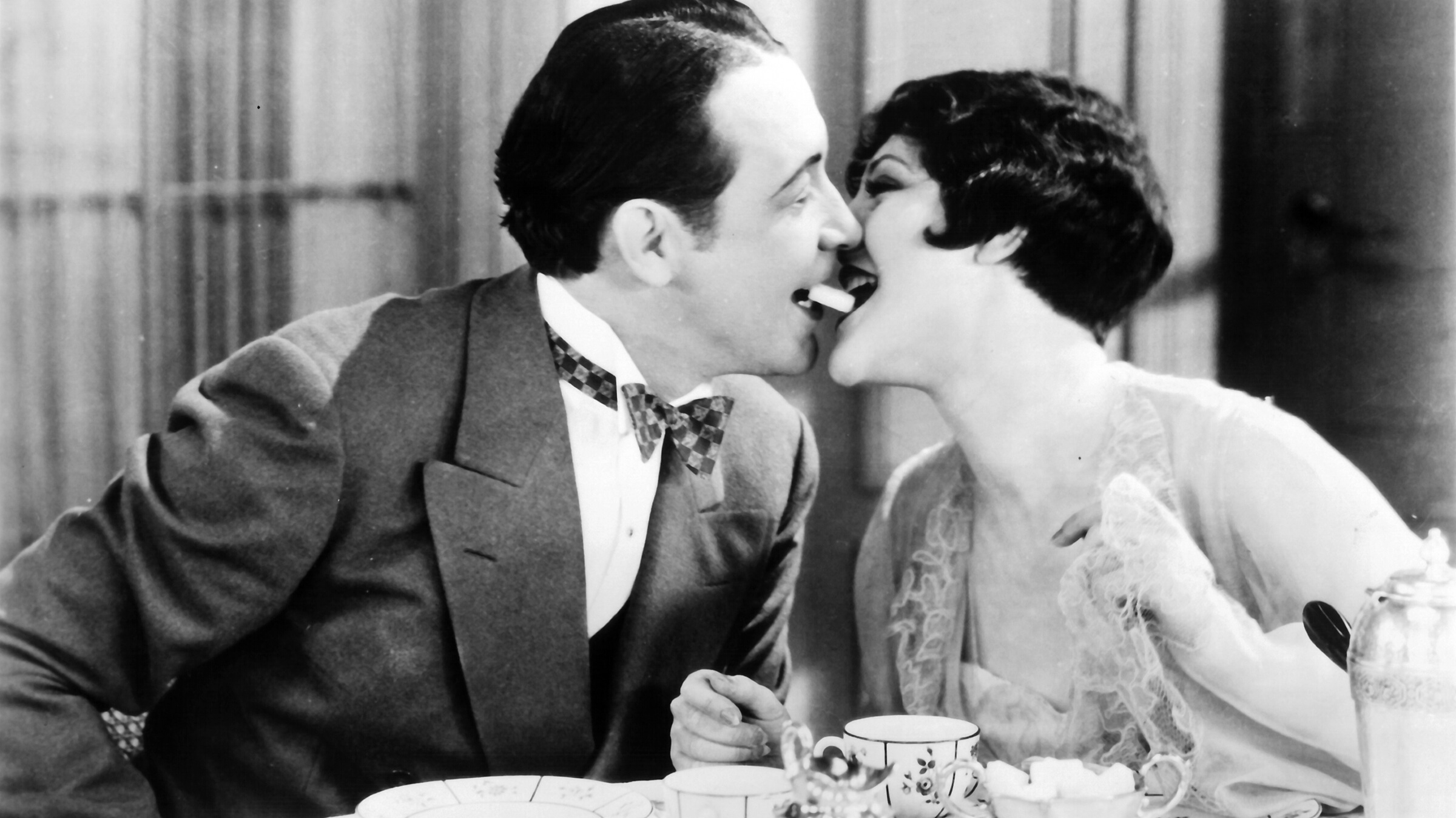
Ernst Lubitsch famously declared, “I’ve been to Paris, France, and I’ve been to Paris, Paramount. I think I prefer Paris, Paramount.” Among the many dazzling Lubitsch films taking place in his imaginary, stylized version of the French capital is So This Is Paris, a frothy sex comedy as light as the most delicate soufflé. Made not at Paramount but at Warner Bros.—the last of several films Lubitsch directed for that fledgling studio, which shortsightedly considered him too highbrow—it’s a racy Jazz Age entry from Lubitsch’s astonishingly fertile and diverse silent period in Hollywood. That influential run of six years remains among the most neglected periods of the German director’s work.
After attracting American interest for his intermittent making of spectacles, Lubitsch was imported by Mary Pickford for Rosita, a 1923 comedy-drama with more subdued spectacle elements. Already tired of that genre by the end of his time in Germany when he turned instead to the tragic Kammerspiel film Die Flamme (The Flame, 1923) with Pola Negri, Lubitsch spent most of the 1920s in Hollywood refocusing his creative energies on intimate character pieces. He pioneered the romantic comedy genre in 1924 with The Marriage Circle, the film that best explains why Jean Renoir said, “He invented the modern Hollywood.” Among the major directors who cited The Marriage Circle as a profound influence on their work were Alfred Hitchcock, Yasujiro Ozu, Douglas Sirk, and Michael Powell.
A virtuosic, supremely witty, and often poignant tale of the temptations overcome by a married couple in Vienna, The Marriage Circle drew from and poked fun at that era’s fascination with Freudian psychology. In So This Is Paris, similar themes of infidelity, suspicion, and deceit, along with raunchy phallic gags involving a cane that would have caused Freud to wag his cigar in delight, are treated in a breezier, more purely playful fashion. The film could take as its motto one of G.K. Chesterton’s paradoxes, “It is so easy to be solemn; it is so hard to be frivolous.”
As in The Marriage Circle, the protagonist is a doctor played by the strapping but goofy-looking Monte Blue, though he’s not a psychiatrist this time. Dr. Paul Giraud is a hapless would-be philanderer who steps out on the town with an old flame, the wild Georgette Lallé (Lilyan Tashman, whose saucy performance so captivated Greta Garbo, according to her biographer Barry Paris, that the actresses became lovers). The cheating couple win a Charleston contest in a lavishly filmed Artists’ Ball sequence that’s one of Lubitsch’s great tours de force. Along the way, the doctor is summoned to jail for insulting a policeman, but through a mix-up, Georgette’s wispy husband (André Beranger) winds up hauled off in his place, but not before stealing repeated kisses from the conflicted but not entirely unwilling Madame Suzanne Giraud (Patsy Ruth Miller).
The screenplay by Lubitsch’s regular silent-film collaborator, Hanns Kräly, has a complicated pedigree. They had filmed a version in Germany, Das fidele Gefängnis (The Merry Jail, 1917), based on an 1851 play by Julius Roderich Benedix, Das Gefängnis. That play inspired an 1872 French farce, Le Réveillon (The Supper Party) by Henri Meilhac and Ludovic Halévy, adapted by Johann Strauss II for his celebrated 1874 operetta Die Fledermaus (The Bat). The official source of So This Is Paris was the frolicsome French play, and Lubitsch’s evolution into a masterful director of subtle character comedy made his Hollywood variation far more enjoyable than The Merry Jail, which is weighed down by the ponderous performance of Emil Jannings as the comical jailer, a part skipped over by the “remake.”
Lubitsch is best known for his wryly imaginative ways of circumventing censorship by suggesting sexual carrying-on that isn’t shown on screen but is made clear in the minds of the audience through his ellipses, clever visual devices, and significant looks passing between characters (a style loosely known as his “touch”). But his deeper creative attention is always drawn to the nuances of how men and women treat each other, a preoccupation that makes him, like Noël Coward in Private Lives, a moralist in opposition to conventional morality. Amanda defines that often-misconstrued concept in Coward’s play: “Morals. What one should do and what one shouldn’t.”
A major reason Lubitsch is seen as the inventor of modern Hollywood is that he brought a continental openness about sexuality to our largely puritanical country, whose film industry was increasingly threatened by censorship as the Victorian attitudes typified by D.W. Griffith films diminished as a result of Roaring Twenties hedonism and notorious Hollywood scandals. Lubitsch took the “un-American” approach of viewing adultery in a mostly positive light, as a stimulant to marriages that could otherwise grow stale. In that he was truly subversive, although paradoxically he also saw the value of marriage, and his films delight in coaxing partners back to the romantic, sexy impulses that originally brought them together.
In contrast to the more dramatic overtones of The Marriage Circle, Lubitsch invites his audience to share in the giddy gaiety of So This Is Paris by showing how ridiculously Paul behaves with the riotous Georgette and how his neglected wife, Suzanne, gets hot to trot swooning over a naughty novel of popular “sheik” fiction. She’s even more titillated by the voyeuristic sight of a real-life pair of “Apache” (pronounced Ah-pash) dancers in the opposite apartment (Lubitsch also spoofs the Apache dance craze in a segment he directed for the 1930 revue film, Paramount on Parade). When Paul patronizingly sticks a thermometer in her mouth, Suzanne explains her sexual desires by declaring, “I’m not sick—I’m just a normal woman.”
The indiscreet interactions between the two couples in So This Is Paris tempt Georgette to dally with the polyamorously perverse Maurice Lallé, and learning of her husband’s romp with Georgette at the ball via radio makes her go there to confront him while he’s drunk and she’s wearing a mask. Lubitsch’s observations of these frivolities are “only superficially superficial,” to borrow Coward’s description of his own work. The film’s risqué elements, including Paul’s unsteady odyssey through Parisian nightlife, evoke Arthur Schnitzler’s 1926 Freudian novella, Traumnovelle (Dream Story), and Stanley Kubrick’s 1999 film version, Eyes Wide Shut. As in those works, Lubitsch and Kräly restore a sense of parity in marriage, partly based on a mutual willingness to overlook its flaws, while enabling Suzanne to declare herself the “Big Boss” of her literally shrinking spouse.
The Charleston sequence—with its dazzlingly avant-garde camerawork by John J. Mescall, settings by Harold Grieve, swirling superimpositions in Lubitsch’s editing style that conveys a feeling of intoxicated abandon—is renowned for being one of the passages in a silent film that most vividly anticipates the coming of sound. Lubitsch had already “invented the musical” (in the words of French critic Jean Douchet) with his uproariously dazzling and rhythmical “Foxtrot Epidemic” scene in his 1919 German surreal silent comedy The Oyster Princess. Here Lubitsch furthers his advances in the medium that would lead to his pioneering the actual musical containing integrated songs and dances with his 1929 film The Love Parade.
As memorable as the Charleston sequence is in So This Is Paris, and as jokingly as Lubitsch tosses off the “moral” of the story at the end, what lingers most charmingly and generously is the director’s sophisticated sense of what a happy marriage entails. One can do no better than to quote Oscar Wilde, whose play Lady Windermere’s Fan was filmed by Lubitsch in 1925, another of his silent masterpieces. So This Is Paris, like The Marriage Circle, demonstrates Wilde’s epigram “The one charm of marriage is that it makes a life of deception absolutely necessary for both parties.”
Presented at SFSFF 2026 with live musical accompaniment by Stephen Horne and Frank Bockius