
“What’s missing from movies nowadays,” D.W. Griffith complained in 1948, “is the beauty of the wind moving through the trees.” That plein-air freshness he longed for is nowhere more abundant than in Scandinavian silent films, steeped in the elemental power of nature. It’s a quality that makes Song of the Scarlet Flower seem to stand outside of time. Scenes of apple-cheeked youths dancing in a ring on a grassy riverbank evoke a lost pastoral innocence, but when a breeze ripples through the wheat or spray billows off foaming river rapids, time dissolves and you can smell the pine trees and sun-warmed earth.
When he made the film, Mauritz Stiller was already one of Sweden’s top directors and on the cusp of international fame. Born to a Jewish family in Helsinki, Stiller left for Sweden to avoid service in the tsar’s army, at a time when Finland was still a grand duchy of Russia. He started as an actor, soon moving from theater to movies and from performing to directing. His name will forever be yoked to that of Greta Garbo—indeed, he is usually credited with coining her surname, an improvement on the prosaic Gustafsson—whom he cast in her breakthrough film, the sweeping costume epic Gösta Berling’s Saga (1924). Openly gay, Stiller cultivated the persona of a cosmopolitan dandy, zooming around Stockholm in a canary-yellow roadster. His hugely influential Erotikon (1920) is as sophisticated a comedy of urbane adultery as those Lubitsch made a few years later.
Song of the Scarlet Flower is something else entirely. Based on the 1905 novel Laulu tulipunaisesta kukasta by Johannes Linnankoski, one of the most celebrated works of Finnish literature, it is the story of a womanizing Don Juan who joins a gang of itinerant loggers and competes in macho feats of skill. Stiller handles this material (in the first of at least five cinematic adaptations of the book) with great subtlety and sensitivity. The film is at once a pastoral fable, couched in poetic verses and the lyrics of folk songs; a modern psychological melodrama; and an account of a man’s existential journey toward self-knowledge.
A big-budget production from the first golden age of Swedish cinema, before its best talents were poached by Hollywood, it is typical of the prestige literary adaptations favored by Svensk Filmindustri. Stiller followed it with several films based on books by Nobel Prize-winner Selma Lagerlöf, beginning with Sir Arne’s Treasure (1919), a chilling tale of murder and betrayal set against the harrowing cold and stinging snows of a medieval winter. By contrast, Song of the Scarlet Flower revels in nature at its most verdant and sensuous; it was shot in the summer of 1918, largely on location around the river Faxälven in northern Sweden. Scenes are often staged on the crests of hills, with vast panoramic landscapes of rolling pastures and pine woods spreading out into the distance. You can see forever in the clear northern light, and the midnight sun gives new meaning to “day for night.” In another contrast with the haunting and haunted Sir Arne’s Treasure, there is not a hint of the supernatural in Song, and the hero soon abandons his boyish talk of wood nymphs and enchanted castles. There are few reminders of religion, either; this is a thoroughly material world in which natural instincts battle with society’s rules.
The story is written on the landscape in water, wood, and earth. The central conflict is between the rooted, settled existence of farmers and the roving freedom of the loggers who pass through, literally carried on the tide. Olof Koskela (Lars Hanson) is the son of a large, prosperous farm, but we first meet him in the woods, felling a huge tree. His wandering eye is quickly established. In the book, Olof dallies with some dozen girls, whom he nicknames after various plants or animals, but in the film he cuts a considerably narrower swath through the female population. After he is caught in the barn with Elli (Lillebil Christensen, later Ibsen), enjoying a—thus-far innocent—roll in the hay, Olof leaves the farm following a violent confrontation with his father. The patriarch’s outrage at his son’s intention to marry a lowly maid is ironically echoed later by the reaction of another squire who angrily rejects Olof’s request for the hand of his daughter Kyllikki (Edith Erastoff); no daughter of his respectable family will marry a vagabond, he insists. Although the story traces Olof’s path from footloose irresponsibility to repentant maturity, it paints a grim picture of the narrow-minded, snobbish world into which he ultimately settles.
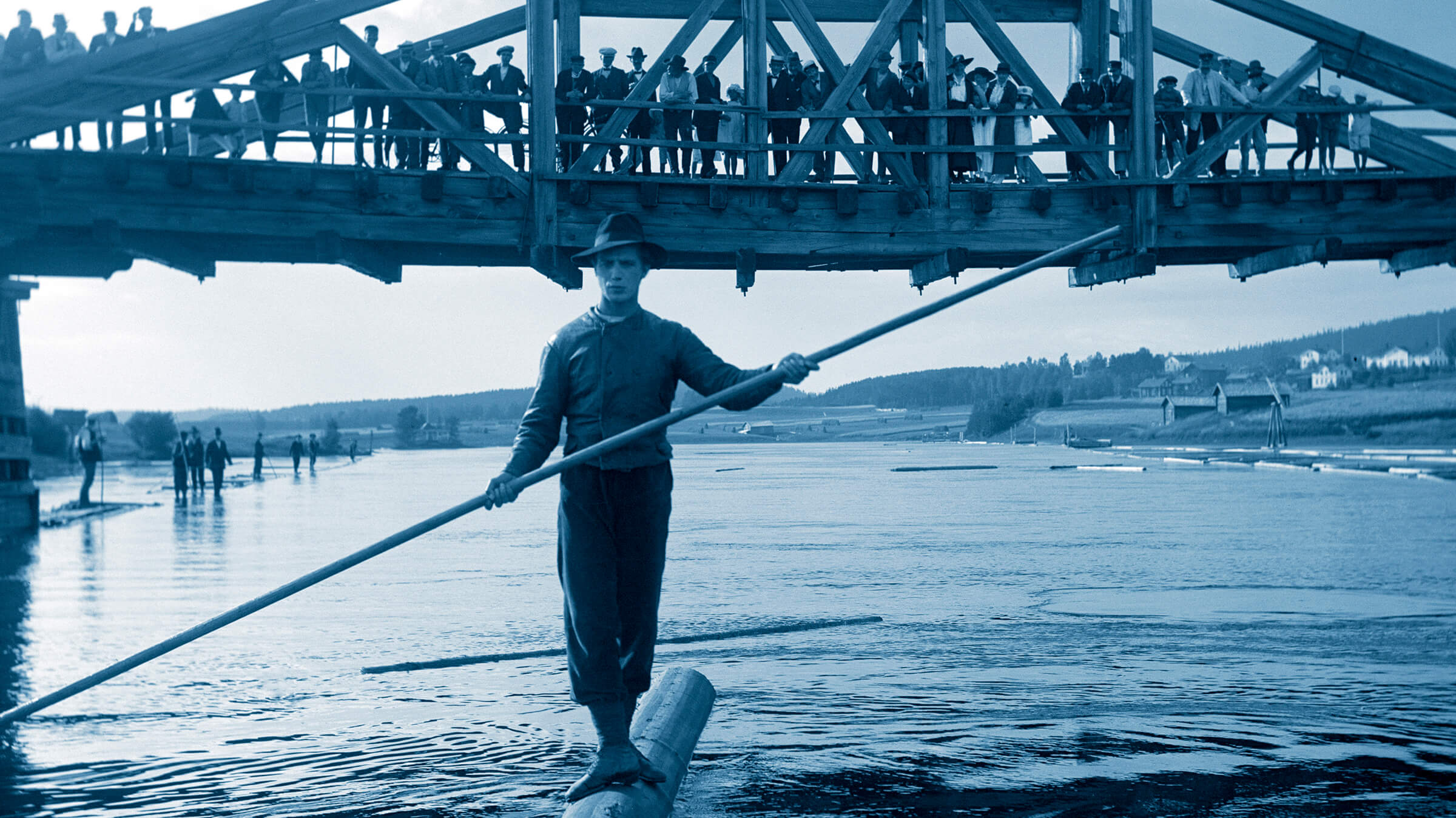
The alternative is the community of loggers, who memorably travel downriver by balancing upright on logs, a kind of primitive and treacherous paddleboarding. The scene in which Olof, seeking to impress the proud Kyllikki, rides a log over the Kohiseva rapids forms an astounding centerpiece to the film. This impossible-looking stunt, evidently being performed for real by someone, is framed in beautiful wide shots in which the tiny figure sails along a broad river whose current shifts from glassy pools to waves surging and galloping over rocks. Rather than goose up the action with fancy editing, Stiller establishes a stately contrapuntal rhythm between the fluid long shots of Olof and cut-in close-ups of the excited crowds watching him. He is a young man showing off, but his grace and the precariousness of his balance crystallize a stunning image of the freedom he is compelled to seek, its exhilaration and its dangers.
Lars Hanson had made his film debut in 1915 under Stiller’s direction and soon became one of Sweden’s most popular male stars. Playing the title character, a defrocked priest, in Gösta Berling’s Saga, he caught the eye of Lillian Gish, who asked MGM to bring him over to play Reverend Dimmesdale opposite her Hester Prynne in The Scarlet Letter (1927). He was ideally cast as the puritan minister who is also an adulterous hunk, since on screen he combines earthy physicality with a high-strung interiority that can easily read as repressed passion or zealous idealism. He left for Hollywood the same year as Stiller and Garbo, with whom he costarred twice. Sweden’s other top director, Victor Sjöström, was already established there, and directed The Scarlet Letter. (Sjöström by then was married to Edith Erastoff, who had played his ill-fated spouse in The Outlaw and His Wife shortly before she appeared in Song. The Swedish film industry was a fairly small world.) The notoriously autocratic Stiller could not adjust to a studio system that expected directors to be cooperative employees; he returned to Sweden, only to die of pleurisy in 1928, aged just forty-five. Hanson also went back home with the coming of sound, to enjoy a long and distinguished stage career.
His most remarkable scene in Song of the Scarlet Flower is Olof’s confrontation with himself in a mirror, an early and striking entry in the history of this cinematic motif. The moment of self-recognition comes in the only chapter of the film set in town, in darkness and rain, and largely indoors; the contrast after the wide-open spaces is abrupt and suffocating. In a brothel, he makes a discovery that reveals for the first time the wreckage he has carelessly left behind him. Swedish cinema was typically ahead of the rest of the world in its sexual frankness, just as it was in developing a naturalistic yet psychologically charged style of acting. We see this at its best in the mirror scene: a look of nausea twists Hanson’s handsome features as he turns to face his reflection. The rather bombastic intertitles in which Olof berates himself are redundant given the self-loathing he conveys, without excessive mugging. The beauty in this scene comes not from wind moving through the trees, but truth unsettling a soul.
Presented at SFSFF 2025 with live musical accompaniment by the Guenter Buchwald Ensemble (Buchwald, Lewis Patzner, Frank Bockius, Stephen Horne)