
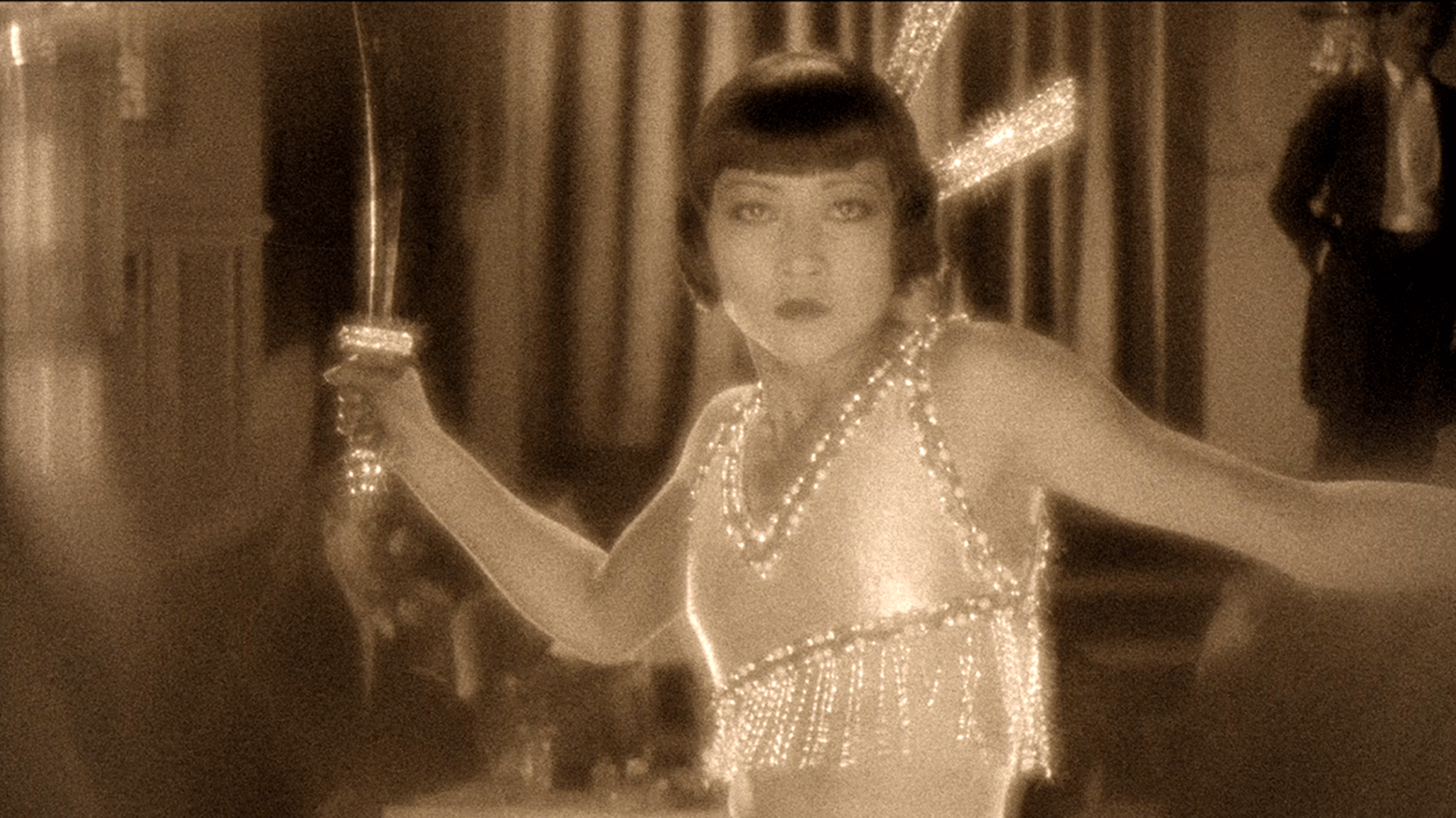
Song might be the most underrated film of Anna May Wong’s four-decade career. By the late 1920s, the Chinese American actress had become disillusioned with Hollywood’s myopic vision for her screen career—always the sing-song girl, never the leading lady. Wong had been grasping for a part that would divorce her from the stereotypical supporting roles she’d become known for. In early 1928, an opportunity finally materialized.
Germany came calling with a picture deal for a starring role and a script written specifically for her by Karl Vollmöller (The Miracle, The Blue Angel). Titled Schmutziges Geld, or Dirty Money, it captured the tragic tale of star-crossed lovers. In fact, the film was later retitled Song in honor of Wong’s character, itself a nod to the actress’s birth name, Wong Liu Tsong. The offer came at the peak of what was known as “Film Europe,” a movement in the mid-1920s to create a pan-European cinema that could compete with the flood of imported American fare and try to conquer some international market for itself.
Of course, there were risks to leaving Hollywood. Talkies had made their debut with 1927’s The Jazz Singer and U.S. studios had begun the transition to sound in earnest. Meanwhile, the major European outfits were a couple years away from integrating sync-sound technology. Wong was faced with a stark choice: stay put and endure more of the same; or leave for distant shores where her success was anything but assured. (Around the same time, Louise Brooks left her Paramount contract behind to make Pandora’s Box and Diary of a Lost Girl. Her foray into German cinema did not bring about a triumphant return to Hollywood, underscoring the gamble involved.)
“I sought the advice of many relatives and friends. I considered all they said. Many of them advised against such a difficult and uncertain venture,” Wong later recalled. She was twenty-three years old. The farthest away from home she had ever been was Canada. And she didn’t speak a word of German. Yet she decided to go.
On her arrival Wong was immediately embraced by the German public. A clipping from the popular film magazine Mein Film shows her disembarking from a train in furs, hugging a bouquet and waving to the crowd underneath the headline, “I am very happy.”
She went to work with director Richard Eichberg, who was also a shrewd producer with a reputation as a star-maker, and her costar Heinrich George, who had played a memorable role in Fritz Lang’s Metropolis. On set, she was slightly perplexed by the little leather books she noticed crewmembers carrying around, which she soon learned were German-to-English dictionaries. The sensible Wong wouldn’t hear of such excessive accommodation on her behalf and decided to enroll herself in German lessons because, in her words, “it would be easier for one person to learn German than for an entire company to master English.”
The film’s plot revolves around Song, a Malay castaway living by her wits along the coast of Istanbul (then commonly known as Constantinople). When two sailors attempt to abduct her for their own pleasure, an unexpected hero emerges in John Houben (Heinrich George). A vaudeville artist living in exile and estranged from his famous ballerina girlfriend who thinks him dead, John helps Song fight the men off and then swiftly goes on his way. But the instantly love-struck Song follows him home. When she arrives at his doorstep in the pouring rain, he gruffly allows her in and so begins their unlikely partnership. She joins his knife-throwing act as the exotic dancing girl who flutters across the stage in a bralette and grass skirt, much to the crowd’s delight, while at home attending to John’s every domestic need.
John remains all but blind to Song’s love for him, a foreshadowing of the literal blindness he later experiences after a train heist goes wrong. Impervious to Song’s charms, his flame still burns for Gloria Lee (Mary Kid), who arrives in town as the star dancer in a touring ballet troupe. When he shows up in her dressing room, she recoils at his newly impoverished circumstances. It is money—dirty money—that drives him into a life of crime with disastrous results.
On paper, the story seems predictable and melodramatic. Seen on the big screen, it’s a marvel of German Expressionism charged with Wong’s magnetism. I first watched the film in one of the small basement screening rooms at the British Film Institute in 2022. The archivist taught me how to spool the 35mm print on a Steenbeck flatbed and swap out the reels, and for ninety minutes I was awestruck by her performance. Here, finally, was a picture that gave Wong the opportunity to demonstrate the full range of her instrument—just as Weimar cinema reached its apogee.
Despite having to play yet another dancing girl in need of rescue with some of the same problematic Orientalism of her Hollywood roles, Anna May Wong felt Song was exactly the kind of meaty part she had been waiting for. “The role is perfect. It is my role like none before,” she confessed to cultural critic Walter Benjamin at a Berlin party one night. Wong was already well known in Hollywood for her ability to turn on the waterworks. When word spread that she was shooting, workers from all around the Neubabelsberg studio crowded the set to watch her cry.
Her performance is much richer than the mere production of tears on cue, however. In one scene where she pretends to be Gloria for the benefit of John, he reaches out tenderly to touch her face and Wong shimmers with suppressed emotion. Her subtle expressions reveal not only the depth of Song’s love for John but also the anguish she has kept hidden from him—something only the audience has been privy to. How did a girl who grew up in a laundry on the outskirts of Los Angeles’s Chinatown learn to do that?
Song premiered at the Alhambra in Berlin on August 21, 1928, dazzling the audience. By Wong’s own account, she received a standing ovation that lasted twenty minutes. Afterward, she was mobbed by admirers in the theater lobby: “I seemed suddenly to be standing at one side watching myself with complete detachment. It was my Chinese soul coming back to claim me.”
A critic for Der Kinematograph praised director Eichberg for discovering Wong “not only for Europe, but perhaps for the cinema, because for the first time he puts this highly talented woman on the big screen, turning her into an Asian Mary Pickford ….” Within weeks of its release, Song was screened at ninety-four cinemas across Germany.
When the film made its way to British audiences, a reviewer for the Bystander was similarly enthusiastic, even comparing Wong to Greta Garbo. “With Anna May Wong in the leading rôle success is ensured, but how she shows up the lesser talent of the other players! … She stands out as being one of the most talented screen actresses of to-day.”
Wong made other films in Europe on the heels of Song’s success, including Piccadilly (1929) and Pavement Butterfly (1929), bolstering her profile across the Continent. Yet just as Film Europe’s aspiration to make inroads into the U.S. market ultimately failed, so did Song’s, even as they omitted depictions of interracial love to please American censors. According to scholar Cynthia Walk, Song’s scenario was “more daring than the released film.” Kissing and caresses were scripted between Wong and George’s characters but never filmed.
Song did not land stateside until December 1929. Retitled as Wasted Love, it had a paltry four-day screening at New York’s Little Carnegie Playhouse. Mordaunt Hall, reviewing it for the New York Times, panned the film as “a hapless piece of work that is years behind the times.” Irene Thirer of the New York Daily News followed with a one-star review, calling Wasted Love “a bolt of wasted celluloid.” It’s no wonder, then, that the film has been nearly impossible to screen on this side of the Atlantic for the better part of a century. Filmmuseum Düsseldorf’s recent restoration has finally brought an end to this misguided censure. At last, Anna May Wong gets her chance to astonish American moviegoers with one of her most brilliant performances.
Presented at SFSFF 2025 with live musical accompaniment by Stephen Horne and Frank Bockius