
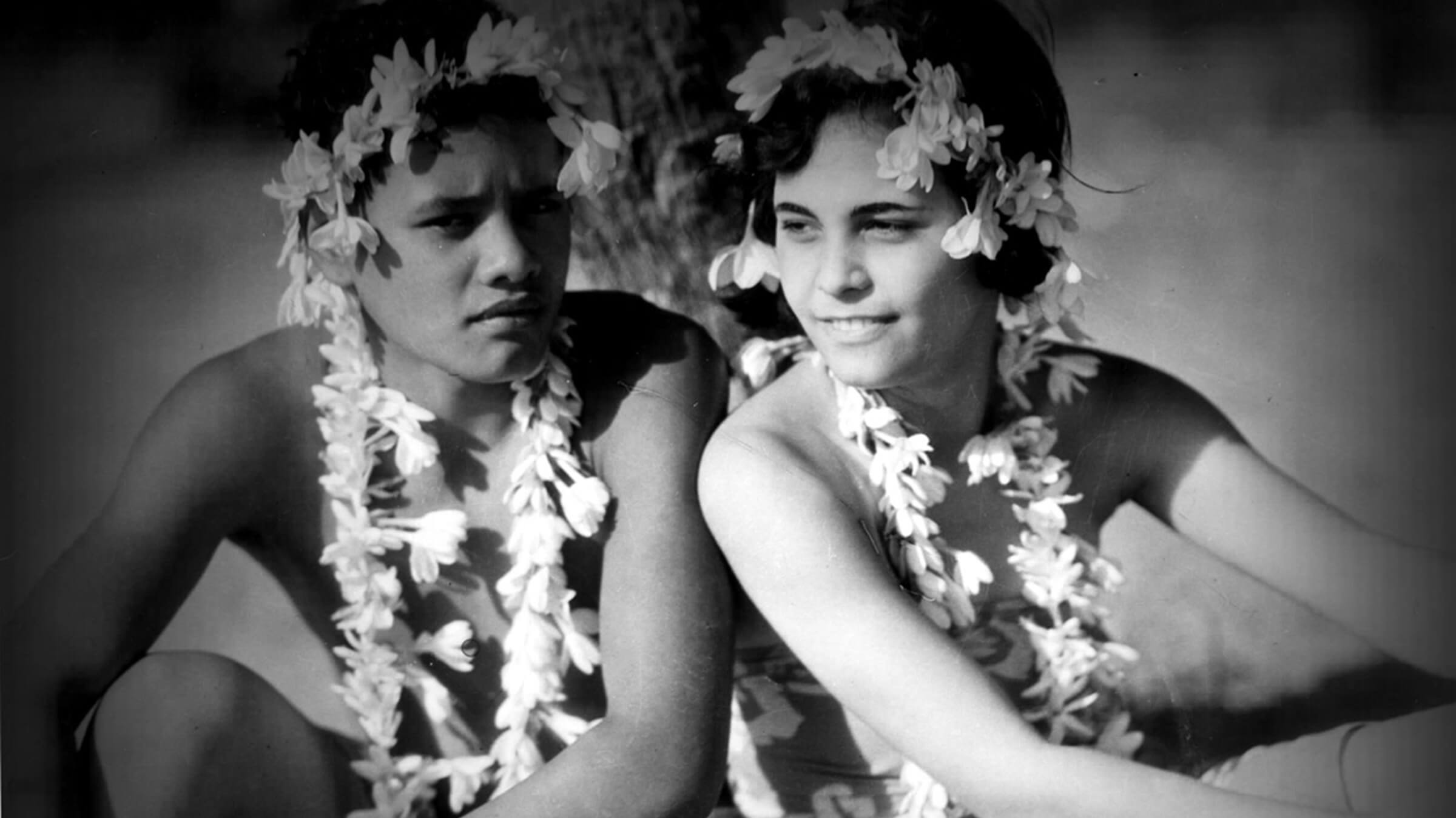
Nearly a hundred years ago, F.W. Murnau, cinema’s great fatalist, and Robert Flaherty, cinema’s great naturalist, left for the South Seas to make a movie. The impetus came from their mutual disaffection with Hollywood, and a legend that Flaherty had heard during his stint unsuccessfully working on location for MGM’s White Shadows in the South Seas. The script for Tabu was written by both men, before and during production.
Financing was ostensibly arranged through an outfit called Colorart, but all they ultimately contributed was $5,000, which forced Murnau to finance the film out of his savings. Murnau bought a yacht and left for Tahiti in the second week of May 1929. On August 20, 1929, Flaherty wrote to his wife: “[Murnau] has decided to finance the picture himself – to forget color – photograph it all with my Akeley – me photographing.”
Production began in January 1930, with Flaherty shooting the opening fishing and waterfall sequences. But his Akeley camera began to tear film, so he wired Floyd Crosby, a young cameraman he had met a few years earlier, to come to Tahiti with his camera. “He had no idea what [the problem] was,” remembered Crosby. “He was completely unmechanical minded; he never drove a car during his whole lifetime. So I went and took over the picture.”
Crosby was drawn to Murnau’s professionalism and aesthetic, but not his personality. For lodging, Murnau had the locals build him a one-bedroom house, with guest lodgings about two hundred feet away. He also had a phonograph, which he only played for himself. “He was a terribly selfish man,” said Crosby. Flaherty was reduced to negotiating with the Tahitians in a way that the aloof German could not. According to Crosby, “Tabu was made by Murnau. Flaherty worked on the story and supervised the lab work. I was the cameraman and had a native assistant. Our entire equipment was my camera and two or three old reflectors. The only moving shots we made were out of canoes.”
Murnau paid Crosby $140 a week, half in cash, half in a small piece of the picture. After a few months, Crosby asked for all of his salary in cash, further pushing Murnau’s finances to the wall. As far as the Murnau-Flaherty partnership was concerned, Crosby said that “They disagreed on everything. Murnau liked Flaherty, but Flaherty disliked Murnau because of his arrogance and his Prussianism, and the fact that he just took the picture and wrapped his arms around it and Flaherty really had nothing to do with it except to help on the story.”
The film was shot on polyglot film stocks: Eastman Type 1, Eastman Type 2, Dupont, and some stock that was completely unmarked. The only real production problem was presented by Reri, who plays the heroine. “She used to get plastered over the weekend,” said Floyd Crosby. “I had to go and try to find her on Monday mornings ….”
Flaherty spent most of his down time with Crosby. “Three times a day, at meals, he’d tell me how he hated Murnau … On the first [film we worked on] White Shadows in the South Seas – [Flaherty’s conversation] would be against Hollywood and the Jews, and on Tabu it was against Murnau. I was sort of an outlet for his discontent.”
Murnau wrote extremely specific shot lists in English, some of which survive: “Matahi comes running in, pearl in hand. All of a sudden he slows down as if he wanted to sneak in. (NO SHADOWS ON SAND IN DOOR OPENING!) …
“All movement of boat + Matahi from left to right.”
The shoot lasted nine leisurely months, with Murnau’s excellent French making translators unnecessary. In a letter to his mother, Murnau rhapsodized: “I am bewitched by this place. I have been here a year and I don’t want to be anywhere else.”
Production was completed in early October 1930; a few days after that, Flaherty sold out his percentage of the film to Murnau for $25,000, payable in installments. Murnau spent the last of his savings having a musical score written and recorded, then managed to sell the film to Paramount for an advance of $75,000.
On February 6, 1931, Murnau received a wire from H.H. Caldwell and Katherine Hilliker, the editors and title writers of Sunrise:
Tabu is a glorious achievement breathtaking in its beauty a great love story we salute you –(STOP)– from only one showing we hesitate to offer editing suggestions but do wish to make one point –(STOP)– Killing of pearl diver by shark throws your entire last half out of gear –(STOP)– Granted it is brilliantly done you get over nothing that your insert does not cover and you stop the stride of the story to arouse breathless interest in characters that never appear again –(STOP)– We got a distinct let down after this sequence and it took some time to get back to our absorption in the lovers –(STOP)– Otherwise we kiss your hands and rub our noses in the dust at your feet Dr Jekyll and Mrs Hyde
The next day Murnau replied:
Dear Jekyll and Hyde Many thanks for your telegram and kind comments … how i wish you were here to discuss and fight your criticism about pearl diver sequence absolutely correct every time i have to look at it it pains me because it hurts smooth running of the main story still I have to establish the tabu spot in which the hero is going to dive at the end its danger and its rich pearl bed in your opinion could i do without this but if i do without what explanation would i have for the floating tabu sign over the spot in which the hero dives … wish i could take the diving sequence out altogether –(STOP)– God how i wish you were here
Regards Murnau
On February 8, Hilliker and Caldwell wired:
Believe you should eliminate pearl dive sequence entirely keep shots of floating tabu sign –(STOP)– In policeman’s first insert reporting rescue of lovers and boys skill as diver plant need of divers since some of their men have been mysteriously lost at one particular location in lagoon –(STOP)– His report later of loss of their best diver and necessity of placing a tabu over the spot where he disappeared will build naturally –(STOP)– Won’t you get even greater thrill if your audience as well as the boy is in ignorance of what awaits him below –(STOP)– Nothing would give us greater joy than to fight it out with you why not come east …
But Murnau did not come east. On March 10, Murnau’s car was on the coast highway outside Santa Barbara when his driver swerved to avoid collision with a truck. The car went over an embankment, rolled twice, and landed bottom up thirty feet below. Murnau’s skull was fractured and he died the next morning. A week later, Tabu, advertised as “A Murnau-Flaherty Production, Directed by F.W. Murnau,” opened in New York City. The review in Variety was condescending, while the New York Times liked it. The film played twelve weeks in New York but got little traction anyplace else in America because, with the exception of City Lights, a silent movie in 1931 was intrinsically archaic. Although Floyd Crosby’s luminous photography earned an Academy Award, the final world gross was under $500,000, leaving Murnau’s estate with $141,000, $13,000 less than he had spent making the picture.
The original negative was destroyed during World War II, but Floyd Crosby personally paid for a duplicate negative made from an original nitrate print at the UCLA archive. Forty years after the film was made, Crosby returned to Tahiti with his wife. He was showing her where some of the scenes had been shot when an old man became hysterical with joy at the sight of Crosby. He told Crosby that Tabu would occasionally be shown and everyone would go to see Grandma and Grandpa. The audience would cry because everyone in the movie was dead, except on the screen, in the radiant silver light cutting through the gentle tropical night.
Tabu remains intoxicatingly romantic with strong undertones of the malignant fate that awaited most of Murnau’s characters and, as it turned out, Murnau himself. Eric Rohmer’s estimation still holds up: “The most gorgeous film by the greatest movie director in the world.”
Presented at SFSFF 2026 with live musical accompaniment by Wayne Barker and Mas Koga