
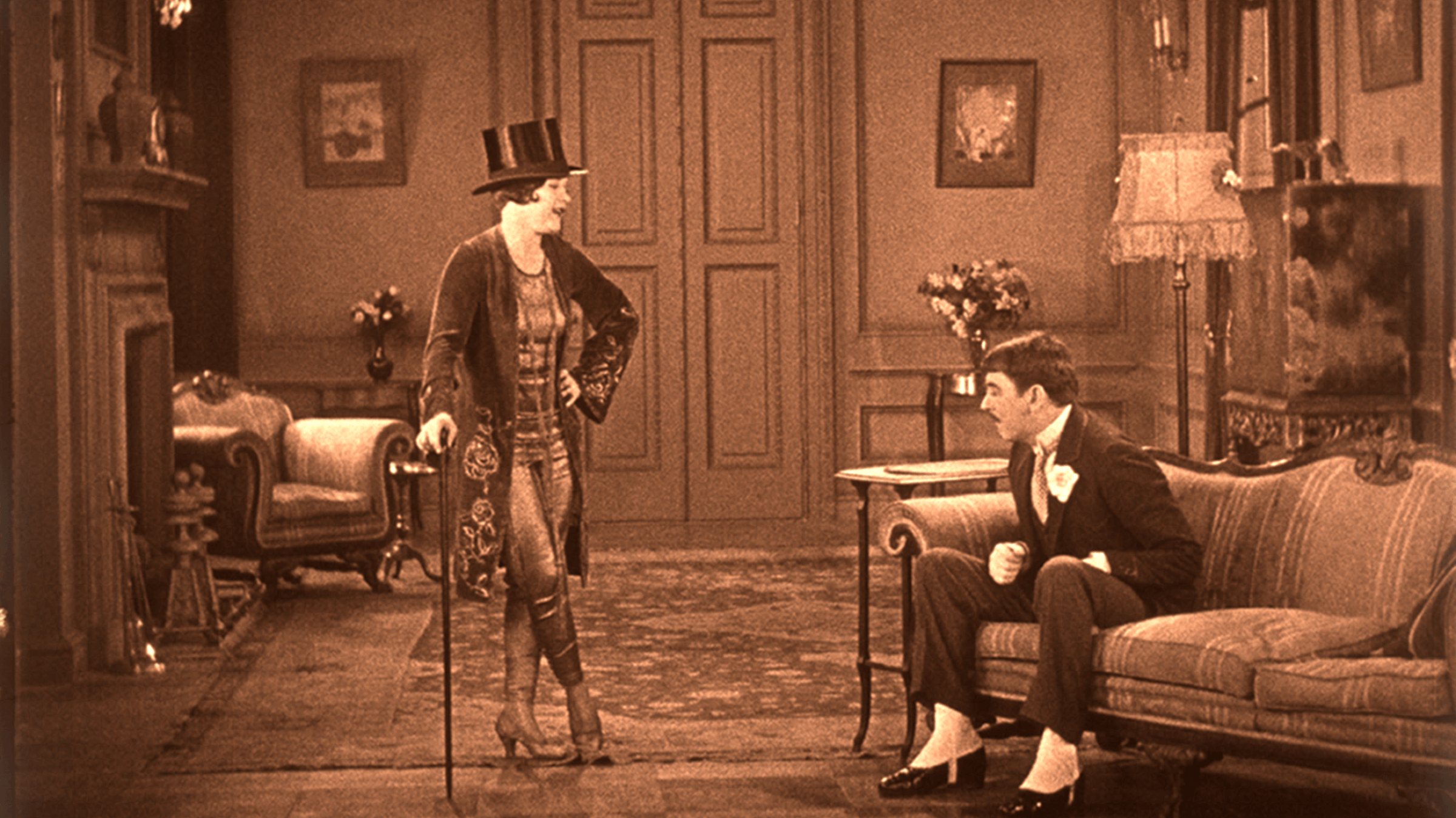
Screwball comedy delighted in frolicking in those effervescing spaces that supposedly exist between the classes: William Powell’s “forgotten man” discovered by bored rich girl Carole Lombard; Jean Arthur’s simple secretary dropped upon by a sable coat; Gary Cooper’s Mr. Deeds learning that high society—shocker!—is morally bankrupt. We’ve become so used to thinking of the genre as Depression-era escapism that we ignore how often the setup was milked long before the Crash. When Warner Brothers released The Caveman (sometimes written as The Cave Man) in 1926, reviewers almost unanimously remarked on the commonplace nature of the rich-girl-makes-over-a-proletarian-Neanderthal frame, but what the story lacked in originality was made up for by upcoming director Lewis Milestone’s handling of the material and the terrific performances, all on glorious display in this world premiere of a spanking new restoration.
Though set in Manhattan, The Caveman has an important San Francisco connection, as author Gelett Burgess began his writing career from a home on Russian Hill, and his association with the city is the chief reason he’s remembered today. That, and the fact that he invented the word “blurb”—among lots of other words that never caught on in the same way, such as flooijab (“an apparent compliment with a concealed sting”); hyprijimp (“a man who does woman’s work”); lallify (“to prolong a story tiresomely, or repeat a joke”); oofle (“a person whose name one cannot remember”); and tashivation (“the art of answering without listening to questions”). All of which are such useful terms it makes one wonder why on earth the only one that stuck is “blurb.” But for those, like me, keen on resurrecting udney (“a beloved bore”) without seeming like an edicle (“one who is educated beyond his intellect”), I suggest you study Burgess Unabridged. A New Dictionary of Words You Have Always Needed (1914).
Five years before the publication of that much- needed tome, Burgess came out with Lady Méchante, a novel whose second half, titled “The Cave Man,” is the basis for the film of the same name. Actually, a 1911 play and two films, the first of which, directed by Theodore Marston in 1915, is believed lost. The Lady Méchante of the title is one Madelaine Mischief, a.k.a. Mrs. Nelly Hellysh, whose first husband was an English lord. Out of boredom in her rooms in New York’s Flatiron Building she tosses a torn $100 bill out the window with a note attached, instructing the finder (be it male only) to come to her apartment and receive the other half. The $100 finds its way into the hands of a coal-stoker with the unlikely name of Haulick Smagg, who arrives at the lady’s apartment covered in soot and exuding working-class beastliness. Naturally while having him cleaned up, she falls for the guy because, well, all women want a brute they can address as “O, Troglodyte,” don’t they? As the novel ends, Lady Méchante finally gets her clinch, exclaiming, “Kiss me like a cave man, Haulick, if you will! Kiss me as I’ve never been kissed before, then take me by the hair of my head and drag me into your cave!”
The novel comes with the subtitle “a farce in filigree,” but let’s pause just for a moment to consider what kind of men—Burgess is hardly unique—perpetuate, even in satire, this concept of jaded womanhood yearning to be controlled by a coarse lout. As Cole Porter wrote in “Find Me a Primitive Man” (1929): “I don’t mean the kind who belongs to a club / but the kind who has a club that belongs to him.” Given the troubling rise of Hegsethian models of masculinity, we do well to consider the problematic nature of this notion, even when written in jest.
In 1925 Warner Bros. began preproduction on The Caveman, entrusting the adaptation to well-established scenario writer Julian Josephson and Darryl F. Zanuck, with Jack Waggoner brought on as “gag man.” A number of changes were made to Burgess’s original, starting with location: the $100 bill is tossed out of a Park Avenue window overlooking Grand Central Station, and the woman throwing it has been rechristened Myra Gaylord, incarnated with understated radiance by the forever marvelous Marie Prevost. The torn banknote’s peregrinations become one of the film’s highlights before finally winding up in the grimy hands of Irishman Mike Smagg (“Haulick” was thankfully jettisoned), a role Matt Moore was born to play. He charges into Myra’s apartment like the literal bull in a china shop, much to the terror of her weary French maid Yvette in the delightful form of Myrna Loy, in one of her earliest roles. Beholding this primitive hulk of a man coated in coal dust, Myra decides to play Pygmalion, inserting Smagg among her high society cohorts as a sort of game to combat her ennui.
What she teaches him about comportment is designed to expose the hypocrisy and artificiality of millionaires only too eager to find a new plaything as long as he’s a member of their own class—Myra passes Smagg off as a sociologist whose coarseness comes from a lengthy study of the proletariat. “Mr. Smagg is a Realist,” Myra explains to a shocked woman at a soirée, labelling him as a Modernist in touch with all the latest artistic trends that give one a fashionable aura. With such credentials and her sponsorship, all his “smaggery,” as Burgess calls it, enhances his honeypot attraction and the ladies fall for him, including Daisy Van Velt (many sources mistakenly call the character Daisy Van Dream, but that’s her name in the novel, not the film) and her mother, played respectively and respectably by Phyllis Haver and Hedda Hopper. As Burgess writes about Daisy, “the pristine power of the primitive appealed to her soul. The immemorial desire for man’s mastery agitated her woman’s heart. Primordial and paramount, in this magnificent exhibition of physical endeavor, she perceived Smagg as a man, a mate, a master, a demigod.” Rupert Hughes, author of the film’s intertitles, doesn’t reach such embellished prolixity, though it would be interesting for a scholar to look into the three letters from Hughes to Burgess existing among the Burgess papers at the University of California, Berkeley, as they may shed light on the novelist’s feelings about the adaptation.
Skewering hypocrisy and the cruelty of apathetic capitalism later became part of Lewis Milestone’s signature, but in 1926, after just two other features, the editor-turned-director was still finding his way within a studio system that wouldn’t have cared yet about his political inclinations. Most reviews were glowing but a few perspicacious critics noted a certain unevenness, most particularly Richard Watts Jr. of the New York Herald Tribune who noted, “There are moments in the picture that suggest Mr. Milestone as a careful student of the methods of the German film makers: bits of comedy that trace straight from Lubitsch, photographic inventiveness reminiscent of Murnau. And then, just as you expect the comedy to develop into a first-rate bit of satiric fooling, there arrives a dreary, commonplace stretch of film ….” Watts is a bit too harsh here, and any occasional lags are more than made up for by the highlights: the flight of the $100 bill is superb, as is a marvelous scene of Smagg’s coal-cart horses racing back home and, perhaps best of all, a sequence at a fancy reception when the lights go out and Smagg grabs every woman nearby and kisses them, something they all wanted but wouldn’t accept when the lights were on.
There may be an explanation for the apparent inconsistencies: two curious articles in the British press (Blyth News Ashington Post and The Picturegoer) claim that in the middle of the shoot, Milestone was called away by Warner’s to start work in Florida on a Famous-Players-Lasky film they loaned him out for, The New Klondike, so Matt Moore stepped in to finish some of the New York scenes. I’ve not found confirmation of this in any of the U.S. press; it certainly seems odd that Milestone would have left The Caveman before completion and entrusted it to his male lead, who hadn’t sat in the director’s chair since 1917. We know Milestone was frustrated that Warner’s kept loaning him out, so he broke his contract and was successfully sued by the studio, but whether he finished The Caveman himself isn’t clear. Perhaps this accounts for a certain all-but-imperceptible nodginess (nodgy: “inconsistent … the one chair that doesn’t match the furniture”). But I don’t think anyone will mind.
Presented at SFSFF 2026 with live musical accompaniment by Mont Alto Motion Picture Orchestra