
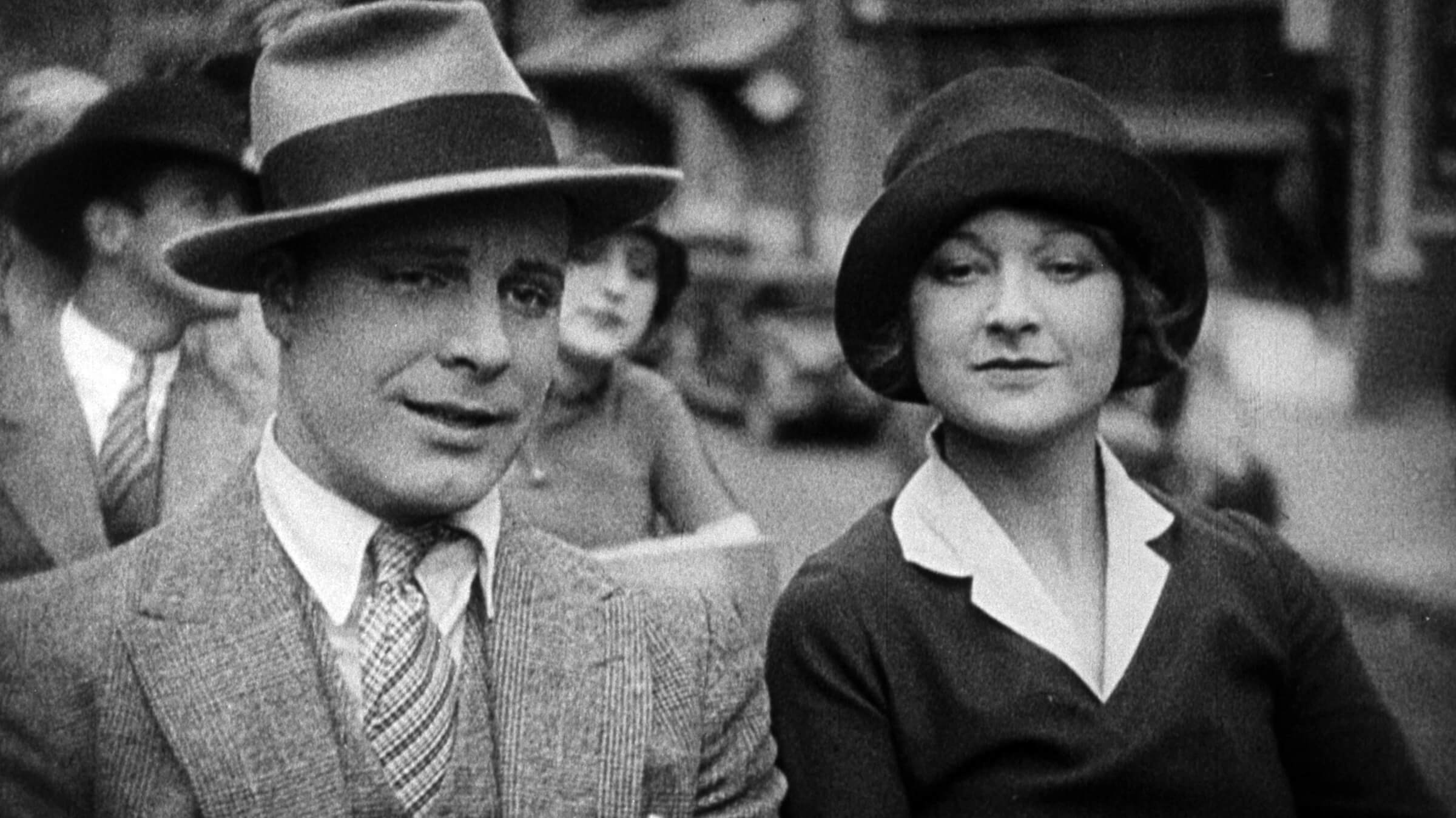
How were movies made in the 1920s? Well, if you’re romantic about it, just imagine Irving Thalberg and King Vidor bumping into each other somewhere in the Metro-Goldwyn-Mayer building. Let’s say it was 1927.
Vidor was thirty-three. His boss, Thalberg, was only twenty-eight. They had just made a huge hit, The Big Parade, a picture about the Great War in which John Gilbert had gone to France, seen battles and mayhem, lost a leg but found a French sweetheart. It was a very big show business event, and it made up for the studio’s losses incurred on Ben-Hur.
So Thalberg asked the director, “Well, what are you going to try next?”
Vidor was caught off-guard. He didn’t have a prepared answer, or so he said later. But he was quick, and he did feel a need or a subject area that was being neglected: “Well, I suppose the average fellow walks through life and sees quite a lot of drama taking place around him. Objectively, life is like a battle, isn’t it?”
Thalberg took barely a second or two, “Well, why didn’t you mention this before?” He asked Vidor if he had a title, and the director came up trumps—“One of the Mob,” he said, even as he first thought of it.
It was a deal; the picture would be made. It was silent, no matter that the tide of sound was coming in very fast. It was a film beyond conventional categories: it was to be an epic of the ordinary, picking out plain lives in the city, caught in the battle for survival. The result was a picture that confounded some reviewers: a few watched it in excited admiration, as if seeing a real America coming to the silvered screen. But others thought it was tedious and downcast, without the kind of strong story the mob could get its teeth into.
Never mind, in the first year of the new Academy Awards, The Crowd was a serious contender. In that debut year, Best Picture was split in two, with one Oscar going to the emphatic crowd-pleaser of the year (it would be Wings, a spectacular history of the war in the air). But there was a second Oscar, for “Unique and Artistic Production.” That prize would go to F.W. Murnau’s Sunrise, but its chief challenger was The Crowd. That Oscar perished on the spot: Hollywood quickly realized that it didn’t want to confuse us or itself about its business purpose.
Vidor wrote the story himself and collaborated on the script. Once he had the support of Thalberg, he could do it his way, even if Thalberg’s partner at MGM, Louis B. Mayer, felt the pursuit of plain, ordinary people was not playing the game. But it was Thalberg’s view that if the great studio was successful then it should be ready to take a few risks.
So a boy meets a girl, John and Mary. They have more hope than capital, but wasn’t that the American condition? They have fun at first, before they start to drift into boredom. They go to Coney Island, but they live in a cramped flat where nothing works well. They have a couple of kids. She looks after the home. He goes to the office and feels it’s like a prison. He keeps forecasting his own big break. But nothing quite happens until the family faces a grave fracture. No need to spell that out here; that would be too great a spoiler. It’s enough to say that the clash between Thalberg and Mayer led to disputes over the ending. As many as seven were written and shot. Finally, as the picture was released, the studio supplied two endings and let theater managers pick the one they preferred.
You can say (or guess) that both endings were cop-outs: this was coming from a cultural factory anxious to convince people they were having a grand time. But no ending can tidy up the humble texture of the film: its urge to get out and film in real places, on the streets or from on top of a bus; its stress on a flat that has too little space; the gradual realization that this America is not inspired by Manifest Destiny but drawn into a cruel gamble in which so many will be losers, mocked by all those advertisements for hope.
Nowhere is the emotional pressure clearer than in the character of John. He is a lead figure who might have had a star actor. But Vidor was determined to resist that type. He wanted an ordinary guy, someone audiences had never seen before. So he started considering people no one had heard of. One day, on the MGM lot in Culver City, he saw a young man in a group of extras. James Murray had thought of being an actor, but he was not convincing as a hero. So he settled for being an extra doing day work in crowd scenes for many pictures. That kept him intent on hiding his face or not looking at the camera, in case audiences started to recognize him. Extras must have faces we don’t notice. And that went with Vidor’s notion of John.
He had to persuade Murray into taking the part. The extra was cynical about proper movie careers. He was happier being just one of the mob, disappearing into the crowd. But the more he talked to the self-doubter the more Vidor was confident that Murray could do it. The man was of Irish descent, and inclined to take a drink in his spare time. He had a broken marriage already. He could smile for a shot, but he had a sad inner life. “I know you can do it,” Vidor told him.
He wasn’t wrong. Murray is pleasant looking, friendly and with a sense of humor. He’s not beautiful or commanding, but he takes a good picture, and you can believe he likes the actress playing his wife, Eleanor Boardman (who was actually married to King Vidor). But then as John and the family come under more stress—from hard times and too many pipedreams—we begin to detect a brittleness in Murray which seems quite natural. We see how subject he is to wild ideas or fits of gloom. He’s ordinary still, a regular guy, but he has the seeds of bipolarity so that we begin to be afraid for him. Not that Murray understood all this, or was in control of it, but we begin to see a nice, hapless guy hanging on by his fingernails. And he has scenes of anguish to carry off.
When it opened, in February 1928, the film was not a big hit like The Big Parade. But it had an audience and some reviews remarked on Murray’s charm and vitality. Not that the actor was convinced. He seemed depressed by the experience. When Vidor asked him what he would do next, the actor had no ready answer or the energy to think of one.
He slipped away. By that time America was in its Depression, a fate that swept away so many Johns and Marys. Vidor lost touch with Murray. But then a few years later he had a new idea: the story of a couple who lose everything and then start anew in a farming life. He would call it Our Daily Bread (1934) and he named the couple John and Mary once more. He even found Murray and offered him the part. But Murray had put on weight and he was drinking seriously. He rebuffed his director and refused to be rescued.
The two men went their own ways. It was July 1936 when Murray’s body was lifted out of the Hudson River. Had he had a drunken accident; been thrown in by other bums or gangsters; had he taken his own life? Vidor was haunted by the mystery and the feeling of an American success so easily snuffed out. In old age, he tried to get a picture set up, The Actor, based on Murray’s moment. That was the late ’70s, when a new screen version of Murray might have been Robert De Niro or Jack Nicholson. It’s something that still might be made, a story of briefly noticed glory, the American way. And that’s enough to convince you that The Crowd is a rare, dangerous film, about living on the brink, made just as sound and the Crash came together.
Presented at SFSFF 2026 with live musical accompaniment by Mont Alto Motion Picture Orchestra