
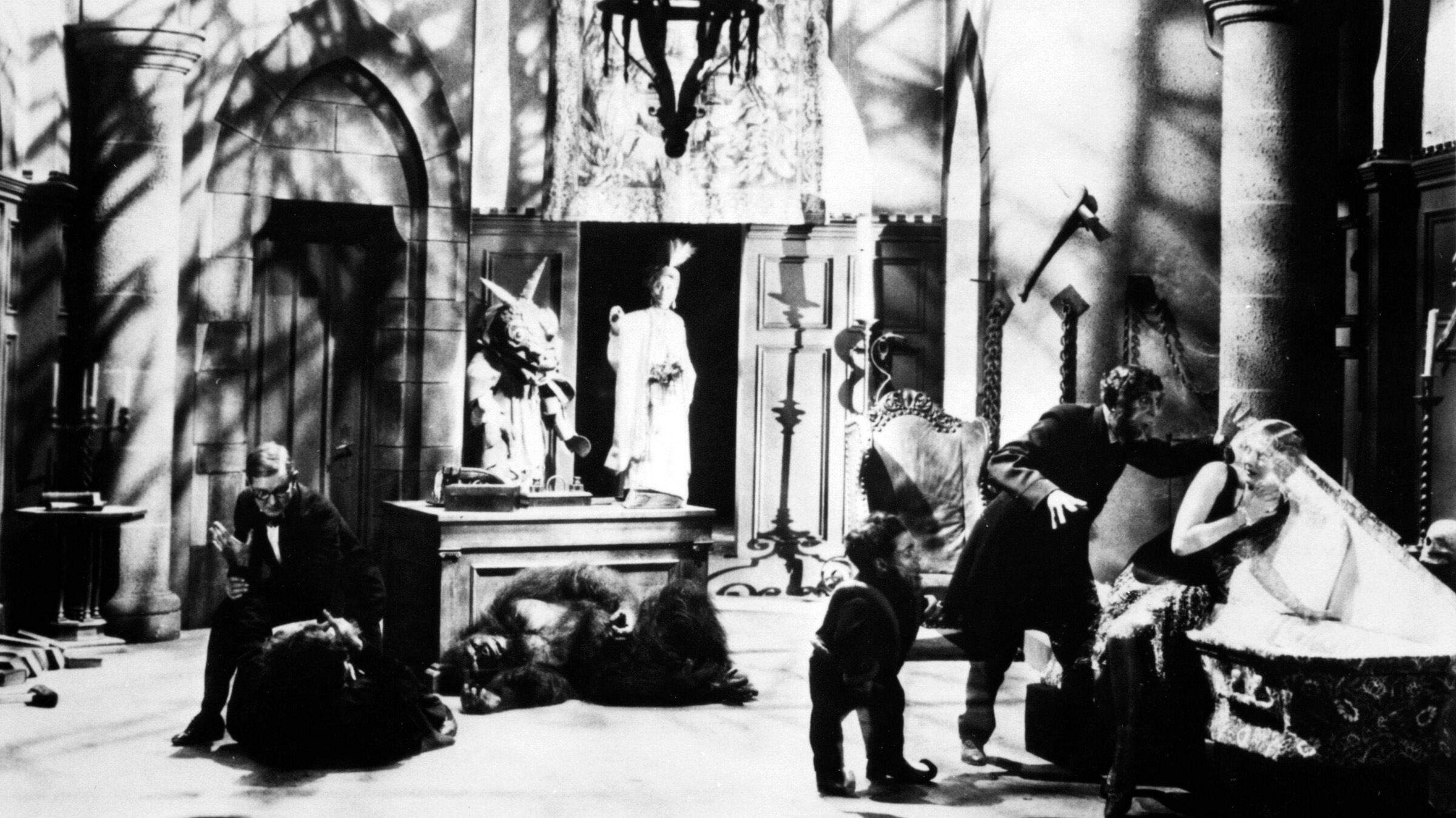
Ah, the boiling pitch and emotive wildfires of melodrama, one of cinema’s foundational modes without which movies would’ve for years been almost entirely comedies or westerns. (Or newsreels.) Commonly defined as hyperbolic dramas heavy on tragic plot and light on complex characterization—indeed, often relying on archetypes (which is a nice way of saying stereotypes)—melodramas were always perceived as low culture, palatable only to the unwashed masses. (Recall that public school attendance was not compulsory in every state until 1918.) That sense persists today and would probably inform many contemporary viewings with Benjamin Christensen’s The Devil’s Circus, as full-on and wild a melodrama as was ever produced by the silent-era Hollywood studios. (In this case, Louis B. Mayer’s MGM.) But I don’t mean to be judgey; perspectives on melodrama still need a paradigm shift. For one thing, vintage silent melodramas are pathmarks of their time, revealing the America of the Interbellum just as Italian neorealist films, American film noir, and Reagan-era blockbusters are emotional diaries of their respective eras. Which also means, given how American silent films largely catered to the 19th-century-bred population of a new and morally fraught nation, they are living records of the lingering psycho-cultural norms of the 1800s, as those sin-fixated frames of mind faced the disruptions of industrialization, massive immigration, increasing literacy, modernism, and World War I.
That’s a lot, but so are the films, which, on top of their historical weight, also helped establish the shape of film narrative, the battery of stock character roles, and the powerful presence of irony as a storytelling coup de grace. The prejudice against melodrama as a form has seen a series of reevaluations as the genre was reinvented and energized by, each in turn, Douglas Sirk (in the ’50s), Rainer Werner Fassbinder (in the ’70s), and Todd Haynes (since the ’90s). But in the silent era, the films were as popular as they were often sneered upon by critics.
Reviews in 1926 slashed at the melodrama-ese Christensen brought to The Devil’s Circus. The New York Times’ aptly named film critic Mordaunt Hall appreciated the film’s details, but found it “pathetic” and “unrelieved from its dismal happenings.” Frederick James Smith, the editor and critic of Motion Picture Classic magazine, dismissed the impressions of some “metropolitan critics”: “To me it was just early Griffith plus a dash of Seastrom pseudo-symbolism.” Variety’s Sidne Silverman drolly dished the film’s leaps of logic, “a fault on somebody’s part if realism were the objective.”
Ah, but we know now that realism mixes like raw milk with melodrama’s plum brandy, and The Devil’s Circus is pretty plummish. Put on a pair of Fassbinder X-ray specs and you can see the pathologies beneath the crusty archetypes. Aptly, a contemporary film lover on the Nitrateville chatboard described the film as a “warped hybrid of Mayer-approved hokum and Danish warlock perversity.” Christensen’s film, his first in Hollywood—after his gadzooks, what-could-they-have-thought goth-orgy Häxan (1922) brought him global notoriety—frames itself as a sermon, but the expected cocktail of vice, sin, ruined innocence, and revival-tent divine justice isn’t merely shaken but set on frappé. The year is 1913, and in short order we meet Carl (Charles Emmett Mack), a sleazy pickpocket, and Mary (Norma Shearer), an orphan teen new to the big city, with her dog in her suitcase and no idea of how to survive. We’re pretty sure he’s a menace, because his suit and tie have stripes running in three different directions, and he has the thin-lipped, thin-chinned affect of a weasel. (Maybe. Mack was actually a bit of a boyish up-n-coming Richard Barthelmess-style heartthrob at the time, and here he was playing against type. He died a year later in a car wreck.) Shearer’s gamine is just as much a standard Griffith-era type, but Shearer herself was such a strange natural in silent film, lovely but a little cross-eyed, and thrumming with the uncanny ability to let us see her intentional thinking, without moving a muscle, that Mary feels like an utterly natural creation.
Seemingly just looking to score, Carl invites her to flop in his flat—heavens forbid—but by the end of this lengthy intro, he morphs into the romantic lead, begging Mary to trust him and searching for redemption. Which is not to come so quickly—that’s when the plot slams into fourth gear. As Mary joins the local circus, Carl gets arrested, jailed, and sent off to fight in WWI, leaving her to the decadent hazards of circus life, personified by slimy lion-tamer boss Hugo (John Miljan) and his manically jealous lover Yonna (Carmel Myers). Years pass, elaborate circus routines unfold (no shortage of near-nudity), trapezes are swung, sexual assault is implied (pretty obviously), bodies get broken, lions get loose (for real), vengeance is wrought, masses get hysterical—Christensen’s scenario packs so much into seventy minutes you begin to see the logic of the contemporary eight-episode limited TV series.
It’s Shearer’s show, and there’s a solid argument to be made that, as both an intuitive actress and a magnetic screen presence, she peaked as a silent actress, when every one of her MGM movies was a hit, and the talkies that followed were a queen’s indulgence by comparison, gifted to her by hubby/MGM head Irving Thalberg, until she semi-retired once the ’30s ended. But take a look at Myers: an intensely busy actress with a dangerous vamp vibe throughout the ’20s, Myers grabs the movie with her huge angry eyes, and when she’s not around, we worry what she’s up to. (Eventually, Myers’s Yonna becomes the malevolent lightning bolt whose decisive action triggers the whole third act, and she pays the ignoble price for it, of course.) Between the two of them, the male actors barely have a chance to register, though Christensen’s handling of the cast is generally defter than you’d imagine from the gothic histrionics of Häxan.
The movie’s racy dive into iniquity, sexual abuse, and violence serves as the ballast for its generous doses of Christian piety, which was a standard combo of the day, given the American audience’s church-going proclivities (the Christian devout in America were estimated to be seventy-five percent of the population in the ’20s; back in Denmark, Christensen’s home turf, it stood at ninety-nine percent), and, as if in response, the corresponding evergreen appetite for spicy melodramatic zest. You could say, as Hollywood producers like Cecil B. DeMille certainly did back then, that the two opposing sensibilities required each other—heady wafts of steamy tantalization demand the clap-back of prayerful redemption, and vice-versa. Being both a Dane and an artiste whose most famous film scalded censor boards around the world, Christensen knew the equations well, and heaped the counterforces onto his plate with gusto.
Presented at SFSFF 2025 with live musical accompaniment by the Sascha Jacobsen Ensemble