
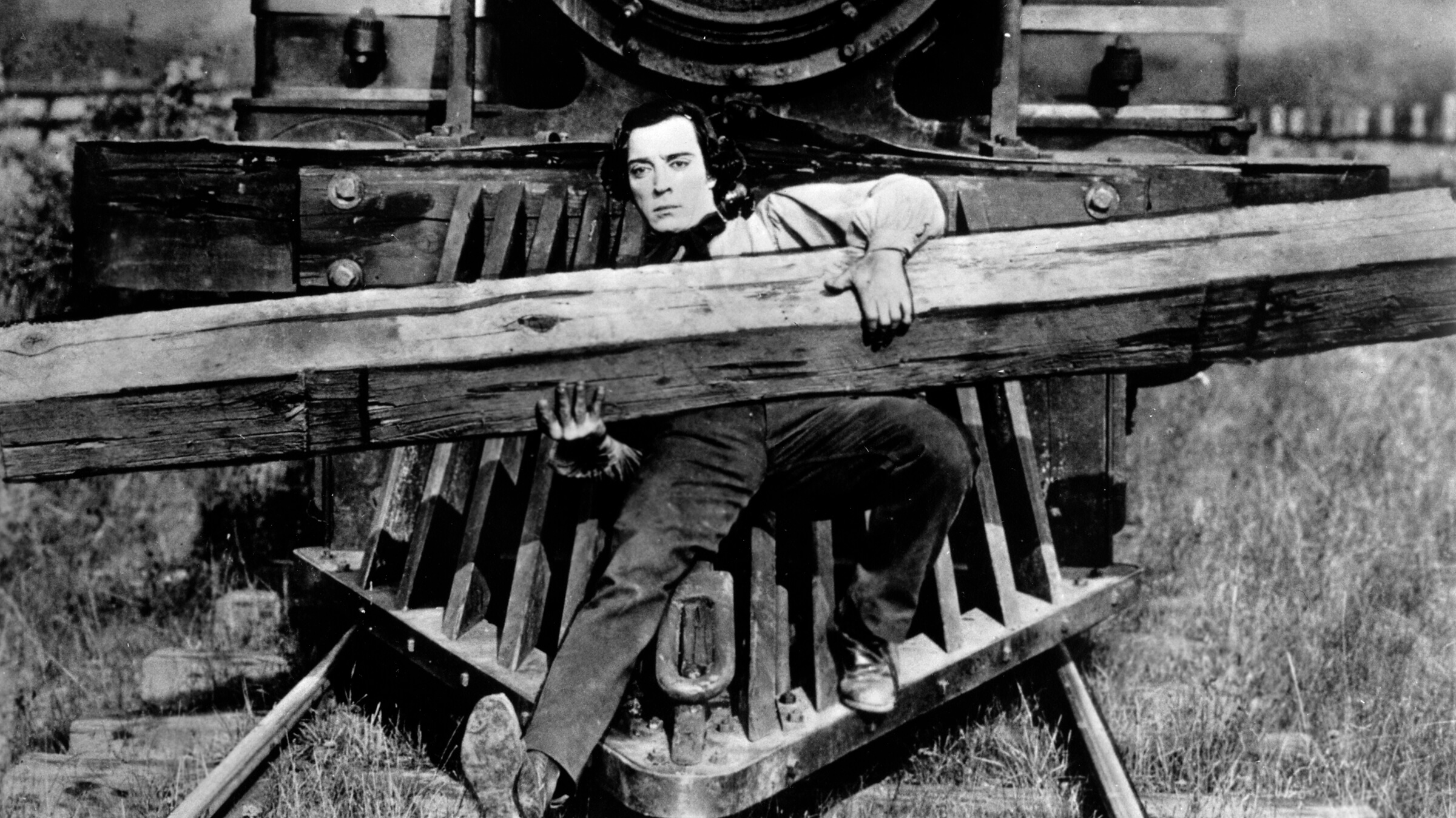
Buster Keaton and Clyde Bruckman’s The General almost stands alone among American silent films, as a work that’s both an institutionalized “classic,” as well as actually being universally beloved. Beloved today, and for the last eighty years of postwar film culture, that is—in its day, it famously did only average business and bored many reviewers who often complained that it simply wasn’t funny enough. That fact can boggle the mind, but whatever—history has had its say, and it’s those eight modern decades that count. (Who cares about the toss-off opinions of critics in the 1920s, who, by definition, knew so much less about cinema than we do today?) As we have seen other filmmakers and other “classics” rise and fall with the currents of fashion and taste over those years, Keaton and The General have only ascended. There are no doubters or haters left; indeed, you look at The General today, a full century after it was made, subsequent to having already eyeballed, say, Lawrence of Arabia (1962) and Reds (1981) and The Revenant (2015) (to sample a few other historical epics, if not comedies), and you see an inspired and pioneering American-poetic breadth, expressing naked human fear and desire by way of momentous action, hurtling physical reality, and a scaled-up engagement with landscape. And c’mon, it’s goddamn funny.
By now, Keaton has emerged in our aggregate wayback-machine mindset as perhaps silent Hollywood’s single deftest auteur, in any genre, and The General is his most intimidating construction—breathtakingly huge relative to the more cerebral Sherlock Jr. (1924), and acutely hilarious relative to the too-amazing-for-comedy Steamboat Bill Jr. (1928). It helps that this masterpiece of large-scale veracity was in fact based on a true story of Civil War espionage and locomotive hijacking, recounted in William Pittenger’s memoir published in 1889 as The Great Locomotive Chase, a Georgia-to-Tennessee sabotage relay fought in 1862 with stolen trains along a key railroad line between Atlanta and Chattanooga. All the same, and eventually shot in Oregon where old-style locomotives were still in operation, The General concocts its eye-popping narrative from whole movie-hog cloth, as you might expect (no bridge was destroyed in 1862), but looking at it today, the film’s most radical move is clearly the decision to frame the tale from the sympathetic perspective of the beleaguered Confederates. Apparently, Keaton thought that, even sixty years after the end of the war, audiences—at least some audiences—wouldn’t take kindly to the Confederates as villains. So, he toggled the film’s point-of-view away from the Union raiders and to the Southerners.
Now, this can present us with an extra-textual problem—a problem that not many thought to have had during the 20th century—but only if we let it, in this age of judgmental hyper-revisionism. (Disney, always wrestling with its own multimedia sentimental ardor for the Old South, made a live-action version of the Chase in 1956, with the Union raiders as the heroes.) Does The General, this revered and stirring silent classic, heroize the Confederacy and, implicitly, its defense of slavery? Must we go there? Recall that only about a decade had passed since the scorched earth of Griffith’s The Birth of a Nation (1915), which mustered countrywide protests but also set ticket-sale records that weren’t bested until nearly a quarter century later, by another romanticized-Dixie epic, Gone with the Wind (1939). Never let it be said that reading the American grain, in movies and otherwise, is ever a settled matter.
But we can agree on a few things. First, no one could ever suggest that Keaton, a Kansas-born, widely traveled vaudevillian born thirty years after the Civil War, was a slavery-nostalgic secessionist. (He also served in the Army, in France, during World War I.) Nor for that matter was Keaton an artist who seemed to think in moral or political terms, about anything—his metier was the sculptural calculus between movement, speed, dread, and irony. The stories of his films were never what mattered; each subject and context could easily be swapped out for any other.
Perhaps we can say that the topic of slavery and the Confederacy’s “lost cause” was for many years an acceptable context and topic for cultural schtick, until they weren’t—much as Nazis could be viewed comically on TV and in movies during the ’60s and ’70s, until they couldn’t. Hollywood never led the way in generational-social shifts like this. Today, of course, it’s unfashionable to overlook any cultural work’s dated and/or obsolete politics, but can we ask, maybe it’s a matter of degree? Griffith’s politics, for example, hit you in the face like a swung shovel. In comparison, The General’s shrugging, sentimental take on the Confederacy may be just inventive window-dressing—a pop culture reflex as backdrop, and perhaps employed with a wink, as nervy as the manner in which the film strangely nudges slapstick into its late scenes of cannon warfare and battlefield death. (The discovery of a huge canvas sack full of dead soldier’s boots comes without a punchline.) Maybe Keaton’s perspectival toggle makes The General a little less stable, a little more quantum, a little more modern, more of a question asked than an answer given.
Certainly, though, to pick at this scab and let it limit the film for you is to, in effect, fail to see the thing at all. Keaton’s art, we dare say, stands above and to the side of squabbles about historical representation. The General is above all a symphony of gravity and momentum, orchestrated in a breathtaking mise-en-scène out of looming machinery, runaway motion, and heedless guile. Watching it, as with other Keaton films, can be a tribulation of wanting to rewind the film as it flies by, to see if what you thought just happened in real time actually did. (At home, you can and will.) Abjuring the montage innovations Eisenstein made in 1925, which created a new type of breathless cinematic “action,” Keaton’s movie dares to do the impossible all at once, over and over again, within uncut single shots—having one train’s cannon fire and “accidentally” hit another engine while both careen around a mountain curve, say, or sending that last locomotive onto the burning bridge, a stunning you-are-there set-piece that would’ve been ruined by a single edit.
Through it all, Keaton himself—as an overlooked, almost spectrum-y mensch who’s also a spry engineer, superhumanly at ease with the fierce physics and systems of locomotive technology—does the hard work of a superhero, often baffled by fate but unstoppable, running on top of speeding train cars as if it was something he did every day. Best of all, the comedy that arises out of the rampaging weight and scale of the film’s visuals pulses with poetry—the moment when Keaton’s downtrodden Everyman sits on his engine’s main rod and doesn’t notice when it starts moving beneath him is funny but also, famously, an anxiously poignant man-and-machine meme that was instantly iconic in 1926, and which resonates even, or especially, in today’s techno fog.
It’s not hard to side with Orson Welles who said The General was the greatest film ever made about the Civil War, which is at least to say it captures the period with the granular realism of a Mathew Brady photograph. But it’s larger than that—it’s totemic, an aria of chaos and synchronicity and grace, and a hundred-year-old testament to the fantastical, did-you-see-that experiences that movies and only movies can offer.
Presented at the Orinda Theatre with live musical accompaniment by maestro Timothy Brock conducting the San Francisco Conservatory of Music Orchestra