
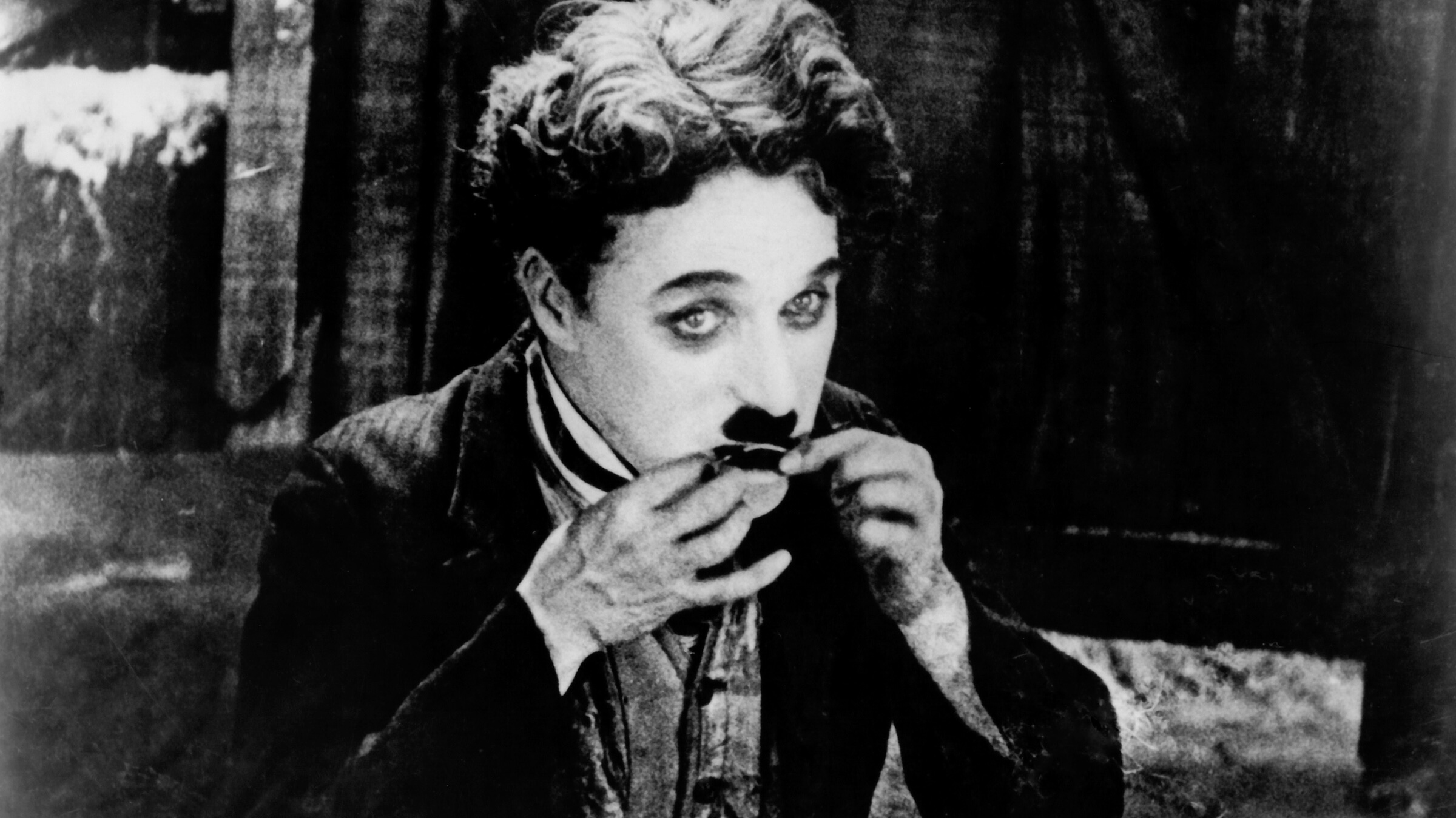
Along with Buster Keaton’s The General (1926), The Gold Rush is one of the very few examples of the historical epic as slapstick. Standard procedure for most silent comedies was to exaggerate minutiae and the everyday to grandiose and absurd proportions—in the way a sales call gone awry leads to the total destruction of a house and automobile in Laurel and Hardy’s Big Business (1929). But in The Gold Rush Charlie Chaplin did the inverse, he took an epic historical event, the Klondike gold rush, and made it intimate by focusing on Charlie’s loneliness and will to survive. Starvation, cannibalism, and isolation became the inspiration for some of Chaplin’s most famous set pieces—the cooking and eating of his boot, the dinner roll dance, and the cabin teetering on a cliff.
Chaplin’s original inspiration for the film is said to have come from stereopticon photographs he had seen while visiting Douglas Fairbanks and Mary Pickford at their Pickfair home. He followed this up by reading about the Donner Party, the infamous group of pioneers who were snowbound in the Sierra Nevada and had to survive by eating the corpses of the members who had died, as well as ox hides, sled dogs, and even their moccasins. Such grisly facts became high comedy—but always with an undercurrent of harsh reality.
In an unusual move for Chaplin, he left the comforts of his studio, where he could control every element, to film exteriors in the mountains of Truckee, California, the same place the Donners had languished in 1846–1847. In 1924, the conditions remained pretty arduous. Although the comedian brought a ton of equipment, carpenters, camera crew, electricians, cast, several assistants, plus trainer Bud White and his performing bear for the month-long shoot, not much of the footage made it into the finished film except for the climb over Chilkoot Pass. For this still-impressive sequence, the company hired about six hundred tramps from Sacramento.
Back at the studio the production team created Truckee’s snowy exteriors, including a small-scale mountain range made out of timber and chicken wire, which was then covered with tons of plaster, salt, and flour to provide the proper wintery look. Chaplin rarely used special effects in his films, but The Gold Rush is an exception. To help achieve its epic scale, he incorporated superimpositions, glass matte shots, dissolves, and miniatures of the cabin, cliff, avalanche, and even a stunt-puppet Charlie.
But the studio shoot had its own challenges. About one hundred extras were used in the barroom scenes, adding not just a big expense but also logistical problems. Even a small indoor scene like the eating of the boot came with unexpected perils. The prop shoes were made of licorice, and Chaplin did so many takes that quite a few had to be eaten, so both he and Mack Swain suffered from the licorice’s laxative effect. Swain later related that the starvation scenes in the cabin took seven months to film, and that he had hypnotized himself into a stupor to do them. He even ended up under a doctor’s care, but once they moved on to other scenes, he fully recovered.
Other complications came with casting. Having decided that his longtime leading lady Edna Purviance wasn’t suitable for this film, Chaplin cast fifteen-year-old Lita Grey who had played the flirty angel in 1921’s The Kid. However, soon after the Truckee shoot, she became an expectant mother and Mrs. Chaplin, so he replaced her with the largely unknown Georgia Hale.
Hale was working as a bathing beauty in Mack Sennett comedies when she landed the lead in Josef von Sternberg’s independently made The Salvation Hunters (1925), which is how she caught Chaplin’s eye. Her subsequent silent films include The Great Gatsby (1926) and The Last Moment (1928), but she had a relatively short career that ended after one sound film and she became a dance instructor instead. In 1983, Hale gave a memorable interview about The Gold Rush and her relationship with Chaplin for Kevin Brownlow and David Gill’s documentary Unknown Chaplin.
The rest of the cast was drawn from Chaplin’s regular players. The great Mack Swain is Big Jim McKay, Charlie’s partner in disaster. One of Chaplin’s Keystone colleagues, Swain was famous for his series of Ambrose comedies for Mack Sennett. An altercation with an important producer at a different studio got Swain blacklisted, but Chaplin made him part of his stock company and used him in The Idle Class (1921), Payday (1922), and The Pilgrim (1923). The Gold Rush jump-started Mack’s career, and he spent the rest of the 1920s in major supporting roles in pictures such as the Raymond Griffith comedy Hands Up! (1925) and an adaptation of Anita Loos’s popular flapper novel, Gentlemen Prefer Blondes (1928).
Perhaps the vilest, and most realistic, villain in film comedy history is Tom Murray as Black Larsen. A veteran of vaudeville, Murray joined the movies along with his stage partner and wife Louise Carver in 1916. The pair eventually moved to Hollywood to become comedy regulars. Murray appeared with Chaplin in The Pilgrim (1923) and worked with A-listers like Buster Keaton and Harry Langdon, as well as working-stiff comics on the order of Billy West, Marcel Perez, and the Hallroom Boys. Jack, Charlie’s rival for Georgia’s attention in The Gold Rush, is played by Malcolm Waite, who specialized in antagonistic roles opposite comedians like Harry Langdon (1924’s Feet of Mud) and Laurel and Hardy (1927’s Why Girls Love Sailors). Other supporting parts were taken by Hal Roach regulars Tiny Sandford as the bartender and Kay Deslys as a dancehall girl, as well as perennial movie butler F.F. Guenste.
Following its premiere in Los Angeles on June 26, 1925, The Gold Rush became a huge hit, especially internationally. Chaplin’s outlay of $923,886 was more than recouped by the $6 million earned in worldwide box office. It remained one of his most famous pictures and Chaplin decided to re-release it in 1942. It wasn’t just a re-issue, but a re-imagining. As silent films were considered terribly old-fashioned at that time, Chaplin brought it “up to date,” removing all the intertitles and replacing them with a newly written narration in Chaplin’s voice. He also trimmed about sixteen minutes and changed the ending from the original fade-out kiss between the Tramp and Georgia to the couple walking away arm in arm. Perhaps his most significant change was a wonderful new score, which he wrote himself.
After 1942 this became the official version of The Gold Rush. Then, during the 1960s, 16mm and 35mm prints of the silent cut began circulating, mostly through the auspices of collectors Raymond Rohauer and Killiam Shows. In 1993, the Chaplin family commissioned Brownlow and Gill to restore the silent edition. Luckily, two detailed cutting continuities from 1925 and 1938 survived. Scouring the world’s film archives for footage, and using the continuities as their guide, they were able to assemble a version close to the original, but which they still considered a work-in-progress.
Recently, the Chaplin estate embarked on another restoration. Using the 1993 edition as a blueprint, a call went out anew to film archives, with the experts at Italy’s Immagine Ritrovata laboratory gathering material for this 4K version. Newly available digital tools helped sharpen and improve some of the distressed footage and ensured that the finished film had a consistent visual quality.
The result is as close to the original 1925 version as possible without have a time machine to go back and retrieve a print. Completing the picture is conductor Timothy Brock’s adaptation of Chaplin’s 1942 score, for a presentation that combines the best of the sound and silent versions. The late David Gill put it succinctly when he said, “in 1925 The Gold Rush was rightly called a masterpiece.” It still is.
Presented at SFSFF 2025 with live musical accompaniment by Timothy Brock conducting the San Francisco Conservatory of Music Orchestra with guest pianist Mongo Buriad