Making one movie as a way of auditioning for a coveted role in another movie seems like an expensive and troublesome way to go about it, but Gloria Swanson was a hard woman to discourage. And in 1924, the part that Swanson wanted was, believe it or not, Peter Pan. Her studio, Paramount, formerly Famous Players- Lasky, was in the midst of acquiring the rights to J.M. Barrie’s hit. Marilyn Miller was scheduled to perform the title role on the New York stage. If the studio brass weren’t already considering her for Peter Pan, Swanson would make sure they had to.
This proposed casting wasn’t as crazy an idea back then as it sounds to a modern audience, who are mostly familiar with Swanson as Norma Desmond in Sunset Boulevard. Swanson, in fact, was known for her rambunctious comic abilities and her desire to show off her versatility. She was in New York to finish a French-set romance, Zaza, for the great director Allan Dwan, and wanted to stay in the city. The best way to do that, Dwan agreed, was to find a good script that would keep her working at the Astoria studios, and he suggested that Swanson consult the screenwriter Forrest Halsey. “Forrest and I hit it off perfectly,” Swanson recalled in her autobiography, and the script Halsey suggested would become one of her favorite films—The Humming Bird. The witty, cultivated Halsey—openly gay in an era when that was highly unusual—was adapting the scenario from a play by Maude Felton.
Together, Halsey and Swanson reasoned that The Humming Bird’s scenes of her shimmying under cafe tables to rob the rich and scampering over walls to elude the gendarmes would suggest that she could be equally charming fighting pirates in Peter Pan. And the actress could easily see that The Humming Bird, under the direction of well-established veteran Sidney Olcott, was going to be a delightful movie in its own right. Best known as the man behind the seminal location-shot 1912 feature From the Manger to the Cross, Olcott was also known as an extremely skilled director of star vehicles, such as Little Old New York (1923) for Marion Davies and The Green Goddess (1923) for George Arliss. Swanson felt herself in more than capable hands.
Like many other silent films loved in their time and remembered fondly by their makers, The Humming Bird’s preservation status is a good news–bad news situation. The bad news is that about fifteen minutes of the original film appears to be lost, with an occasional early scene missing or incomplete. Gone, too, is the bulk of the real-life World War I battle footage used to emphasize the drama of the movie’s final third. The good news is that we still have sixty minutes, and that remainder has been skillfully pieced together, then filled in with stills and intertitles based on the script and synopsis, by Milestone Films. One hundred years later, The Humming Bird still looks gorgeous. As Milestone co-owner Dennis Doros has said, what we have left is “one of the most beautiful tinted and toned prints around.”
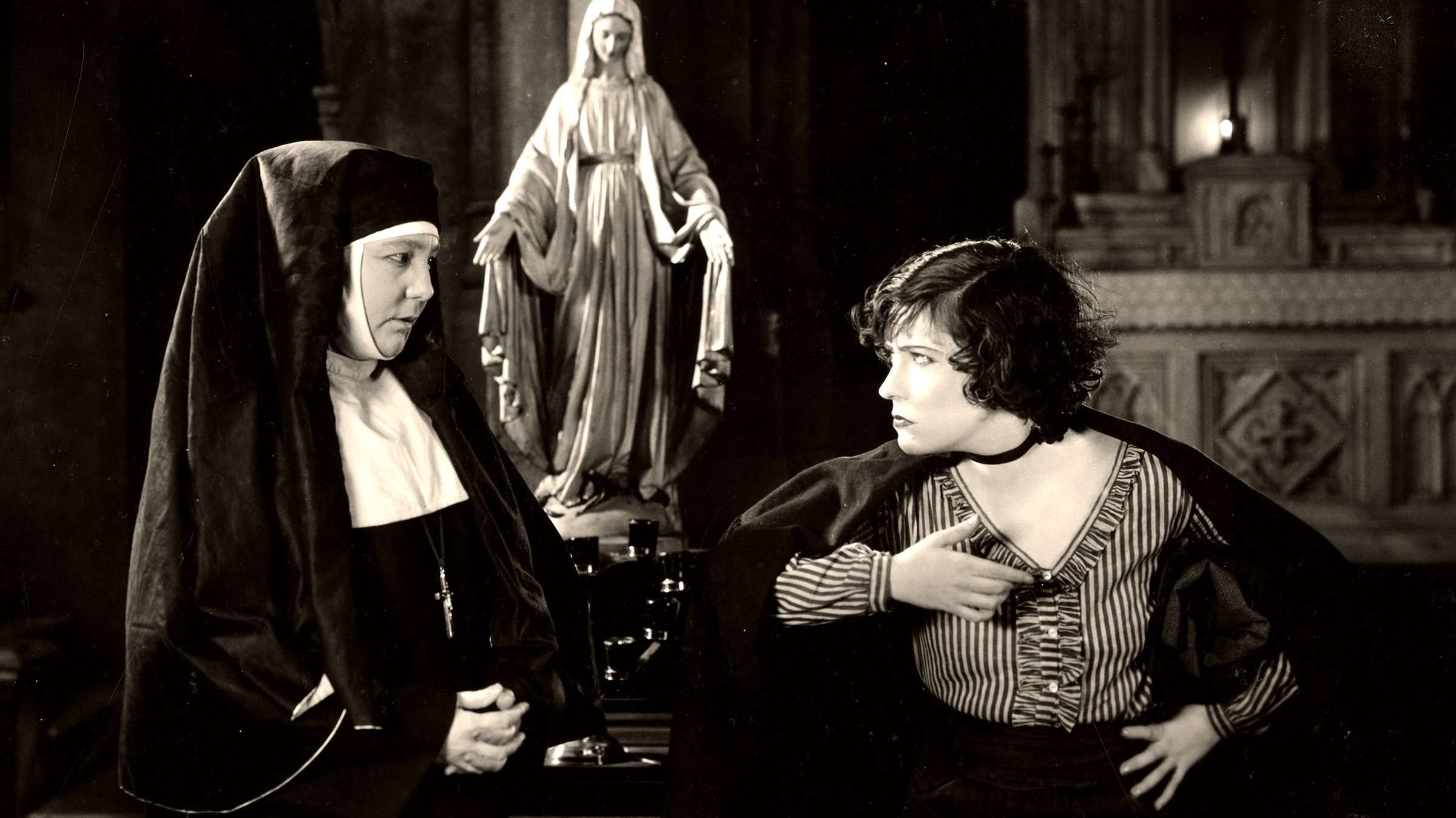
The setting is Paris just before the Great War. The movie’s main character, Toinette, is a “britches role,” one that required Swanson to spend much of the running time dressed as a boy—she called Toinette “a gamine Paris pickpocket.” Toinette, known to police and the underworld as (you guessed it) the Humming Bird, has her trade down to a science. Her confederates distract the unwary rich at an outdoor cafe with their bouncy street music, so that Toinette can slide bracelets, rings, and watches off the hands and wrists of its patrons. Her confidence is such that she shouts to the police that they’re about to arrest the wrong man before leading them on a chase, slipping into a nearby church, and donning the feminine garb she’s stashed there.
Her love interest, American reporter Randall Carey, is played by Edward Burns (sometimes billed as Edmund and apparently no relation to his latter-day indie namesake). Carey is enlisted to help police find the Humming Bird, so naturally he shows up at the most notorious criminal dive in Paris impeccably dressed in his finest suit. Toinette, portrayed as naïve about love despite her milieu, falls hard for the Yank.
When an American studio in the silent era set a film in Paris, they did so with a headlong determination to make everything scream “France,” from the set to props to the very faces of the cast. Toinette’s gang are portrayed as “Apache” thieves, a subculture associated with the late 19th century and popularized through story and song, perhaps most notably in the Apache dance that the great entertainer Mistinguette made her signature. Accordingly, Le Caveau, the Montmartre basement hideout of les Apaches, seems not to have been redecorated (or cleaned) since medieval times. The battered-looking faces of character actors such as William Ricciardi (Papa Jacques), Cesare Gravina (Charlot), and Adrienne D’Ambricourt (The Owl) appear also to date to the Hundred Years’ War. There is an obligatory mention of absinthe. Toinette prefaces what feels like roughly a third of her lines with “Zut!” The cobblestone streets and the walls that separate gardens and buildings look meticulously authentic.
The Humming Bird has a major tonal shift about two-thirds of the way through, when the war breaks out. Randall enlists in (what else) the French Foreign Legion. Toinette, changed by her love for him, delivers a rousing speech to the “wolves” of Le Caveau, appealing to their latent love for France. Shamed by the courage and fire of this young woman (and Swanson could deliver “rousing” like few other stars), the men of this underworld enlist. So does Toinette, but at this point someone in the film manages to see past her britches. She’s recognized and tossed into a convincingly fortress-like French jail. Will Toinette emerge from the dungeons to reclaim her lover and her patriotism? What do you think?
But a well-told story is always satisfying; add Gloria Swanson, and you’re set. The raves rolled in. Photoplay, an important voice in the industry, was positively ecstatic: “The finest piece of acting Gloria Swanson ever has done. Her work, and the almost faultless direction of Sidney Olcott, make this one of the best pictures in months … When Zaza appeared, it was hailed as her best work. But in this picture she is so infinitely better that there is no comparison.” Take that, Allan Dwan.
Not that Dwan or anyone else seems to have minded. The success of The Humming Bird meant that Swanson was not required to return to Los Angeles. She sailed instead for France to make Madame Sans-Gêne. And there Swanson also fulfilled the fantasies of Francophile romantics everywhere when she met and married the Marquis Henri de la Falaise de la Coudraye. “Hank,” as she called him, was commonly agreed to be the love of her life.
But even Gloria Swanson couldn’t always get what she wanted. The role of Peter Pan went to the novice teenager Betty Bronson.
An interesting coda to the making of The Humming Bird shows how Gloria Swanson helped set the template for American celebrity in ways both pleasant and un-. During filming, a bizarre rumor began that she was dead—shades of “Paul is dead” conspiracy theories about the Beatles, and the many social-media pseudo-scandals of our own age. Paramount circulated on-set stills of her very much alive, but gossip reporters claimed they were using a double. At last, the decidedly not-dead Swanson agreed to talk to a reporter from the Associated Press. She permitted a bit of lèse-majesté by allowing the scribbler to touch her beauty mark. She pointed out, with a great deal of asperity, that she would never let herself be upstaged by a mere double. Still the reporter wasn’t convinced. Swanson, in her cool stylish way, lost her temper: “Ask the public. Ask anyone who has a ticket to The Humming Bird as soon as it’s released. After forty-two pictures, I assure you the public knows me, or they wouldn’t keep coming back!”
Whether or not that did the trick, shortly afterward the AP acknowledged that Swanson was in fact Swanson. She was surely right, though—no one viewing The Humming Bird will ever doubt they’re seeing the genuine article.
Presented at SFSFF 2026 with live musical accompaniment by Wayne Barker