
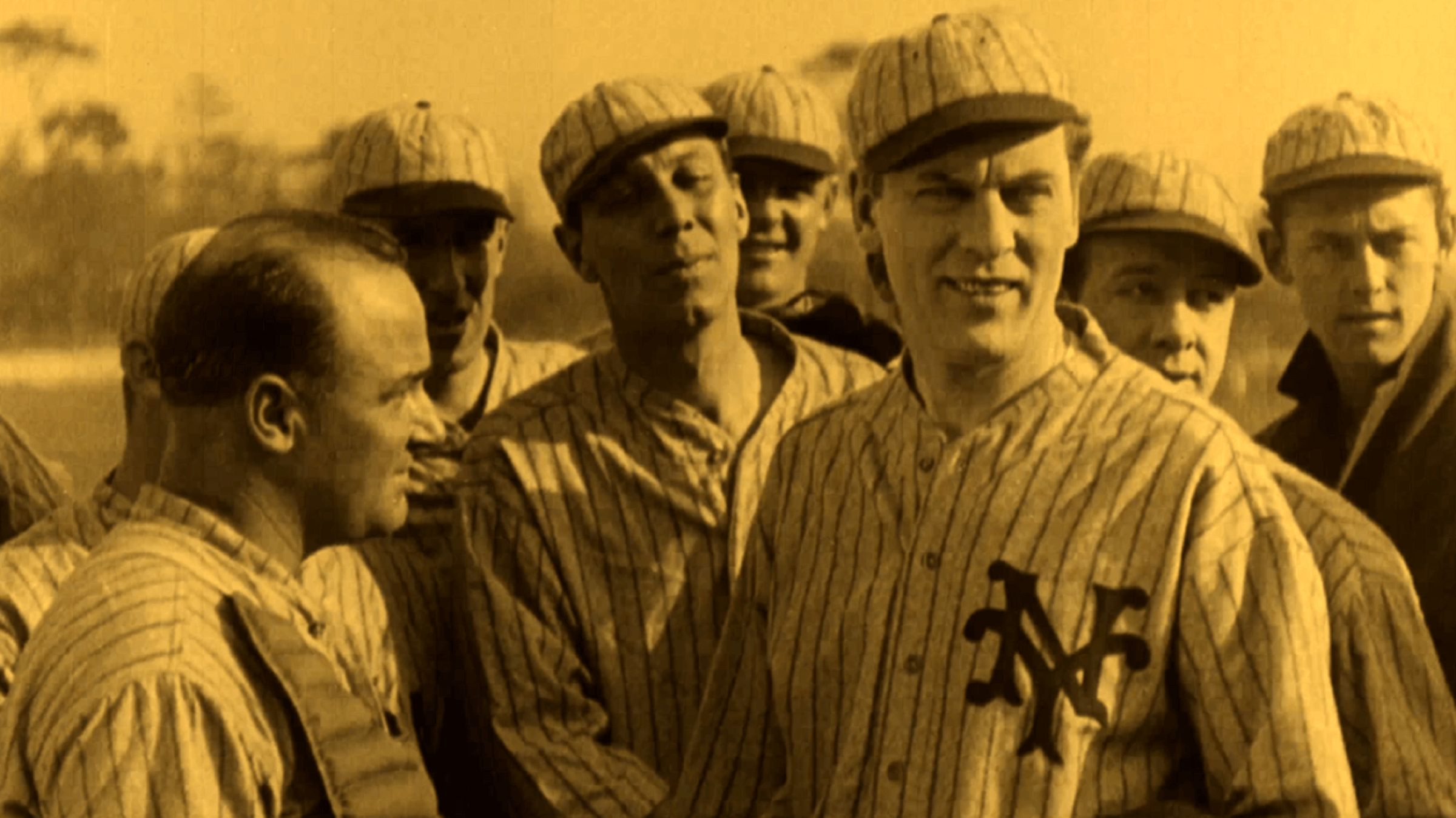
“What’s it going to be—baseball or real estate?” asks The New Klondike, a 1926 Paramount feature that brings together two American obsessions of the time: Major League baseball and the Florida land boom. The original Klondike rush of prospectors to Alaska in the late 1890s is reimagined as epic comedy in this year’s festival opener, Chaplin’s The Gold Rush. The land-buying rush to Florida reached frenzied heights between 1924 and 1926 and is enacted here as an up-to-the-minute social satire.
Centered on a New York team distracted from Florida spring training by get-rich-quick real-
estate dreams, The New Klondike was based on an unpublished story by Ring Lardner, the humorist sportswriter best known for baseball tales populated with amusingly dim players. His script drew inspiration from scenes of gullible northerners swarmed at Miami’s train station by real-estate hucksters wielding maps and contracts. Credit was loose under the assumption that the value of lots would continue to skyrocket. Most Major League teams chose Florida for 1925 spring training, and Lardner chronicled the hazards: “What ball players are not crippled by accident or food down south were crippled by Florida real estate … If the ocean rises six inches this summer and floods all of Florida, you can go to the ball grounds, not to see a ball game, but to see how many players you can count committing suicide.” Lardner caught a screening of the film, advertised as “a roaring comedy of Florida,” in San Francisco and was stunned by what had befallen his script: “The audience seemed to like the picture and I done the roaring when I realized that 286 of the 288 titles I had written had been thrown into somebody’s ash barrel.” The script had gone through at least three additional hands, including those of an uncredited Ben Hecht in his first screenwriting job.
Thomas Meighan, a forgotten star whose name is above the title in the opening credits, plays the New York team’s “popular pitcher” who gets lured into land speculation. At forty-six, Meighan seems a touch old for professional baseball but fits his veteran character, “Tom Kelly,” who is cut from the team purportedly for diminishing prowess but in truth from jealous schemes by the mustachioed manager in league with a rascally realtor. Jobless and pegged as broke by real-estate hustlers—the “Florida Fruit” button on his lapel is their code for a “dead-head”—Tom takes us on a downward journey into South Florida’s thievery, price gouging, and housing options at flophouses and pool halls. He is only saved by a promoter who recognizes that his “name and reputation” can be monetized for land deals. After all, Babe Ruth endorsed everything from insurance companies to “Babe Ruth Home Runs Chocolate-Coated Ice-Cream Baseballs.”
Meighan consulted the New York Giants’ longtime manager John McGraw about appropriate costumes and so it’s little accident that the unnamed ball club in the film appears to wear Giants uniforms. The film’s team is said to have won the World Series the year before, thanks to Tom. The club’s owner, “Colonel Dwyer, millionaire sportsman,” would have reminded viewers of the Yankees’ owner, Colonel Jacob Ruppert, who also spent lavishly on his team. “Home Runs” and “Home Sites” are neatly linked when a player hits a homer and then stops at every base to consult maps of such watery developments as “Neptune Acres” and “Eden by the Sea.” Indeed, so many actual Giants players were gobbling up Florida acreage that when McGraw was asked in 1925 if they would win the National League pennant again, he replied, “If Florida real estate holds up, there is nothing can stop us.” McGraw, too, got the bug, selling properties in “Pennant Park,” his own baseball-themed housing development.
Baseball teams and Florida schemes made for two separate cycles of mid‑1920s dramas. Baseball films included The Battling Orioles (1924), Hit and Run (1924), Casey at the Bat (1927), and Slide, Kelly, Slide (1927), to cite only features that survive. The Marx Brothers’ Florida land-rush comedy Cocoanuts opened on Broadway in December 1925, just as The New Klondike began shooting across the East River in Astoria, New York, and on location in Florida. In Cocoanuts Groucho plays a Florida hotel owner who sells Everglades swampland as “Cocoanut Manor” while Chico and Harpo pocket everything not nailed down. Reversing the expected pattern in It’s the Old Army Game (1926), W.C. Fields plays a Florida drugstore owner who bumbles into land riches by selling New York lots to Floridians through the “High-and-Dry Realty Company.”
A Florida Romance was The New Klondike’s working title, and it softens its satire with a pair of romances started on shipboard from New York to Florida. Tom literally runs into an heiress named Evelyn Curtis, “the most charming girl in the world,” played by Lila Lee, whose chemistry with Meighan had been pretested in nine earlier film pairings, beginning in 1919 with Cecil B. DeMille’s Male and Female, where she wins him from Gloria Swanson. A contrastingly comic couple unites Evelyn’s seasick maid with Tom’s seasick sidekick—played by Paul Kelly—a bush league batter whom Tom is bringing to Florida for a tryout. “Paul Kelly is so good that he almost steals the picture,” as the New York Herald Tribune put a sentiment repeated in other reviews. There were long gaps in Kelly’s early film career both before The New Klondike and soon after. He’d acted exclusively on stage for the previous five years, and then in April 1927 he was charged with manslaughter for a fatal fistfight with his lover’s husband. Given a ten-year sentence, he served a little more than two. With uniquely Hollywood irony, Kelly had the sole title role of his career playing Warden Clinton T. Duffy in Duffy of San Quentin (1954), set where Kelly had been imprisoned. The New Klondike is the third feature and first at Paramount in Lewis Milestone’s forty-year, Oscar-winning directorial career. He came late to the production, just before filming began, escaping Warner Bros., which had sued him into bankruptcy over a contract dispute. Thomas Meighan seems to have initially suggested the Florida land-rush theme, drawing from his own lucrative early involvement with Florida real estate.
Some theaters screened The New Klondike under the title The Florida Bubble. Already by the film’s March 1926 release, the land rush could be seen by calmer eyes as a housing market boom-and-bust, of the sort familiar to us from the 2008 crash. In the film, Tom seems ethically shady when he cuts in his teammates on what they assume is “easy dough” without revealing that he’s then only a middleman. In life, Meighan and his New York realtor brother formed a Florida “land-buying syndicate” that March with buy-ins from Hollywood colleagues, including Gloria Swanson and Victor Heerman (the initial director of The New Klondike before his replacement by Milestone). But the final blow, literally, to Florida’s land rush came just six months later with the Great Miami Hurricane, which hit the coast at 145 mph, smashing slipshod structures constructed under lax building codes, leaving some fifty thousand homeless, and tearing an entire wing off the new Hotel Pancoast, seen in the film as the grand “Beach Haven Hotel,” where most of the action is set.
Movie reviewers wwere enthusiastic: “The New Klondike is a corker” (St. Louis Post Dispatch); “A wow of a baseball–real estate story” (Moving Picture News); “The picture is an unadulterated success” (New York Herald Tribune); “The New Klondike just tickled me to pieces!” (Chicago Tribune). Throughout the 1920s Paramount was regarded as Hollywood’s most reliable producer of superior films. The New Klondike is one of the Paramount silents to have survived through just a single 35mm print donated by the studio in 1970 via the American Film Institute to the Library of Congress. These films remain “lost” in any practical sense until, as with this impressive new restoration, they can be preserved and seen outside of archives. Paramount features surviving through single Library of Congress prints also include The Secret Sin (1915), Changing Husbands (1924), North of 36 (1924), The Showdown (1928), and so many other fascinating but forgotten films that await rediscovery.
Presented at SFSFF 2025 with live musical accompaniment by Mont Alto Motion Picture Orchestra