
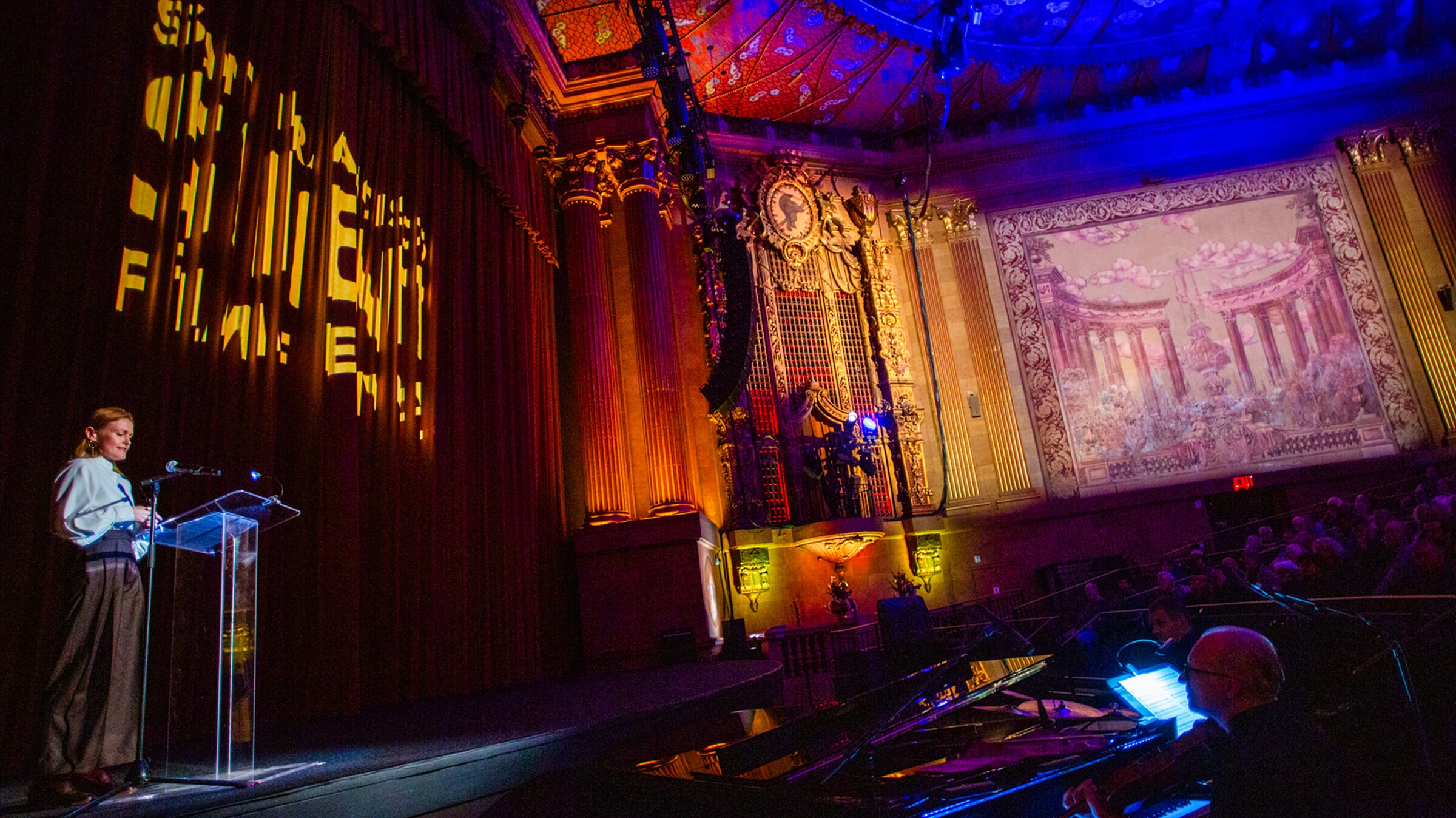
This interview was published in conjunction with the screening of Janko the Musician at SFSFF 2026
Film archives face many challenges. When staff aren’t trying to identify exactly what they have in their collections or looking for funds to help them in their acquisition, preservation, and restoration efforts, they are busy researching and networking to try to find missing pieces of their valuable holdings.
Then there is the Filmoteka Narodowa–Instytut Audiowizualny (FINA), Poland’s national film archive in Warsaw. World wars and attendant neglect destroyed as much as ninety percent of the archive’s silent film holdings and documentation. Then, in 2021, a rightwing government takeover of the archive led to the dismissal of 150 employees. Despite these daunting circumstances, Elżbieta Wysocka, FINA’s director for digital collections and digitization and this year’s recipient of the SFSFF Award for commitment to the preservation and presentation of silent cinema, has persisted.
How did you get into this line of work?
I wanted to be a painter and eventually decided to become a conservator. I studied easel painting conservation in Krakow, but the program was quite traditional. I was very interested in new media and went into video art and early internet art conservation and saw the early possibilities of digital film restoration. It was so amazing what we could do, but a bit scary as well when film became a sequence of zeros and ones. We had the same vibes then as we do now with A.I.—that there would be no ultimate authenticity because you can manipulate so much. Nevertheless, it was precisely in digitization that we saw opportunity and the future. Everything we have from the silent period is very degraded and fragmented. Only digital tools give us a chance to resurrect them.
How have you weathered the political turmoil the archive faced?
The Filmoteka has held a silent film festival since 2003. Thanks to my predecessors and a shared love for presenting silent films with live music, it became a beloved Warsaw event. When my colleagues and I were forced to leave our jobs under difficult circumstances, we founded the Siostry Archeo (Archeo Sisters) collective and held Sounds of Silents screenings as a form of resistance and political expression. The festival is dedicated to the memory of our dear former director, Anna Sienkiewicz-Rogowska, who passed away in 2022. After the government changed, a new director of the film archive, Tomasz Kolankiewicz, was hired and gave us a chance to rehire many of the dismissed employees and reconstitute the archive, which we have been doing for the past year and a half.
What can you tell us about the Polish films showing at this year’s festival, The White Trail and Janko the Musician?
Both of these films were made during the transition to sound and exist in silent and sound versions. The White Trail depicts Poland’s highlanders in Zakopane. This Polish resort was a center of modernism, folklore, and freedom that is beautifully expressed in this film.
Janko the Musician’s ending came as a surprise as it is based on a famous story by renowned Polish writer Henryk Sienkiewicz, who ends it with Janko getting beaten to death for stealing a violin. It was a required reading when I was nine years old, which today would be considered pretty traumatizing for children. When the film came out, I think Polish audiences were as relieved as I was that this poor child escaped that fate.
For years, we presented this film as silent because the original shellac sound disks were lost. A colleague, Michał Pieńkowski, found them in the hands of private collector and it was thanks to
Sienkiewicz-Rogowska that we were able to acquire them. At the time, the film was shown in Poland as a sound film in a handful of sound-equipped cinemas and as a silent film in the rest. We also know that the film was screened in the U.S., where it premiered in 1933 as a sound film. In San Francisco, we will show a hybrid silent-sound version.
Thanks to earlier generations of archivists at the Filmoteka, the support of professional networks such as FIAF, and my colleagues at FINA who painstakingly reconstructed Poland’s prewar film collection, we have the privilege of sharing these films with an international audience.
What are you working on now?
We are part of a European project that is conserving and restoring eight films, including silents like Michał Waszyński’s Kult Ciała (Rhapsody of Love, 1930) and our oldest discovered Polish film Tajemnica pokoju nr 100 (Mystery of Room No. 100, 1914). Later this year, we’ll work on a film found at Amsterdam’s Eye Filmmuseum, which I will keep as a surprise. But it is a very early Polish feature film that we are very excited to bring back to the big screen because Pola Negri is in it. We also need to revisit and possibly update our previous restorations because elements are still being uncovered.
Now that the worst is past, are you hopeful that you can restore the full functions of the archive?
Our story has a good ending, but we are still living in a time when nothing is promised. But we would never have known what we are capable of if we did not have this experience. And it’s crazy that it happened in a film archive, which is the most innocent place you can imagine, and our tool of political communication was silent movies with music!