
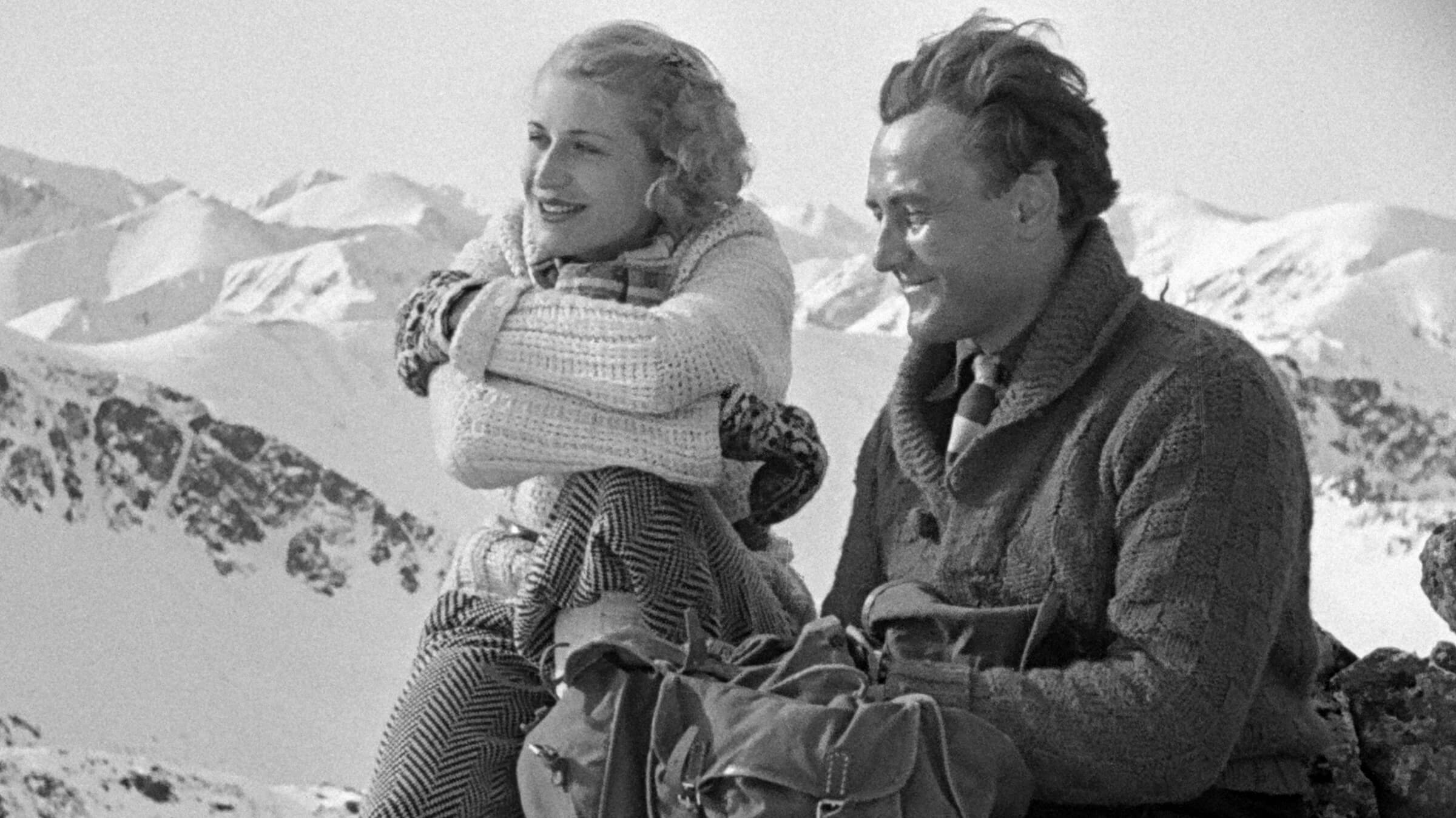
Poland had regained its statehood following the end of the First World War and set about rebuilding itself politically and economically, as well as culturally. The reborn nation’s film industry was part of its renewal.
In his 2002 book, Polish Cinema: A History, Marek Haltof notes that Poland’s capital, Warsaw, was the center of its film industry all throughout the period leading up to the Second World War. And not surprisingly, Warsaw stars dominated the attention of the Poland’s film magazines and that of its moviegoing audiences.
Haltof also says that Warsaw was crucial to Polish cinema for another reason: “… even though it had only 10 percent of all movie theaters in Poland, the city generated as much as 33 percent of total box office sales. This figure is reflected in the choice of filmic themes related to Warsaw, in the settings, and in the type of humor popular in Warsaw cabarets and revue theaters. It is fair to say that interwar Polish filmmaking clearly became a Warsaw societal affair.”
As a result, it was uncommon for commercial films to be produced outside the Polish capital. One notable—even singular—exception is Biały ślad (The White Trail), which was shot in the rugged Tatra Mountains in southwest Poland. Today, The White Trail (sometimes translated as White Trace) would be called an independent production. It was produced, directed, filmed, and edited by Adam Krzeptowski, an athlete, sports journalist, photographer, and sometime filmmaker who lived in the region. The scenario is by Rafał Malczewski, another local and the son of the great Symbolist artist, Jacek Malczewski, and himself a successful painter.
Krzeptowski spent two years on The White Trail, a film he began shooting in 1930—the year the first Polish sound film was released. The White Trail was made with a small group of amateurs at their own expense, shot on location and without access to sound equipment or a soundstage, without Polish stars, and largely without the support of Warsaw studios.
In fact, no professional actors appear in the production. Most of the cast were athletes from the area. The three main roles were played by Janina Fischer (a cross-country skier and the winner of sixth place at the 1929 International Ski Federation, or FIS, World Championships), Stanisław Gą sienca-Sieczka (one of the first Polish ski-jumpers), and Andrzej Krzeptowski (a Polish national champion and two-time Olympic skier who was the brother of the director). Other competitive skiers appear in cameo roles.
The White Trail was made following the conventions of a silent movie, with its dialogue taking the form of intertitles. The film’s original soundtrack, scored by a local composer, was effectively used as musical illustration. The only outside support came in the form of added sound effects and postproduction work completed through Asterfilm, a studio located in Warsaw.
A photographer by trade, director Adam Krzeptowski opened a portrait studio in the mid-1920s and soon became interested in cinematography. Around 1930, he began shooting footage showing the beauty of the area in which he lived, namely the popular resort town of Zakopane and the surrounding Tatra Mountains.
Krzeptowski’s cinematic output comprises two short documentaries, Z Tatra (From the Tatras 1930) and Zima w Zakopanem (Winter in Zakopane, 1931), along with two feature films, The White Trail (1932) and Zamarłe echo (Dead Echo, 1934). In the years leading up to World War II, Krzeptowski later worked as a cinematographer, including on the 1934 short Wiosna narciarzy (Spring of the Skiers), while footage from The White Trail was incorporated into a few later films. The avalanche scene appears in the 1938 drama Druga Młodość (A Second Youth) and the skiing scenes were excerpted for the 1939 comedy Sportowiec Mimo Woli (The Accidental Sportsman).
Black-and-white film does what sound could not to enliven the wintry beauty of The White Trail. As Michał Pieńkowski and Federico Striuli say in their 2016 notes for a screening of the film at Pordenone: “Many months were spent shooting outdoors. The weather in the Tatra Mountains was (and still is today) very unpredictable and changeable; anyone who has ever tried to film there knows that one has to wait many hours, sometimes even many days, for the right sunlight to produce the desired effect. Krzeptowski shot in difficult conditions, high among rocks and on snowy slopes, using a simple handheld camera. He observed wild mountain animals, but most of all his lens captured the wonderful chiaroscuro of nature bathed in sparkling snow.”
Months prior to its release in Poland, The White Trail was shown at the first ever Venice International Film Festival. (Among the twenty-five others entries in competition that year were Frankenstein, Mädchen in Uniform, and another film with a mountain setting, Leni Riefenstahl’s The Blue Light.) The White Trail received mixed reviews. Some reportedly claimed Krzeptowski, a novice filmmaker, had taken on a challenge beyond his abilities, and another Polish film, by an established director, should have taken its place at the event. Others found fault with the amateur actors and melodramatic story of unrequited love centered on a young highlander secretly in love with a young woman just returned from the big city who in turn is in love with another mountaineer played out against the dramatic backdrop of a dangerous mountain landscape. Some, however, appreciated the film’s remarkable cinematography and overall visual style.
The fact that The White Trail represented Poland in Venice (a distinction reported in the Polish press) helped kindle interest in the film at home. The Polish premiere took place on December 10, 1932, at the Colosseum, Warsaw’s largest cinema. And although there was criticism of the film’s less polished aspects, it was hailed as something new in the nation’s cinema.
During the 1920s and 1930s, some Polish moviemakers looked to neighboring Germany for themes and techniques in further establishing its own national cinema. Broadly speaking, The White Trail bears comparison to some trends in German films of the time, such as The White Hell of Pitz Palu (1929)–one of the handful of mountain films by Arnold Fanck—and the celebrated “film without actors,” People on Sunday (1930), directed by Robert Siodmak and Edgar G. Ulmer.
Aside from such comparisons, and despite its simple story and inexperienced actors, The White Trail stands on its own as a notable and rare example of early Polish cinema. (It is estimated that nearly ninety-five percent of all Polish silent films are lost.) In the early talkie era, it is a story told visually. The film displays sophisticated storytelling techniques in its prolific use of a lightweight, handheld camera, its rhythmic cutting and the interplay of long and medium shots, a bit of montage, foreshadowing, and bravura camerawork.
Some shots are breathtaking, as in the scene when the two main characters survive a blizzard and start to ski down the mountain while still above the clouds. Intertitles sometimes read like Romantic poetry, as in: “The icy wind blew at Jarewsiak and cured his broken heart. / The sight of giant rocky mountains soothed his soul.”
The White Trail reveals, subtly, a tension between the old Poland with its folkloric ways and the still emerging modernity of the 20th century. It also displays regional pride as well as an appreciation for the cinematic beauty of the natural world. And like the 1929 Polish film Mocny Człowiek (A Strong Man), shown at SFSFF 2017, it pulls back a battered, near century-old curtain on fleeting images of a world gone by.
Presented at SFSFF 2026 with live musical accompaniment by Guenter Buchwald