
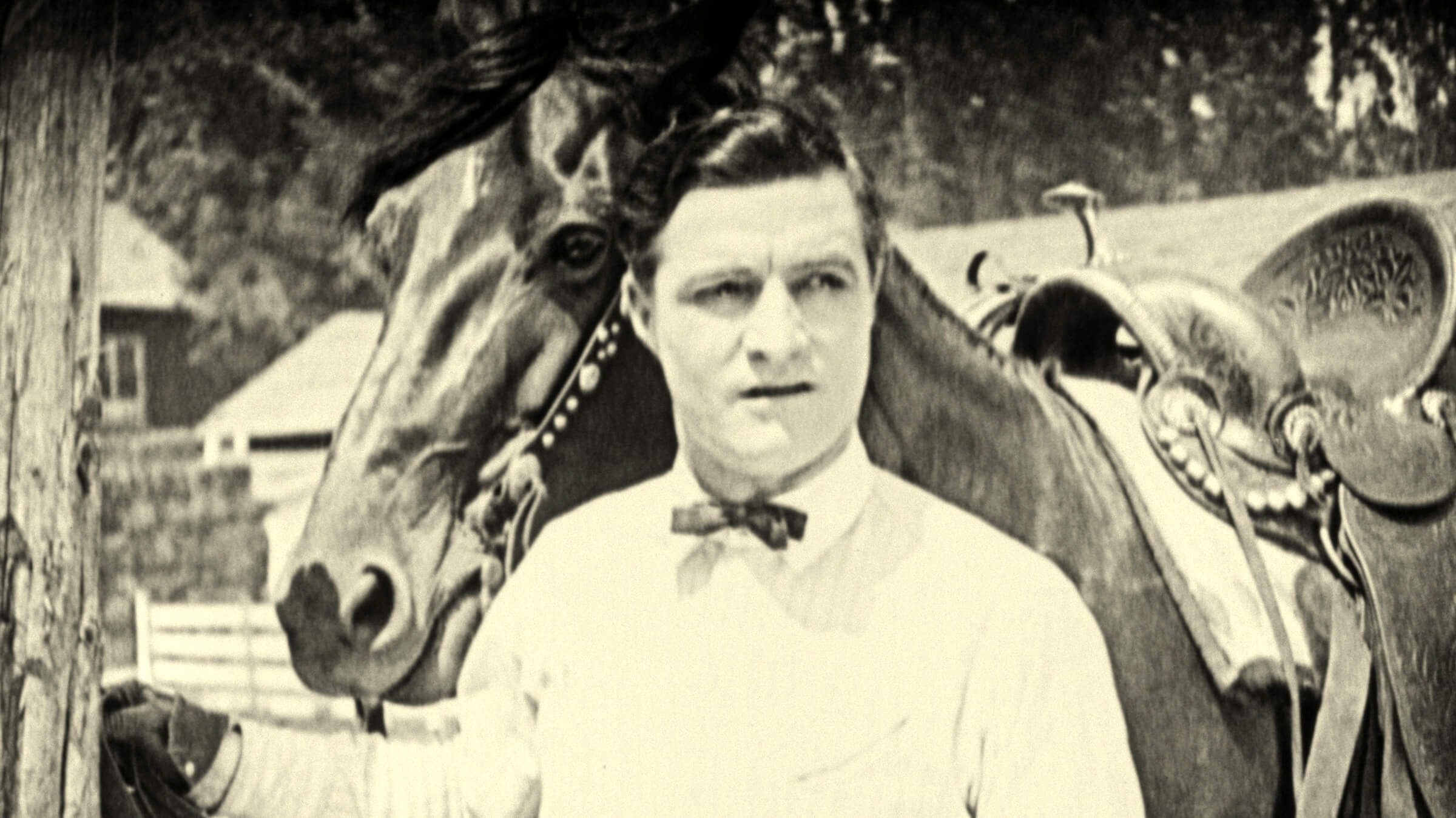
Only a true film star whose screen persona is practically etched onto the public’s consciousness could simply make a new film without their usual costume and have the novelty of it raise curious eyebrows. Imagine a 1920s audience accepting a Chaplin film without his baggy trousers and mustache, or a Harold Lloyd picture sans the round glasses. Trailin’ likely presented audiences with a similar dissonance: an entire Tom Mix film where the granite-jawed hero traded his usual ten-gallon hat and cowboy duds for “tenderfoot” attire.
Having the stunt-riding star pose as an East Coast elite may have been an attempt by director Lynn Reynolds, a frequent Mix collaborator, to shake up the usual Mix formula—although it was admittedly a formula that had yet to be broken and was hardly in need of fixing. By this point in 1921, the hardworking Mix had well over two hundred westerns under his belt, whether he was involved as a bit player, stuntman, director, writer, or as the star. Most of these “oaters” were filmed in the great outdoors, which suited Mix who recoiled from the idea of being confined to a set: “I have to have a regular man-size job,” he told Motion Picture Magazine in 1921, “out in the open, with lots of room—and I couldn’t work without horses.”
Mix spoke not just from his experience in front of the camera, but from his years as a ranch hand and then as a stunt rider for the Oklahoma-based Miller Brothers 101 Ranch Wild West Show, an authentic training ground for his future stardom. Tales from his early days were greatly—at times wildly—embellished in the press, egged on by the consummate showman himself. But this exaggeration was balanced by a sincere sense of responsibility to his fans, many of whom were children. During a promotional tour of New York City, he spoke proudly of making “decent” pictures and his awareness of being a role model: “I live decent, so when I meet a bunch of boys … I can say, ‘Boys, I don’t smoke, I don’t drink, and I take care of my body. If I didn’t, I couldn’t do the stunts I do in pictures.’ That gets ’em every time.” In his private life, Mix may have been known to tipple, but on screen, he didn’t allow liquor to touch his lips.
To audiences, Mix represented the embodiment of strength and derring-do in the American West (albeit a contemporary West that features the occasional automobile). “A sturdy survivor of the graceful and romantic type,” gushed Motography in 1913, “the cowboy that followed the knight in buckskin down the shadowy trail of the vanishing frontier, is Tom Mix….” To movie exhibitors, especially ones whose theaters fell under the category of “small town patronage,” the star represented a sure thing at the box office. In 1919 Moving Picture World reported that the Mix film Fame and Fortune had drawn seventy percent of the population of tiny Prairie du Rocher, Illinois. Daring horsemanship and stunts, smokey gunfire, slightly undercranked chases, a fight scene in a rough saloon or town square, and just a touch of romance was a winning combination that guaranteed audience turnout—a combination that could transcend even the gimmick of Trailin’.
Trade ads for the film proclaimed “A Different Tom Mix and a Different Mix Picture” and offered a series of portraits of the star in sporty suits, caps, and even a top hat perched rather awkwardly on his head. Reviews complained that the plot was unnecessarily convoluted and indeed the whole “vengeance-and-familial-secrets” story remains a head-scratcher. However, what the film does offer is the fun of seeing Tom as Eastern “aristocrat” Anthony Woodbury butting heads with skeptical Westerners, carrying himself with the kind of steady confidence that later defined John Wayne’s performances. After arriving from Boston, Anthony is quickly faced with having to prove his horseman skills—highly developed thanks to his extensive polo-playing and fox-hunting—and then defend himself after a drunk at a saloon overhears him ordering a “very sour lemonade” and takes him for an easy target. At one point a yokel exclaims, “He looks like a tenderfoot and he sounds like a tenderfoot, but I seen him ride and he ain’t no tenderfoot!”
Mix’s Trailin’ costar was the fetching Eva Novak, a gray-eyed blonde whose star was beginning to rise. Happy to do her own stunts, she was often coached by Mix, especially when horses were involved. Born in St. Louis, she joined LK-O in 1917 and by the early 1920s was starring in adventure films set in locations as diverse as the South Seas and snowy Alaska. Her sister Jane, a fellow blonde with a slightly more fragile beauty, was also an actress. The sisters had practically identical careers, with both frequently playing the sweethearts of movie cowboys; Eva starred in ten Tom Mix Films while Jane was primarily paired with William S. Hart. They even lived just a few blocks apart in Sherman Oaks, Los Angeles. Eva joked that Jane was the true actress in the family, claiming she herself was more interested in “the paycheck.”
As usual, Trailin’ featured several daring Mix stunts, from riding his trusty mount Tony across a bridge that collapses into a river to an effortless Douglas Fairbanks-esque leap over a five-foot fence from a standing position. In the most exciting sequence, both Mix and Novak slide down a nearly vertical precipice in a cloud of dust and grit—and so does Tony, who apparently had little choice in the matter. Doubtless such exciting sequences gave the studio pause: was it better to protect future box-office receipts by hiring stunt doubles to ensure the star doesn’t wind up injured or worse? Or should they capitalize on the star’s bravery in advertising to fatten said box-office receipts? Directors who worked with the stunt-loving Mix knew he would always insist on the latter.
Theater owners writing in to trade magazines reported largely positive feedback on the film, as well as the usual wave of brisk business: “Another good Mix picture. Will go over well where the patrons like Mix”; “A splendid Western that has the thrills and plenty of action. Went over big”; “A dandy and a good money getter.” As far as the convoluted plot was concerned, magazines like Wid’s Daily were breezily pragmatic: “The story doesn’t matter very much where the admirers of Mix or western offerings in general are concerned, so if you know that they like the star you can go right to it on Trailin’.”
Mix got back into his signature ten-gallon Stetson by 1922’s Sky High, a drama about a smuggling ring shot on location at the Grand Canyon. It’s one of the few of his Fox features to survive intact (after a 1937 vault fire claimed most of the studio’s silent archive) and is readily accessible today, unlike fellow survivor Trailin’. That these films exist at all is a happy stroke of luck, reminding us that whether his characters were galloping through a grand landscape of rolling desert hills or ordering a lemonade at a rough-and-tumble saloon, their appeal was fundamentally the same. In the words of a well-circulated Mix slogan from the popular Depression-era radio show in his name: “Straight shooters always win, lawbreakers always lose. It pays to shoot straight.
Presented at SFSFF 2025 with live musical accompaniment by Wayne Barker