This interview was published in conjunction with the screening of Tabu: A Story of the South Seas and other titles at SFSFF 2026
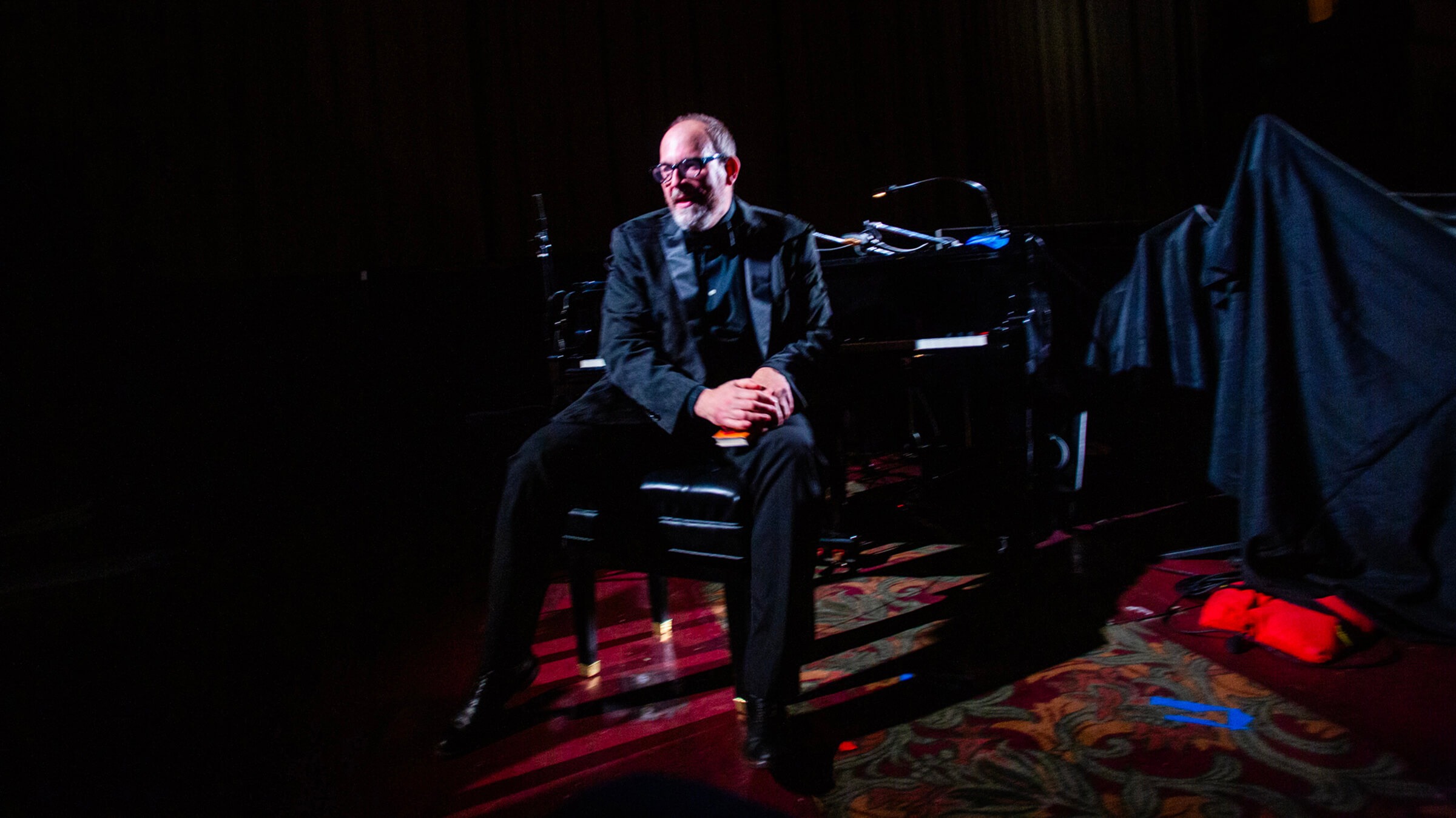
Wayne Barker has no reason to be modest. By any measure he’s been wildly successful, with credentials that include a Drama Desk Award and Tony nomination for Peter and the Starcatcher. Not only a pianist, he’s a presence, having appeared on stage for Pulitzer Prize-winning dramatist Beth Henley and with the late great Australian satirist Dame Edna Everage. Still, he harbored a lifelong dream. “I grew up south of Rochester and my earliest memory of classic film is my mother taking me to see The General at George Eastman House.” When his older brother left behind a school textbook, Kevin Brownlow’s The Parade’s Gone By, he says, “I just devoured [it] over and over. Even to my thirteen-year-old self, there was something profound, elegiac, about the oral histories in that volume.” It took relocating from New York to San Francisco and a bit of serendipity to finally be able to marry his musical virtuosity with his love of silent movies.
How did SFSFF find you?
I saw a presentation by Donald Sosin on the Berkeley campus. He was showing silent clips and invited the audience to suggest music to play for each of them. He’s very good at eliciting suggestions and everyone’s idea is a good idea. When he showed some dubious vaudeville act, I piped up from the back, “this could be very bad music.” He asked if I could demonstrate what I meant. We had never met before and he had no reason to think I was a musician but I went up to the piano and did all my little tricks—when a magic butterfly in the film flew around the room, I played flowery triplets. He said, “Wait a minute! Who are you?” There were two other people in the audience who knew Anita [Monga] and, a couple of weeks later, I was sitting down to lunch with someone I’d been wanting to sit down to lunch with for years.
If you hadn’t gone to that presentation, it might not have happened?
I remember trying to make sample recordings for Anita and thinking, “I don’t have anything.” You know, you can put off things because you don’t think you have enough impressive material. But you’re not always the best judge of what’s going to get you the job. In 2015, I did a full piano score for Beth Henley’s play inspired by her love of Fatty Arbuckle. She had previously written The Jacksonian, a pretty dark play, so to recover from that she watched a lot of silent comedies and then wrote Laugh. It was a very poetic treatment of the kinds of things you see in those films and the director, our friend David Schweizer, had the idea that someone—me—could be on stage playing piano for the whole thing. Then the following year, La Jolla Playhouse did Joe DiPietro’s Hollywood, about the 1922 unsolved murder of William Desmond Taylor. That director, Christopher Ashley, also had me on stage. At that point I said, “Well, I’m qualified now!”
When Anita asked for some titles that I might play for, Exit Smiling with Beatrice Lillie was on my list. It was on her list, too, and two weeks later, I was invited to play for it at the Castro. That’s what I call starting at the top! It was probably the greatest day of my life.
How did you prepare never having done it before?
The music I had written for Peter and the Starcatcher has lots of underscoring. Much of its staging had actors moving in tempo, almost like dancing. Someone goes up the stairs then goes back down the stairs—bum bum Bum BUM—then goes back down the stairs—BUM Bum bum bum—and the music follows.
I grew up watching Warner Bros. cartoons—I didn’t appreciate it as a kid, how could you?—but that music is a language. Every five seconds, in some cases, there’s a contrasting musical choice. It was not a done deal that animation would be scored that way. It was a combination of Carl Stalling’s pluck and the fact that early in his tenure he discovered that the studio owned the copyrights to all these popular songs, so he could just drop in little quotations from titles that people would recognize like raisins in a plum pudding. So now it just seems natural to me that when a character runs across the screen, the music should go a certain way.
Why do you think you love accompaniment so much?
I was not good in Form and Analysis class. I was not good at writing a sonata form movement. In fact, a few years ago I did finally study composition with a great Julliard teacher because I thought it was high-time I created some concert music. But it just seems like too much to ask. There’s already more music in the world than professional orchestras have time to play. It’s so expensive. Rare circumstances have to fall into place to premiere a piece of music. But with movies, there’s a context. Why is this lovely music playing? Because it’s an effective counterpoint, or an effective underlining. Concert audiences still struggle with atonal music. But use some of it in a horror movie and it’s an unquestioned enhancement of the experience.
The piano is so closely tied to silent film, how do you keep it fresh?
I wish I had more hands. When I’m playing, I’m hearing Charles Gerhardt conducting the National Philharmonic for the RCA film score series from the 1970s—that famously rich sound with all of that meat. But you all only get to hear what my ten fingers can do. I long to score a film and have it played by a little orchestra, but such a thing has to be prepared far in advance. It will happen, though—somehow—hopefully before deep dotage.