
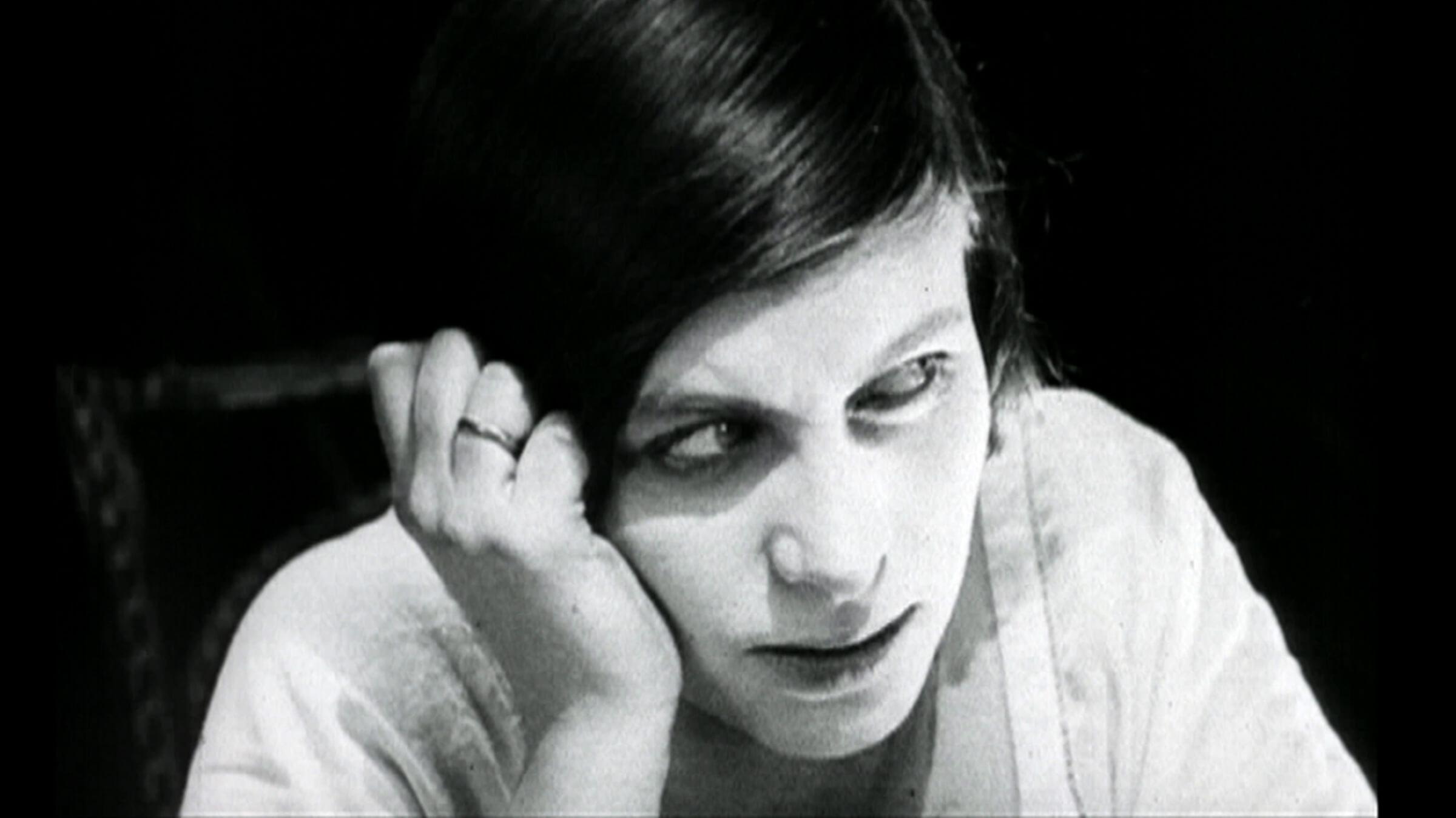
“The setting is familiar to each and everyone—a Moscow flat, or more precisely ’33 square arshins of living space,’ which belongs to an ordinary Soviet employee and is situated in a semi-basement, from the only window of which you can see a reflection of the life of the town.” — Abram Room
The original title of Bed and Sofa, Lyubov’ vtroem (literally “triple love,” that is to say, menage á trois) was trop trop even for the Bolsheviks, whose vanguard had initially advocated the overthrow of bourgeois notions of romantic love along with capitalism. So, the title in Russian became Tretya meshchanskaya, or Third Meshchanskaya Street, but not before it appeared on posters and in reviews.
Third Meshchanskaya Street actually existed, and Julian Graffy tells us in his deeply researched 2001 KinoFilm study of Bed and Sofa that it makes two appearances in the movie: at the exhilarating beginning, when the city is waking up and a lamplighter extinguishes one of the streetlamps; and toward the end when Kolya is out buying bread one evening and the lamp is relit. Cinematographer Grigorii Giber wrote at the time that after the crew began filming on the street so many people gathered to watch, they had to return in the dead of night to finish shooting.
Third Meshchanskaya was one of four so-named Moscow streets just north of the Sadovoye koltso, or Garden Ring, the once treelined beltway that traces the former path of the city’s original ramparts. These few blocks date back to 1671 when Tsar Aleskei Mikhailovich, the second Romanov to rule, conquered Smolensk and part of Ukraine then proceeded to kidnap Belarussians, Ukrainians, and Poles and “resettled” them in this new neighborhood, which grew to about seven hundred households within two decades.
According to Graffy, Meshchanskaya originates from “mesta” in Belarussian and “miasto” in Polish, meaning simply, town. The Russian, meshchane, would logically be akin to “townspeople,” but instead was a legal term for foreign residents who had no trade to speak of. Over time meshchane and its forms (like the adjective meshchanstvo) became commonplace in Russian discourse and literature as a pejorative for the narrowminded and vulgar. Meshchane is what Maxim Gorky titled his first play, from 1901, which in English gets called The Philistines.
Enter the Revolution to add an ironic layer, as the merchant/tradesmen class—which the original meshchane were decidedly not—are the new philistines, and primary targets for scolding, reeducation, ridicule, imprisonment, or worse. In 1920’s “About Rubbish,” written by the great Russian Futurist poet Mayakovsky whose relationship with the married Lilya Brik provided inspiration for Bed and Sofa, complained of the “muzzle of the meshchanin” and its clinging onto of things. In 1923, Sergei Tretyakov (a prominent member of the avant-garde known for scriptwriting Eliso and Salt for Svanetia) criticized the “fat-bottomed bourgeois-meshchaniskii byt,” saying that “even the most powerful blows of the Revolution had not been able to destroy [it] leaving man the ’slave of things.’” The year after Bed and Sofa, the protagonist in Fridrikh Ermler’s Parisian Cobbler is exhorted to “leave meshchanstvo behind.”
State propaganda had already been instructing the people to clean out the “dirt of the old world,” advising them to paint all their walls and furniture white, with an added warning that clutter only provided a home for bacteria and made housework more arduous. Russian Constructivist designer El Lissitzky imagined in 1926 that future homes would contain only a mattress, a folding chair, a table, and a gramophone. Komosomolskaya pravda urged its readers to throw away their junk (never mind if any of it “sparked joy”) and to share their testimonials with the newspaper.
Bed and Sofa’s Kolya and Liuda are unmistakably meshchanstvo, their flat chockablock with things that a good revolutionary would have already discarded. Graffy says the throw pillows that Liuda fluffs in the film and the drinking of tea were considered meshchanstvo. Some workers asked to evaluate the finished film missed the point of the film’s purposeful set design and complained that the soup tureen and the metal glass-holders were “unproletarian.” (The portraits of Stalin and his close ally, Marshal Budyonny, could presumably stay.)
When the critics critiqued, meshchane was invoked more than once. “The film contains no lofty gestures or lofty words about the equal rights of women,” wrote a critic in Leningradskaya pravda, “but every pot in it speaks more than any slogan. In its entire essence this work summons the Liudmilas in the cinema auditorium to abandon their own Third Meshchanskaya Streets.” Khrisanf Kheronsky also appreciated what scriptwriter Viktor Shklovsky and director Abram Room were doing, if they fell a bit short: “[they] have tried to cast light on a little corner of meshchanstvo, if not yet with Lenin’s searchlight, then at least with Chekhov’s lamp.”
For a Russian living in those revolutionary times, the English-language title would have also carried some sociopolitical weight. A sofa was not only considered a luxury, according to Russian-American scholar and playwright Svetlana Boym, but “ideologically suspect.” Beds, Graffy says, also had the taint of meshchanstvo. He points out that director Eisenstein once “boasted of having slept on the mirrored door of a wardrobe” and describes a celebration of revolutionary fervor in his 1927 film October that includes a triumphant sequence of a sailor “ripping the royal mattress” in the tsarina’s bedroom.
In the late 1920s, soon after Bed and Sofa’s release, Graffy tell us the Meshchanskaya blocks were renamed First, Second, Third, and Fourth Civic streets. Soon after, Third Meshchanskaya got an even newer name still in use today: Shchepkin Street, for the 19th century proponent of realist acting, Mikhail Shchepkin.